

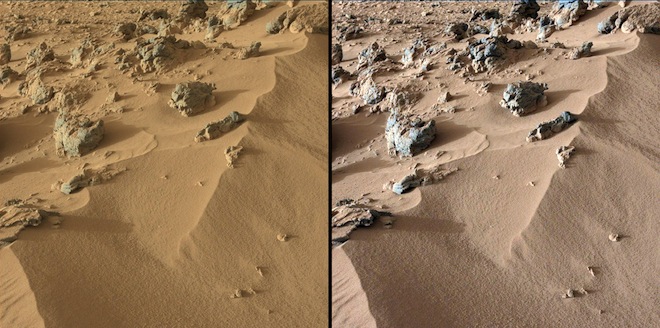
Photo: A view of the Rocknest area where Curiosity is currently parked. On the left, the image shows how it would appear to a person on Mars while the right-hand image has a filter that mimics lighting conditions on Earth. NASA/JPL-Caltech/MSSS
NASA’s Curiosity rover has completed the first-ever detailed X-ray analysis of Martian sand, determining that it contains minerals similar to volcanic soil found at places like the Mauna Kea shield volcano in Hawaii.
Curiosity has been scooping and sampling the Martian regolith at an area called Rocknest for the past month. The probe is starting to live up to its original, official name Mars Science Laboratory, doing lab work that hasn’t until now been possible on Mars. No previous lander or rover has been able to perform X-ray diffraction because the machines required for the technique are typically the size of a refrigerator. Engineers were able to shrink the instrument down to roughly the size of a shoebox and make it less power-hungry, allowing it to be packed and sent to Mars on the rover.
via Wired






