fresh bytes
Subscribe Now

Cosmologists finally capture an elusive signal from the beginning of time

b_over_b_rect-660x352.jpeg

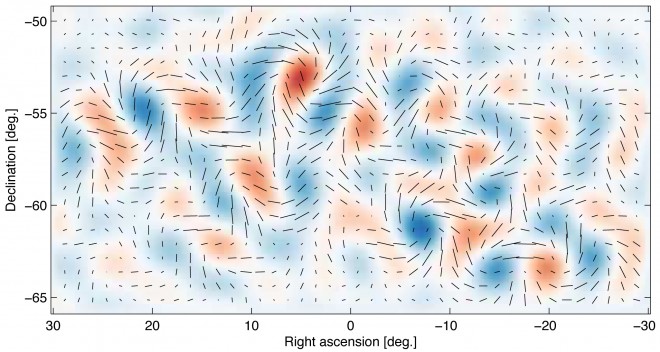
A team of scientists may have detected a twist in light from the early universe that could help explain how the universe began. Such a finding has been compared in significance to the detection of the Higgs boson at the LHC in 2012.

What they detected is known as primordial B-mode polarization and is important for at least two reasons. It would be the first detection of gravitational waves, which are predicted to exist under Einstein’s theory of relativity but have never before been seen. But the thing that has scientists really excited is that it could provide the first direct evidence for a theorized event called inflation that caused the universe to exponentially grow just a fraction of a fraction of a second after it was born.

“Detecting this signal is one of the most important goals in cosmology today,” astronomer John Kovac of Harvard, who led the team announcing the discovery today, in a press release.
via Wired

Continue reading 

Image: Primordial gravitational waves may have been detected in this swirly pattern of light from the early universe. 
Credit: BICEP2 Collaboration

Leave a Reply

featured blogs
Apr 24, 2026
A thought experiment in curiosity, confusion, and cosmic consequences....

featured paper

Quickly and accurately identify inter-domain leakage issues in IC designs

Sponsored by Siemens Digital Industries Software

Power domain leakage is a major IC reliability issue, often missed by traditional tools. This white paper describes challenges of identifying leakage, types of false results, and presents Siemens EDA’s Insight Analyzer. The tool proactively finds true leakage paths, filters out false positives, and helps circuit designers quickly fix risks—enabling more robust, reliable chip designs. With detailed, context-aware analysis, designers save time and improve silicon quality.

Click to read more

featured chalk talk

What’s Driving Zephyr’s Momentum
In this episode of Chalk Talk, Brendon Slade from NXP and Amelia Dalton explore what Zephyr makes unique, how it compares to other RTOS options, and how its design philosophy enables developers to scale from simple prototypes to production-ready systems with confidence.
May 4, 2026
10 views