fresh bytes
Subscribe Now

Brazilian architect Guto Requena 3D-prints unique shapes based on participants’ emotions

sao-paulo-design-week-love-project-1-thumb-620x348-88847.jpg

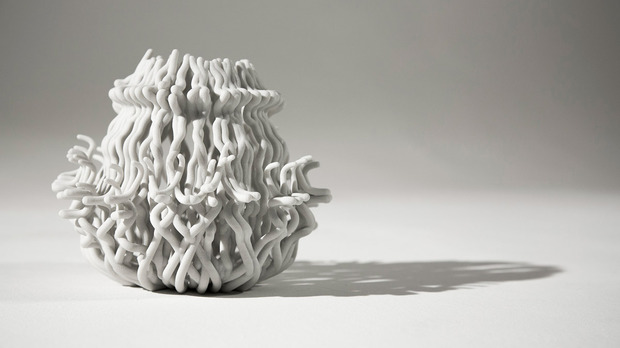
Brazilian architect Guto Requena launched a project that is very close to his heart at Design Weekend São Paulo. Through a special software developed by D3 Studio, personal emotions are captured to define new shapes for everyday objects. “The Love Project is a study in design, science and technology that captures the emotions people feel in relating personal love stories and transforms them into useful objects. The project suggests a future in which unique products will bear personal histories in ways that encourage long life-cycles, thus inherently combining deeply meaningful works with sustainable design,” Requena writes on his website.

The design process is peculiar and involves three stages. First, three sensors are applied to the users in order to read their sudden reactions while they tell a love story that defined their lives. “Participants are isolated during this process so that they can more intimately expose their feelings and that data can be more accurately captured,” Requena further explains. As users speak, data drawn from their changing emotion is captured by a software specially created for this. This data turns into a special design, that is then printed using a 3D printer.
via Cool Hunting

sao-paulo-design-week-love-project-4-thumb-620x348-88853.jpg

Continue reading

Images: Studio Guto Requena

Leave a Reply

featured blogs
Apr 24, 2026
A thought experiment in curiosity, confusion, and cosmic consequences....

featured paper

Quickly and accurately identify inter-domain leakage issues in IC designs

Sponsored by Siemens Digital Industries Software

Power domain leakage is a major IC reliability issue, often missed by traditional tools. This white paper describes challenges of identifying leakage, types of false results, and presents Siemens EDA’s Insight Analyzer. The tool proactively finds true leakage paths, filters out false positives, and helps circuit designers quickly fix risks—enabling more robust, reliable chip designs. With detailed, context-aware analysis, designers save time and improve silicon quality.

Click to read more

featured chalk talk

GaN for Humanoid Robots
Sponsored by Mouser Electronics and Infineon
In this episode of Chalk Talk, Eric Persson and Amelia Dalton explore why power is the key driver for efficient and reliable robot movements and how GaN technologies can help motor control solutions be more compact, integrated and efficient. They also investigate the role of field-oriented control in humanoid robotic applications and why the choice of a GaN power transistor can make all the difference in your next humanoid robot project!
Apr 20, 2026
7,433 views