fresh bytes
Subscribe Now

Brain chip helps quadriplegics move robotic arms with their thoughts

Screen_Shot_2012-05-16_at_1.57.04_PM.png

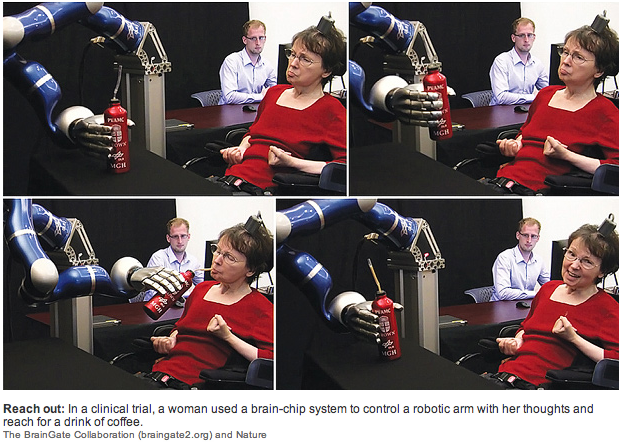
A paralyzed patient equipped with an implanted brain chip has been able to use a robotic arm to reach for and pick up a bottle of coffee, bring it close enough to her face so she could drink from a straw, and then place the bottle back on the table.

The quadriplegic patient was outfitted with an electronic brain implant that can drive a robotic arm to reach and grasp objects (see video). A study published today in the journal Natureshows that people with the brain chips can use the devices to perform complex three-dimensional tasks that could be helpful in daily life. Furthermore, the implanted electrodes can record neuronal signals for as long as five years—longer than had been suspected. In previous studies, patients using brain implants have been able to move a cursor on a screen, but not perform complicated movements with objects in the real world.
via technology review


Continue reading 

Leave a Reply

featured blogs
May 6, 2026
Hollywood has struck gold with The Lord of the Rings and Dune'”so which sci-fi and fantasy books should filmmakers tackle next?...

featured paper

Want early design analysis without simulation?

Sponsored by Siemens Digital Industries Software

Traditional verification methods are failing today's complex IC designs, which require a proactive, early-stage analysis approach. A shift-left methodology addresses IP block integration challenges and the limitations of traditional simulation and ERC tools. Insight Analyzer detects hard-to-find leakage issues across power domains, enabling early analysis without full simulation. Identify inefficiencies earlier to reduce rework, improve reliability, and enhance power performance.

Click to read more!

featured chalk talk

CBOT MULTIGIG Transceiver Platform
In this episode of Chalk Talk, Anders Thelin from TE Connectivity and Amelia Dalton explore how the CBOT MULTIGIG transceiver platform helps address these challenges with a modular, high-performance approach to rugged, high-density connectivity. We also investigate how this platform supports next-generation system architectures, improves design efficiency, and enables robust performance in even the most demanding environments.
May 18, 2026
900 views