

fresh bytes
Subscribe Now

Anti-Tetris project is a study in hand tracking (video)

anti-tetris.png

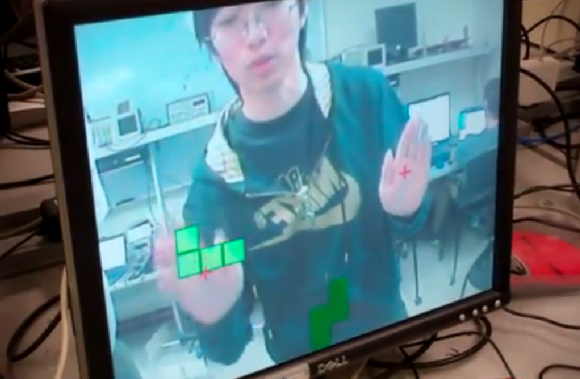
The game of Anti-Tetris is played by standing in front of a monitor and watch falling Tetris pieces overlaid on a video image of your body. Each hand is used to make pieces disappear so that they don’t stack up to the top of the screen. We don’t see this as the next big indie game. What we do see are some very interesting techniques for hand tracking.

An FPGA drives the game, using a camera as input. To track your hands the Cornell students figured out that YUV images show a specific range of skin tones which can be coded as a filter to direct cursor placement. But they needed a bit of a hack to get at those values. They patched into the camera circuit before the YUV is converted to RGB for the NTSC output.
via Hack a Day


Continue reading

Leave a Reply

featured blogs
Feb 24, 2026
How a perfectly good Bosch HVAC system was undermined by preventable mistakes, and a thermostat interface that defies logic....

featured video

Cadence Chiplets Solutions | Helping you realize your chiplet ambitions

Sponsored by Cadence Design Systems

In this webinar, David Glasco, VP of Compute Solutions at Cadence, discusses how Cadence enables customers to transition from traditional monolithic SoC architectures to modular, scalable chiplet-based solutions, essential for meeting the growing demands of physical AI applications and high-performance computing.

Read eBook: Helping You Realize Your Chiplet Ambitions

featured chalk talk

Global Coverage With NTN
In this episode of Chalk Talk, Paul Fadlovich from TE Connectivity and Martin Lesund from Nordic Semiconductor and Amelia Dalton explore the what, why and how of NTN technology. They also explore the role that antennas play in satellite communication systems, and how Nordic Semiconductor’s nRF9151 System-in-Package and TE Connectivity’s broad range of antenna solutions can jump start your next global IoT design.
Feb 19, 2026
6,802 views



