fresh bytes
Subscribe Now

Ancient scrolls blackened by Vesuvius are readable at last

scoll-close.jpg__800x600_q85_crop.jpg

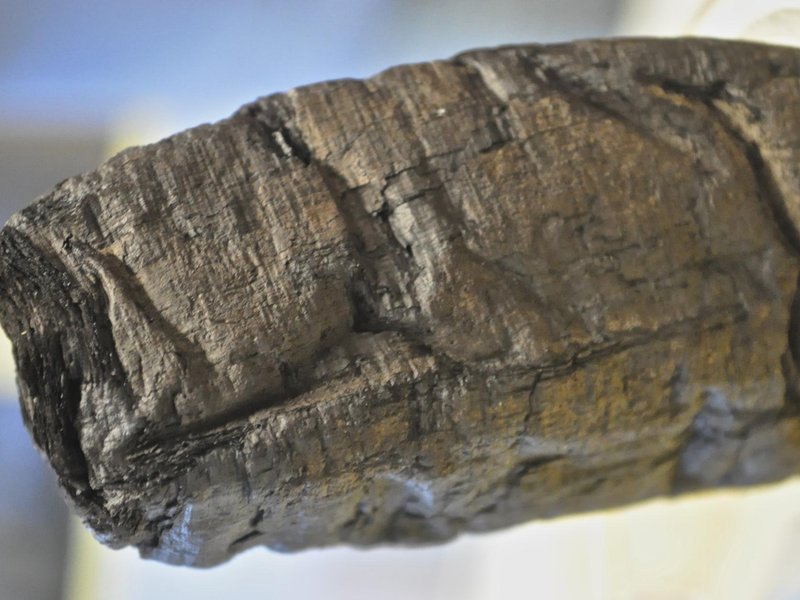
The 79 A.D. eruption of Mount Vesuvius is most famous for burying Pompeii, spectacularly preserving many artifacts—and residents—in that once bustling town south of Naples. The tumbling clouds of ash also entombed the nearby resort of Herculaneum, which is filled with its own wonders. During excavations there in 1752, diggers found a villa containing bundles of rolled scrolls, carbonized by the intense heat of the pyroclastic flows and preserved under layers of cement-like rock. Further digs showed that the scrolls were part of an extensive library, earning the structure the name Villa of the Papyri.

Blackened and warped by the volcanic event, the roughly 1,800 scrolls found so far have been a challenge to read. Some could be mechanically unrolled, but hundreds remain too fragile to make the attempt, looking like nothing more than clubs of charcoal. Now, more than 200 years later, archaeologists examining two of the scrolls have found a way to peer inside them with x-rays and read text that has been lost since antiquity.
via Smithsonian.com

Continue reading

Image: E. Brun

Leave a Reply

featured blogs
Apr 2, 2026
Build, code, and explore with your own AI-powered Mars rover kit, inspired by NASA's Perseverance mission....

featured paper

Quickly and accurately identify inter-domain leakage issues in IC designs

Sponsored by Siemens Digital Industries Software

Power domain leakage is a major IC reliability issue, often missed by traditional tools. This white paper describes challenges of identifying leakage, types of false results, and presents Siemens EDA’s Insight Analyzer. The tool proactively finds true leakage paths, filters out false positives, and helps circuit designers quickly fix risks—enabling more robust, reliable chip designs. With detailed, context-aware analysis, designers save time and improve silicon quality.

Click to read more

featured chalk talk

GaN for Humanoid Robots
Sponsored by Mouser Electronics and Infineon
In this episode of Chalk Talk, Eric Persson and Amelia Dalton explore why power is the key driver for efficient and reliable robot movements and how GaN technologies can help motor control solutions be more compact, integrated and efficient. They also investigate the role of field-oriented control in humanoid robotic applications and why the choice of a GaN power transistor can make all the difference in your next humanoid robot project!
Apr 20, 2026
691 views