

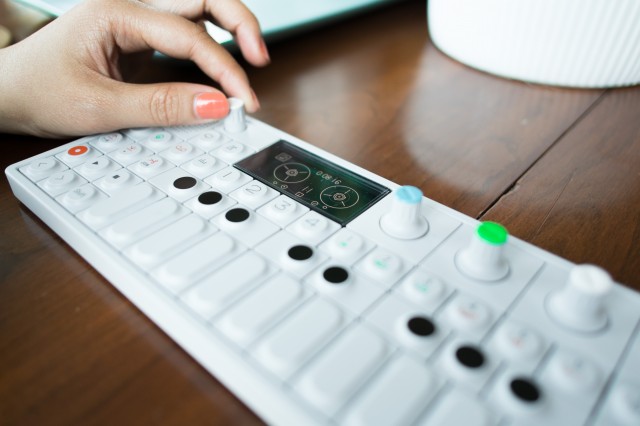
This time last year, I walked into a Toronto store called Moog Audio and walked out with a Teenage Engineering OP-1—a curious little portable digital synthesizer that looks, at first glance, like a child’s toy. It has a row of just four candy-colored knobs as primary input controls, and there are only enough keys for an octave-and-a-half’s worth of range. But damn does it ever sound cool. Its tiny OLED screen uses all sorts of clever visual conceits to convey otherwise complex audio transformations. Colors and animations explain the differences between synthesizer engines, changes to modulation and frequency, and attack and decay. And it’s done in a way that’s easy for anyone with little synthesizer knowledge to understand while still being powerful in more experienced hands. This is a synthesizer, drum machine, and four-track recorder all-in-one—all in a device that fits inside a purse or messenger bag with ease.
It wasn’t always like this. In fact, it was 50 years ago this year that, in 1964, a man by the name of Bob Moog unveiled a synthesizer of a very different sort. Called the Moog Modular, it is regarded as one of the first. Though Moog wouldn’t officially advertise his creation as a synthesizer until 1966, that’s precisely what it was—an array of electronic modules that Moog designed, often controlled via keyboard, and connected to one another with a bird’s nest of cables that, somehow, produced weird musical sounds unlike anything anyone had heard before.
via ars technica







