



We recently looked at levels of data communication in the Internet of Things (IoT) and established three levels:
– Formal communications protocol level (e.g., TCP/IP)
– Generic data level (e.g., Xively)
– Business objects
At the recent Internet of Things Engineering Summit, I talked with another company that illustrates some of how this works. They’re called Econais. (I keep seeing this as looking French, and I want to pronounce it “eh-koh-NAY” – but that’s wrong: it’s a Greek company, and it’s pronounced “ee-KOH-ness”).
Econais recently announced a new module for connecting Things to WiFi. And the focus is on making integration easy: with 20 lines of code, you can connect to a local WiFi network. Assuming your Thing doesn’t have a screen (and, like a motion detector, might even be mounted someplace inconvenient), your phone acts as the keyboard, launching Thing code that gets connection information from the access point. This is part of their ProbMe (“probe me” – named after its pinging capability) in-situ management system.
Because Econais implements standards like WiFi and TCP, with no further abstraction, it occupies the comms protocol level (i.e., the first of the three above). But they also partner with Xively, who lays over the protocol level. In fact, for a programmer, both APIs are then available: you can write at the detailed Econais level or at the more abstracted Xively level.
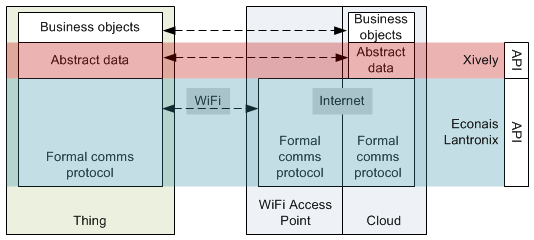
The overall idea here is that you can get onto the network easily with Econais, but you can then manipulate data more easily at the Xively (or whoever lies above this) level. Of course, the WiFi only goes as far as the access point; to get to the cloud, you then transition to the various other wired (or even wireless) comms protocols that make up the Internet.
Econais actually has two families of WiFi module, the 19D01, which doesn’t have an MCU in it (so presumably you attach it to your Thing that already has an MCU) and the recently-announced 19W01, which includes an MCU as well as integrated FLASH and an antenna. It’s all a bit confusing since, at the time of this writing, these distinctions aren’t clear on the website or some of the graphics. But size is an important selling factor for them: the MCU-less version is an 8-mm square module; the W01 is 14 mm x 12 mm.
And, just as I was preparing to post this, notice came in of a new Lantronix WiFi module for Arduino boards. So it slides into the same category. It is larger, at 24 mm x 16.5 mm.
For more info on Econais’s new W01 board, check out their announcement; for Lantronix, you can find their announcement here.
Update (5/14/14): I have some more clarification on the Econais integration story.
- There’s an EC32L module that has an MCU separate from the WiFi chip.
- The EC19W products integrate the MCU in with the WiFi chip, although the MCU is still available for developer programs. Some of the other hardware interfaces (A/D, GPIO, etc.) are reduced vs. the EC32L.
- Both of these include FLASH and an antenna, so they’re certified by the various international organizations.
- The EC19D excludes the FLASH and antenna. It’s therefore not certified (but presumably a system including it would need to be).






