There are many ways to slice and dice embedded engineering space (where, as everyone should know by now, no one can hear you scream). Take microcontrollers, for example. If I were to raise the topic of MCUs in a room full of embedded engineers, it wouldn’t take long before names like STMicroelectronics, NXP, Texas Instruments, Microchip Technology, Infineon, and Renesas bid a cheery “hello” in the conversation. Collectively, these companies offer vast portfolios serving automotive, industrial, consumer, medical, and countless other applications.
However, if I were to shift the conversation to ultra-low-power wireless connectivity, another name would quickly leap onto the center stage: Nordic Semiconductor. This fabless technology company is best known for its Bluetooth, Matter, Thread, Wi-Fi, and cellular IoT solutions, and Nordic has earned a place in everything from fitness trackers and smart-home gadgets to industrial sensors and asset-tracking systems.
There are multiple facets to the Nordic Semiconductor story that I find fascinating. For example, it was founded in 1983 in Trondheim, Norway (where it’s still headquartered) by four graduates of the Norwegian Institute of Technology (NTH), which was the country’s premier engineering school at the time. In 1996, NTH became a core part of what is now the Norwegian University of Science and Technology, or Norges teknisk-naturvitenskapelige universitet (NTNU), as the locals say, which is one of Scandinavia’s leading technical universities.
I’ve been fortunate enough to visit Trondheim on several occasions, giving keynote presentations at the FPGA Forum and guest lectures at NTNU. During one visit, we were treated to a performance by Trondhjems Studentersangforening (TSS), the university’s official male voice choir. Founded in 1910, this choir is renowned for its traditional student songs and appearances at academic and social events. Their singing was magnificent, reminding me of a Welsh male voice choir—except, naturally, the lyrics were in Norwegian. Happily, this made little difference to me, because I am equally fluent in both Welsh and Norwegian (so long as we take “equally” to mean “not at all”).
As an aside, many early microcontrollers possessed what one might politely describe as “characterful” architectures. Consider the venerable PIC family, for example. Originally developed at General Instrument in the 1970s and now part of the Microchip Empire, these devices were remarkably capable in their day. They were also delightfully quirky, featuring memory banking, a single working register, and other architectural idiosyncrasies that could make life interesting for programmers.
One consequence was that developers often continued to write PIC applications in assembly language long after users of other processor families had embraced higher-level languages such as C. Generating efficient C code for these devices was possible, but it was certainly not straightforward.
Enter two students at Norway’s Norwegian Institute of Technology (NTH), Alf-Egil Bogen and Vegard Wollan. Frustrated by the limitations of existing microcontroller architectures, they set out in the mid-1990s to create something better suited to modern software development. The result was the AVR architecture—a clean 8-bit RISC design based on a modified Harvard architecture and expressly intended to support efficient compilation from C.
Commercialized by Atmel in 1996, AVR was also one of the first microcontroller families to employ on-chip Flash memory for program storage. The AVR architecture later found worldwide fame as the heart of the Arduino platform, introduced in 2005, and was eventually absorbed into the Microchip Collective following the acquisition of Atmel in 2016. Interestingly enough, the aforementioned Vegard Wollan is now the CEO of Nordic Semiconductor. But as usual, I’m getting ahead of myself. And, as usual, we digress…
The reason for my current waffling—and for my trip down memory lane—is that I was just chatting with Øyvind Strøm, EVP of Short-Range BU, and Arjun Chandra, Head of AI, at Nordic.
For most of its history, Nordic has focused on a deceptively simple proposition: connect things wirelessly while consuming as little power as possible. The company’s Bluetooth Low Energy, Thread, Matter, Zigbee, Wi-Fi, cellular IoT, and satellite-connected products have found homes in everything from wearable devices and smart-home gadgets to industrial sensors and asset trackers.
Today, however, a new challenge is emerging. The number of connected devices worldwide is measured in the tens of billions and continues to grow. At the same time, users increasingly expect these devices to exhibit some degree of intelligence. They want sensors that recognize patterns, wearables that understand gestures, hearing aids that distinguish speech from background noise, and industrial monitoring systems that can detect anomalies before equipment fails.
Traditionally, achieving this sort of intelligence meant sending data to the cloud for analysis. That approach works, but it introduces latency, consumes bandwidth, raises privacy concerns, and—most importantly for battery-powered devices—burns precious energy. The obvious alternative is to perform inference locally on the device itself, but until recently, the processing and power requirements of machine learning have placed this beyond the reach of many ultra-low-power systems. This is precisely the problem Nordic is targeting.
The centerpiece of Nordic’s latest effort is the nRF54LM20B, a wireless SoC designed for battery-powered edge-AI applications. At first glance, its architecture appears deceptively conventional. A 128-MHz Arm Cortex-M33 serves as the primary application processor, while a secondary RISC-V processor handles housekeeping and ultra-low-power supervisory tasks.
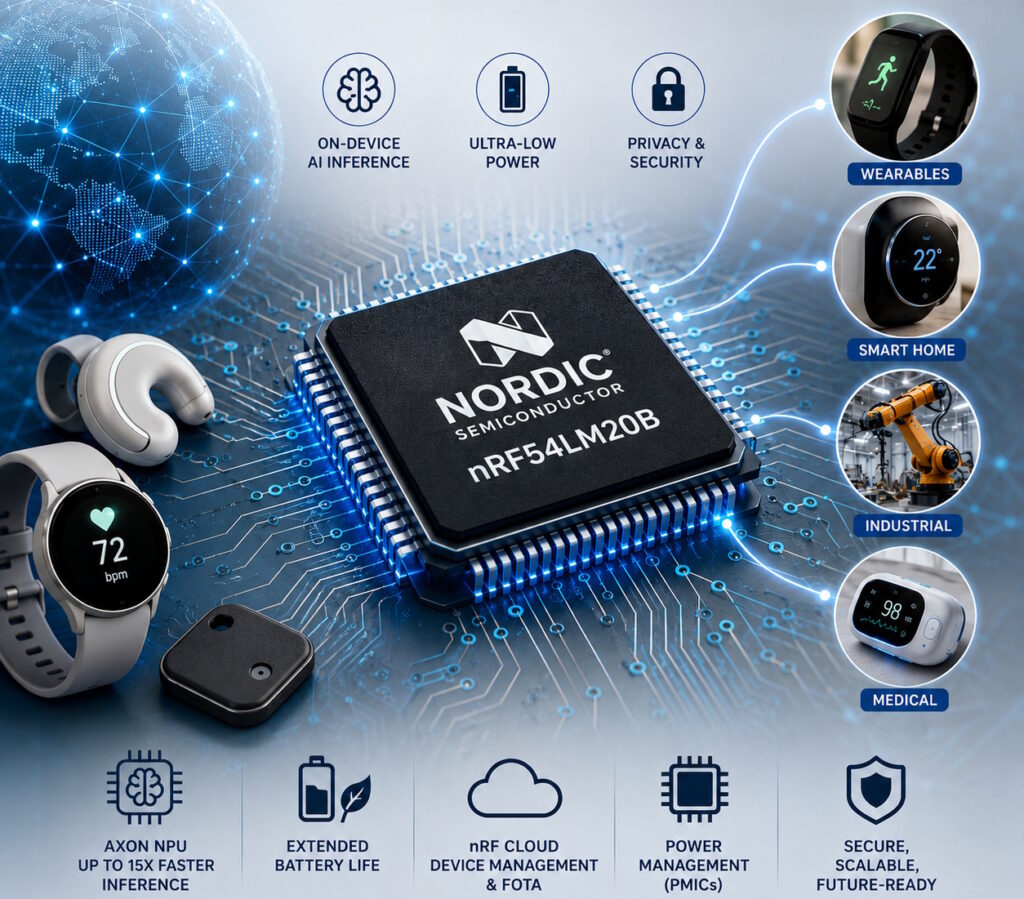
Ultra-low-power connected edge AI. Intelligence where it matters. Power that lasts.
(Source: Me and ChatGPT)
The interesting part lies elsewhere. Alongside these processors sits Nordic’s new Axon neural processing unit (NPU), a machine-learning accelerator optimized for the sensor-driven workloads commonly encountered in wearable, consumer, and industrial IoT devices. Unlike many NPUs originally developed for image and video processing, Axon was designed from the outset for applications such as gesture recognition, activity monitoring, keyword spotting, anomaly detection, predictive maintenance, and biometric sensing.
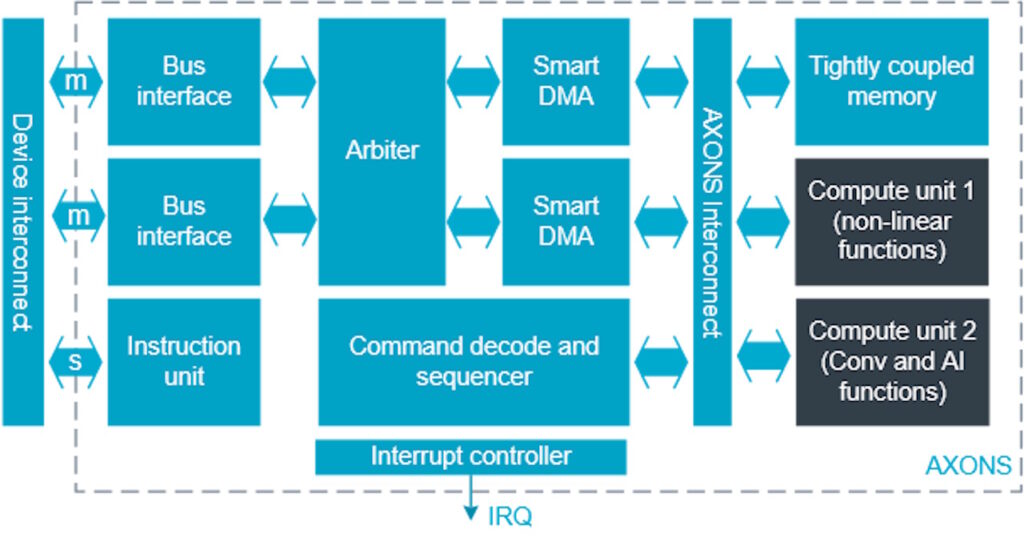
High-level architecture of Nordic’s Axon NPU (Source: Nordic)
At first glance, the Axon architecture may appear modest compared to the large NPUs found in smartphone processors or AI accelerators. That is entirely intentional. According to Nordic, the goal was never to compete with vision processors analyzing megapixel video streams. Instead, the company optimized Axon for “bounded” machine-learning problems—tasks that comfortably fit within the power, memory, and performance constraints of a battery-operated wireless device.
The architecture combines dedicated neural-network processing hardware, DSP functionality, tightly coupled memory (TCM), DMA engines, and a compiler that transforms TensorFlow Lite models into an execution schedule optimized for the underlying hardware. By carefully orchestrating data movement between nonvolatile memory, SRAM, and local accelerator memory, the design minimizes one of the biggest energy consumers in modern embedded systems: moving data around.
The origins of Axon are also noteworthy. Rather than licensing a conventional third-party NPU, Nordic acquired the intellectual property and engineering team of the AI company Atlazo in 2023. The resulting technology forms the foundation of the Axon accelerator and reflects Nordic’s focus on sensor-centric machine-learning workloads rather than the video-centric applications that dominate many larger AI processors.
The results are impressive. Nordic reports inference speeds up to fifteen times faster than executing equivalent workloads on the Cortex-M33 alone. For example, a keyword-spotting model based on MLPerf Tiny benchmarks reportedly executes in approximately 4.5ms on the Axon versus roughly 70ms on the Cortex-M33. Equally important, the accelerator substantially reduces energy consumption, helping preserve the battery life that remains central to Nordic’s value proposition.
As usual, of course, hardware is only half the story. Over the past decade, many embedded engineers have discovered that training, deploying, and maintaining machine-learning models can be considerably more challenging than integrating the hardware that ultimately executes them.
To address this issue, Nordic has assembled an increasingly comprehensive edge-AI software ecosystem. At one end of the spectrum lies Neuton, an automated machine-learning framework capable of generating remarkably compact inference models—often less than 5 KB in size—which can execute directly on the Cortex-M33 without requiring hardware acceleration. At the other end lies the Axon tool chain, which compiles TensorFlow Lite models into an optimized representation suitable for execution on the NPU.
The company’s longer-term vision extends beyond model generation. Nordic’s Edge AI Lab, software development tools, device management infrastructure, and nRF Cloud services are intended to support the entire product lifecycle—from model development and deployment to over-the-air updates and long-term fleet management.
But wait, there’s more! “More?” you say. Yes, “More!” I cry. It seems that Nordic’s ambitions extend beyond wireless SoCs and AI acceleration. The reason I say this is that the company has also established a rapidly growing power-management business centered on power management ICs (PMICs) optimized for battery-powered embedded systems.
While PMICs rarely receive the same attention as processors and AI accelerators, they often determine whether a battery-powered product achieves its target operating life. According to Øyvind and Arjun, Nordic’s relatively recent entry into this market provided an unexpected advantage: the company was able to design modern PMIC architectures without carrying decades of legacy assumptions and design baggage.
The result is a family of power-management devices optimized for the battery technologies, operating modes, and ultra-low-power requirements of today’s connected products. These little scamps (the PMICs, not Øyvind and Arjun) have proven sufficiently attractive that customers are deploying them both alongside Nordic’s wireless SoCs and in designs that have nothing whatsoever to do with Nordic’s connectivity products.
Looking back over my conversation with Øyvind and Arjun, what strikes me most is that Nordic isn’t treating AI as a feature to be bolted onto an existing product line. Instead, the company is approaching the problem from the opposite direction. Start with the realities of battery-powered connected devices. Accept that power is precious, memory is limited, wireless connectivity is essential, and battery life may be measured in years rather than hours. Then build the silicon, software tools, cloud infrastructure, AI acceleration, and even the power-management hardware required to make intelligence practical within those constraints.
Of course, the embedded world is littered with grand visions that never quite made it past the marketing department. But Nordic enters this arena with several advantages: decades of experience in ultra-low-power wireless design, deep expertise in connectivity, a growing software ecosystem, purpose-built AI acceleration, and a healthy appreciation for the fact that even the smartest device is only as good as its battery life.
And now you see why, when you say “Ultra-Low-Power Connected Edge AI,” I instinctively respond (feel free to imagine the rich, resonant tones of a young James Earl Jones), “Nordic Semiconductor!”