



There are many ways to categorize engineers—to “slice and dice” them, if you will. I’m speaking figuratively, of course (we don’t want anyone to get any unfortunate ideas…especially since… the incident). Just sticking to the electronics realm, we have analog and digital, hardware and software, those who simulate and those who solder, those who document and those who don’t—and the French.
As you may recall, I’m a hardware design engineer by trade. The reason I mention this here (in addition to the fact that I just like hearing myself say it) is that design engineers and verification engineers are like two sides of the same coin. Design engineers spend a lot of time and effort creating interesting and unexpected bugs, while verification engineers get all the fun of finding and fixing them.
The reason I’m waffling about this is that I was just chatting with Abhi Kolpekwar, who is Senior Vice-President & General Manager at Siemens EDA. As part of our conversation, Abhi mentioned that the latest developments in Siemens’ verification tools may result in Verification Engineers transmogrifying into Verification Scientists.
I know. I bet your reaction was the same as mine. The first thing I thought was, “Well, that will look very tasty on their business cards.” Great minds think alike, as they say. Of course, they also say that fools seldom differ, but I’m sure that doesn’t apply to us.
Things are moving fast in AI space (where no one can hear you scream). Less than a year ago, in my column Smart AI-Enabled Verification Will Increase First Silicon Success, I reported on the introduction of the Questa One smart verification software portfolio, whose claim to fame was, “Faster engines, faster engineers, and fewer workloads.”
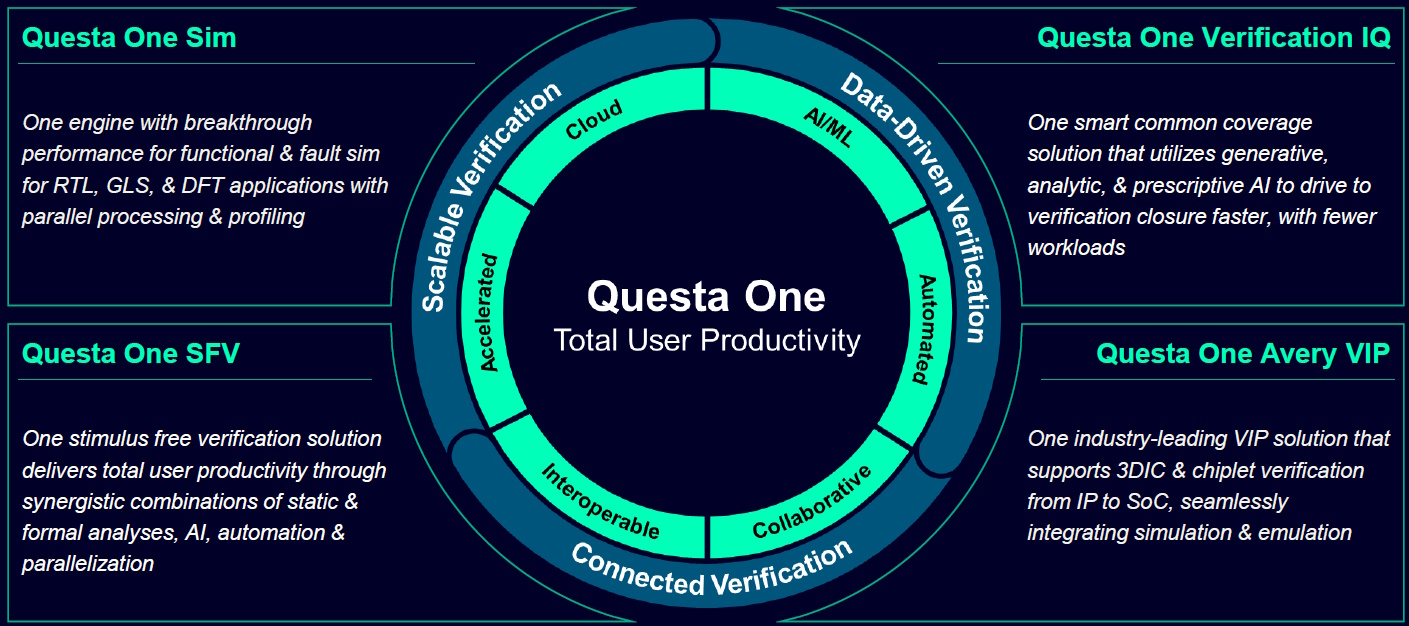
Questa One: Faster engines, faster engineers, and fewer workloads (Source: Siemens EDA)
Questa One’s fundamental focus was on end-user productivity, defined as a function of faster engines (where the products themselves are fast), faster engineers (where the products automate and speed engineers’ work), and fewer workloads.
The last point (the “fewer workloads”) may seem a little like marketing fluff until you unpack what it actually means. The idea is that Questa One reduces workloads by replacing much of the manual, repetitive, and fragmented verification effort with AI-driven automation and unified flows. So “fewer workloads” doesn’t mean less verification; rather, it means less wasted effort. It’s not that there’s less work to do; it’s that the AI takes care of all the tedious, repetitive, soul-sapping bits, leaving the engineers to focus on the parts that actually require intelligence (human or otherwise).
Well, things have been racing along since then to the extent that we can now think of Questa One as the lower layer of a yummy three-layer cake, as illustrated below. To put this another way, Questa One is an engine-level play that boasts embedded AI (that is, AI embedded in the tools themselves). The whole idea of Questa One is the unification of engines, the integration of flows, and the enablement of a holistic solution that drives end-user productivity.
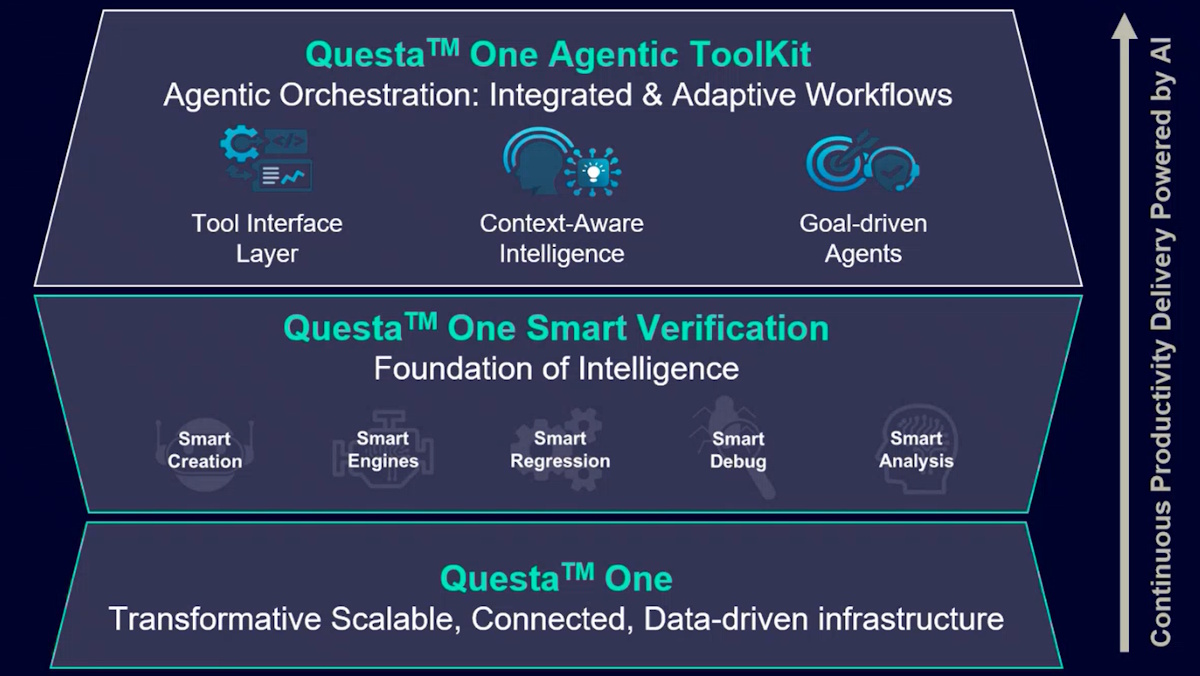
The road from embedded AI to generative AI to agentic AI (Source: Siemens)
With Questa One, the AI is conceptually “underneath” or “inside” the tools; we might say “embedded intelligence,” if you will. This allows users to perform analysis, including predictive analysis, and other tasks directly within the tools themselves. Now, the guys and gals at Siemens have added two more scrummy layers to the cake—generative AI and agentic AI—which sit conceptually “on top” and “all around” the tools, not just assisting but actively directing the show.
In a desperate attempt to stop my brain wobbling on its gimbals, I like to think of this AI trio, triad, or troika in the following context:
- Embedded AI: Analytical and predictive AI for smarter, data-driven insights and intelligence.
- Generative AI: Accelerating process productivity, knowledge, and problem-solving.
- Agentic AI: Automated creation and verification with expert agents and MCP support.
“MCP support,” I hear you say, “what’s that when it’s at home?” Well, the Model Context Protocol (MCP) is an open-source standard introduced by Anthropic that enables AI models to seamlessly connect with external data sources, tools, and software systems. It solves AI integration fragmentation by acting as a universal connector, allowing developers to build servers that expose data to AI applications (clients). In this context, the simulation and verification engines in Questa One are the tools that can be accessed and controlled by higher-level generative and agentic AIs.
If Questa One is about putting AI inside the tools, the Questa One Agentic AI Toolkit is about letting AI take the reins—albeit with a human sitting comfortably in the driver’s seat with hands hovering over the steering wheel (and possibly the emergency brake), just in case.
At its heart, the Agentic AI Toolkit transforms verification from a sequence of manual tool invocations into intelligent, goal-driven workflows. Instead of an engineer painstakingly stitching together lint, CDC, simulation, debug, and closure tasks, the system can decompose a high-level objective into a series of coordinated steps, execute them, adapt based on results, and keep going until the job is done.
A key enabler here is Siemens’ use of MCPs, which expose the inner workings of the Questa engines in a structured way. This allows agentic systems to interact with the tools not as black boxes, but as fully accessible, context-aware resources. In effect, the tools become callable services, and the agents become orchestration layers that know what to run, when to run it, and why.
What makes this particularly interesting is the combination of three elements: access, awareness, and intent. The toolkit provides access to the engines, builds context-aware intelligence from the user’s design and verification environment, and introduces goal-driven agents that can reason about what needs to be done next.
The result is not just automation, but adaptive automation. These agents don’t simply execute predefined scripts; they adjust strategies across runs, learn from prior results, and build up a form of persistent expertise over time.
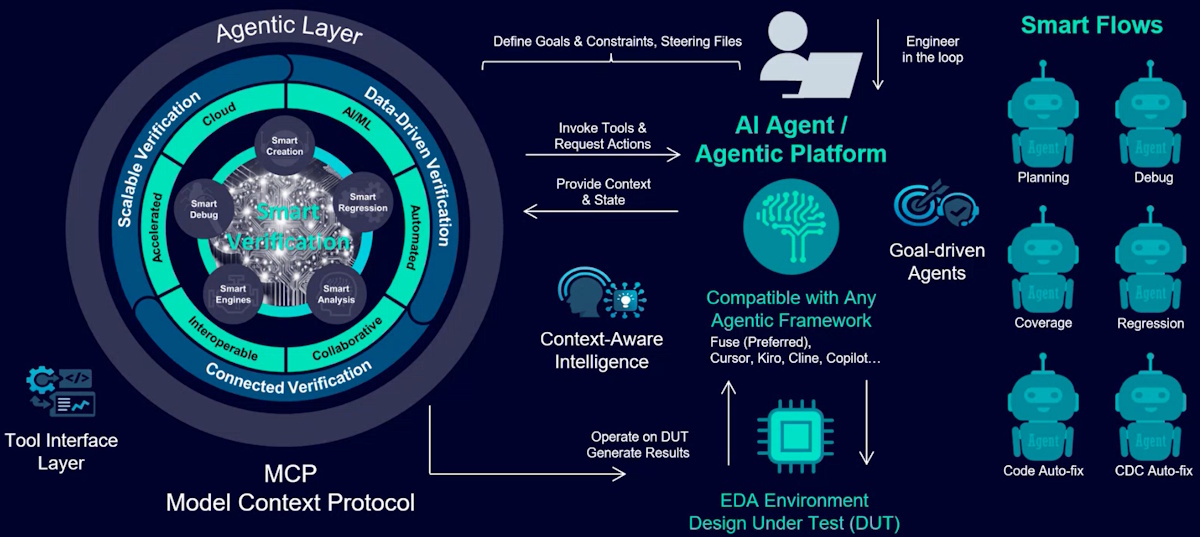
Questa One enables connection to AI agents through a standardized context protocol (Source: Siemens)
Early examples of these agents include RTL generation, lint optimization and auto-fix, CDC analysis, automated verification planning, and debug acceleration. In one case, a task that traditionally takes months—deriving a comprehensive verification plan from a specification—can be reduced to minutes, with the engineer reviewing and refining the output rather than constructing it from scratch.
Crucially, Abhi notes, “This is not about removing the engineer from the loop. Quite the opposite. The philosophy here is ‘human in the loop,’ where engineers guide, validate, and refine the AI’s output. The agents handle the mechanical work; the humans handle the judgment.”
All of this brings us to the fact that verification engineers aren’t being replaced… they’re being promoted. Now, instead of spending their days checking boxes and wrangling tools, they can focus on higher-level questions of system behavior, intent, and coverage. In short, they are well on their way to becoming the “verification scientists” Abhi mentioned earlier.
Of course, even the smartest agents need a place to hang their hats—and that’s where the Fuse EDA AI Agent system enters the stage. If the Questa One Agentic Toolkit provides the brains for verification-specific workflows, Fuse provides the broader AI framework in which those brains can operate. Think of Fuse as the connective tissue that links generative AI, agentic AI, large language models, and EDA tools into a coherent, end-to-end system.
One of the most important aspects of Fuse is that it’s “preferred,” but not “prescriptive.” In other words, while the Questa Agentic Toolkit integrates tightly with Fuse to maximize performance and capabilities, it is also framework-agnostic. Users are free to employ other AI frameworks, coding environments, or agentic platforms should they so desire.
This flexibility is more significant than it might first appear. In a world where AI ecosystems are evolving at breakneck speed, the last thing design and verification teams want is to be locked into a single vendor’s stack. By keeping the architecture open, Siemens allows users to leverage existing investments—whether that’s in tools, flows, or AI infrastructure—while still benefiting from advanced agentic capabilities.
Fuse also provides the scaffolding for generative AI applications. This includes the ability to interpret natural-language specifications, generate code or verification artifacts, and interact with engineers in familiar development environments. The agentic layer can then build on top of this, using generative AI as one of its tools while orchestrating broader workflows.
In practice, this means an engineer might start with a simple request—“Generate a verification plan from this specification”—and the system will use generative AI to interpret the input, agentic AI to structure and execute the workflow, and the underlying Questa engines to perform the actual verification tasks.
Another key point is that Fuse supports a wide range of interfaces—from command-line environments to modern IDEs like VS Code—and integrates with popular AI-assisted coding tools. This lowers the barrier to entry, allowing engineers with varying levels of AI expertise to adopt the technology and see immediate benefits.
Stepping back, the combination of Fuse and the Questa One Agentic Toolkit represents a shift from tool-centric verification to system-level intelligence. Instead of engineers driving tools, the tools and agents can collaborate to drive the verification process itself.
In a crunchy nutshell, we’re moving from a world where verification engineers conduct the orchestra one instrument at a time to one where they stand on the podium, set the tempo, and let an ensemble of AI-powered musicians take care of the rest. And if all of this means that verification engineers evolve into verification scientists, then “more power to their elbows.”
Of course, it goes without saying (but I’ll say it anyway) that if verification engineers do start calling themselves “verification scientists,” this means I’ll be obliged to update my own business card to “design scientist” or “bug creation specialist,” but that’s a price I’m prepared to pay.






