



There are lots of things I know nothing about. If I were to create a list, electric motors would likely appear near the top. I do remember one of my lecturers at university droning on and on about electric motors and generators. Unfortunately, I don’t actually recall anything he said. All I vaguely remember is him sounding a bit like the muted, mwah-wah-WAH-wah trombone noises you hear when the adults are talking in Charlie Brown cartoons.
I wish I’d paid more attention when I had the chance because it turns out that motors are much more interesting than I ever supposed. The only problem is that there are numerous variations of these little scamps.
For example, on offer are DC motors (brush and brushless), AC motors (induction and synchronous), and specialized motors (universal, servo, stepper, and linear). This sounds simple enough, but every category seems to have sub-categories ad infinitum. Further muddying the waters is the fact that every source seems to group, gather, slice, and dice things in different ways, often employing different terminologies for the task.
I was hoping to present a picture illustrating all this. However, having just spent more time than I care to remember roaming the web, only to be presented with a mindboggling array of mind-numbing interpretations, I’ve decided to take a stand and throw in the metaphorical towel (I didn’t say it was a brave stand).
The reason for my newfound interest in electric motors is that I was just chatting with Chance Claxton (CEO) and Marcus Hays (CTO) at Orbis Electric. The guys and gals at Orbis recently announced their latest and greatest offering, the HaloDrive platform, which can be configured to act as a motor, a generator, or a pump.
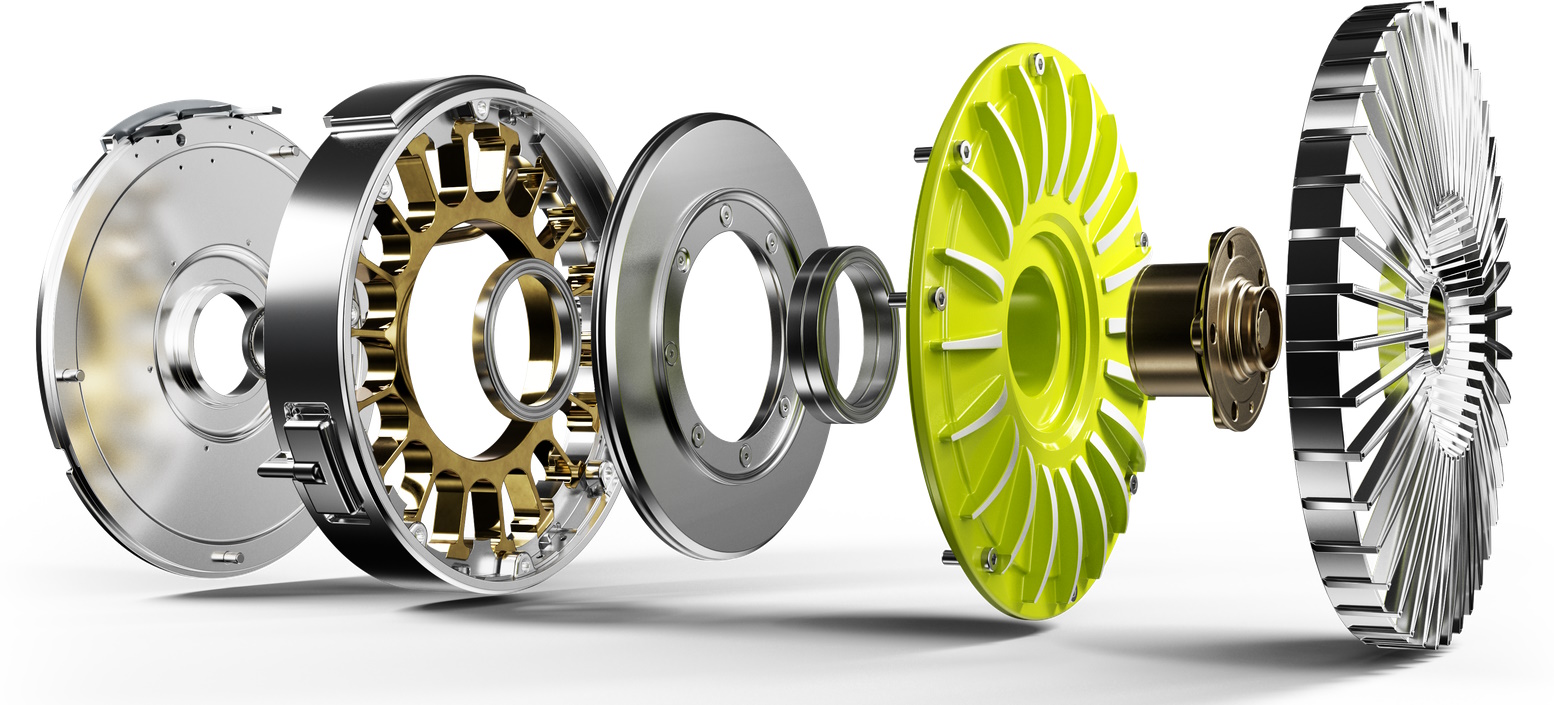
Exploded view of HaloDrive configured as a motor (Source: Orbis Electric)
As Chance modestly put it, “We have reinvented the wheel… and the motor… and the powertrain, for that matter.” Chance continued to say, “So we power anything that moves and move anything that needs power.” Bold words, but can they back them up? Why, yes, they can (otherwise I wouldn’t be writing this column)!
It turns out that the HaloDrive is a patented, permanent-magnet, axial-flux DC motor, often referred to as a brushless DC motor in this architecture.
Just to make sure that we are all tap-dancing to the same skirl of the bagpipes, we can divide this portion of motor space (where no one can hear you scream) into radial flux motors (RFMs) and axial flux motors (AFMs). In the case of RFMs, magnetic flux flows radially—from the center (rotor) outwards (or vice versa) toward the stator teeth. RFMs have a cylindrical shape with a relatively long axial length, the stator surrounds the rotor (or vice versa), and the rotor spins inside or around the stator.
By comparison, in the case of AFMs, magnetic flux flows axially—along the axis of rotation, across the faces of the rotor and stator. Imagine two discs facing each other—the flux goes straight from one disc face to the other. These “pancake-shaped” motors are wide (relatively speaking) in diameter but short (relatively speaking) in length.
RFMs are the more common, but AFMs are gaining traction (no pun intended) in certain applications, such as electric vehicles (EVs), especially in high-performance and/or space-constrained deployment scenarios.
The HaloDrive’s breakthrough modular tunable permanent magnet machine architecture separates the platform into four core components, each optimized for high-volume manufacturing, and together offering enhanced performance, efficiency, and configurability. These components are as follows:
- Injection-Molded Plastic Stator: This stator is produced using injection molding, which is a cost-effective and scalable manufacturing process.
- Tunable Gearset: The motor includes a tunable gearset that allows for adjustable gear ratios, enabling the motor to be configured for different applications and performance requirements. This flexibility contributes to the motor’s versatility across various sectors.
- Axial Flux Rotor: The rotor employs an axial flux design, which is known for its high torque density and compact form factor. This design contributes to the motor’s ability to deliver high torque and power density while maintaining thermal stability.
- Integrated Cooling System: The motor utilizes a dielectric oil-based cooling system, where the rotor pumps oil through the stator and into the motor housing, which serves as a passive heat sink. This integrated cooling approach eliminates the need for external cooling lines, reduces costs and mass, and simplifies the integration of the motor into various applications.
The HaloDrive offers high efficiency (up to 97% operational efficiency), high torque density (matching a V8, estimated at 100 Nm/kg or more), lower cost (up to 35% reduction in drivetrain cost over traditional radial-flux motors), and versatility (functions both as motor and, with minor winding changes, as a generator).
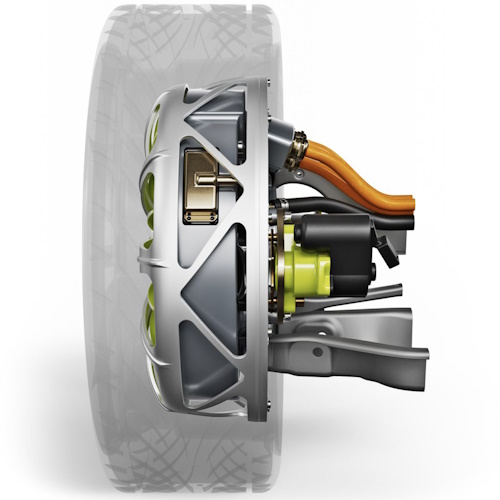
As an example deployment in its motor incarnation, the HaloDrive can be used in-wheel as illustrated below. This isn’t just “pie in the sky.” In August 2024, the chaps and chapesses at Orbis Electric delivered a 750-horsepower all-wheel-drive prototype to Volkswagen, featuring their in-wheel powertrain technology. This system was developed without any unsprung weight penalty and without altering wheel offset or suspension geometry, thereby demonstrating its potential for OEM applications.
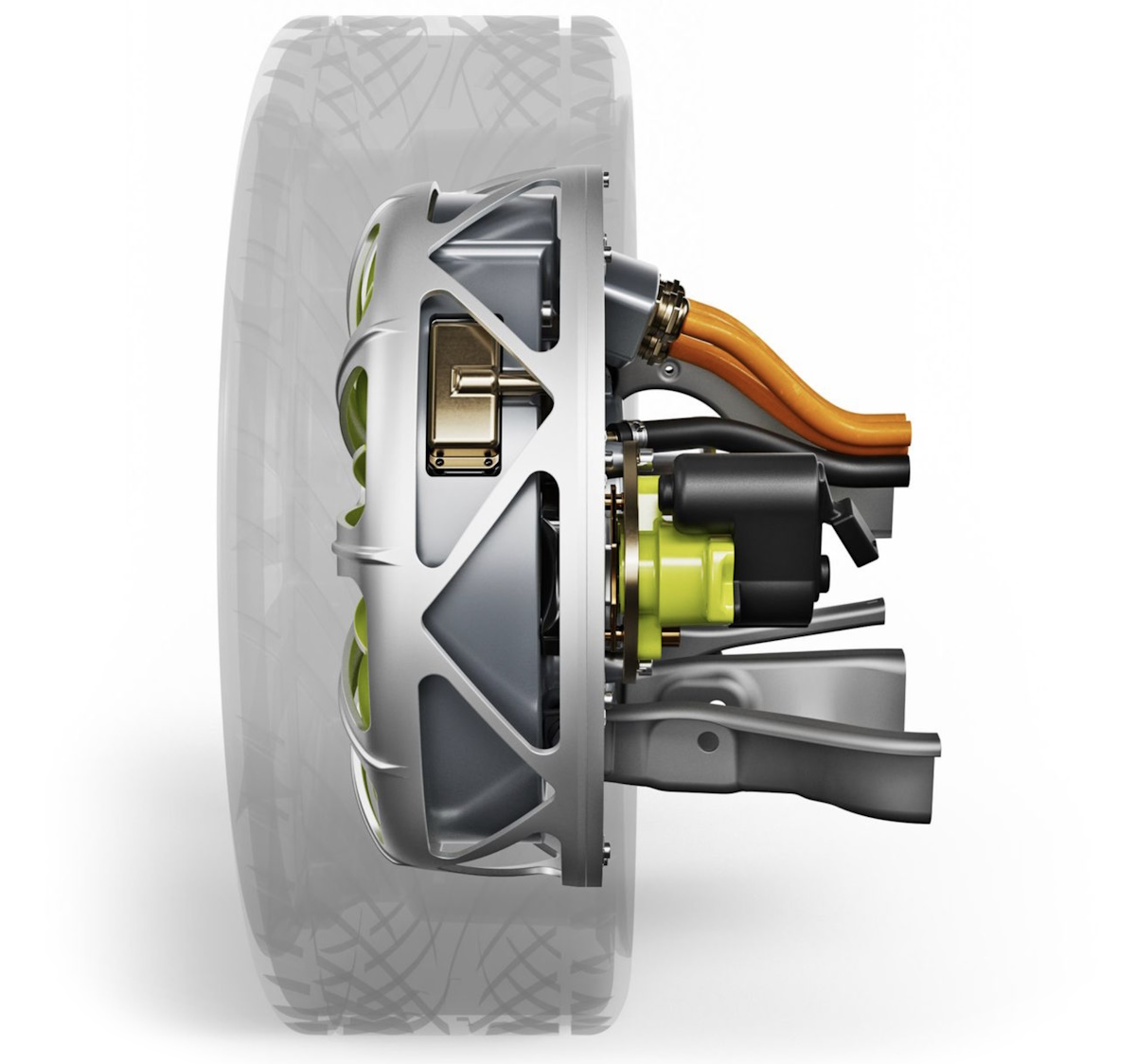
HaloDrive in an in-wheel deployment (Source: Orbis Electric)
Compare this to traditional EVs, like a Tesla, for example, which have their electric motors mounted in the vehicle’s chassis, between the axles, and connected to the wheels via a driveshaft or halfshafts. (I can’t believe I’m calling Tesla “traditional,” but there we are.) Mounting the motors in the wheels frees up valuable space inside the car’s body, thereby supporting interior space optimization, including more room for passengers or cargo and more flexible cabin layouts.
Furthermore, since the wheels are no longer connected to driveshafts, this allows the vehicle’s center of gravity to be lowered, thereby offering multiple advantages, including the potential for individual wheel control, improved handling and stability, better traction and acceleration, and enhanced ride comfort.
But wait, there’s more! According to an article on Advanced Clean Tech News, the transport refrigeration units (TRUs) found on trucks that haul perishable cargo are responsible for ~20% of toxic air contaminants from moving goods around in California. These trucks are powered by diesel, which is horrible for the environment. This article goes on to say, “In 2019, the California Air Resources Board (CARB) estimated that TRUs within the state were responsible for nearly 900,000 tons of greenhouse gas (GHG) emissions, 7,000 tons of NOx, and 277 tons of toxic diesel particulate matter.”
Orbis Electric’s NetZERO provides an example of a HaloDrive deployment in its generator incarnation. This is a zero-emission solution that eliminates the need for diesel-powered refrigeration units. The system mounts on the driveshaft or axle of the vehicle; when the vehicle decelerates, the generator harvests energy. It stores enough energy during motion to maintain refrigeration both during travel and when stationary—up to 10 hours without needing an external power source— and optionally supports plugging in when needed.
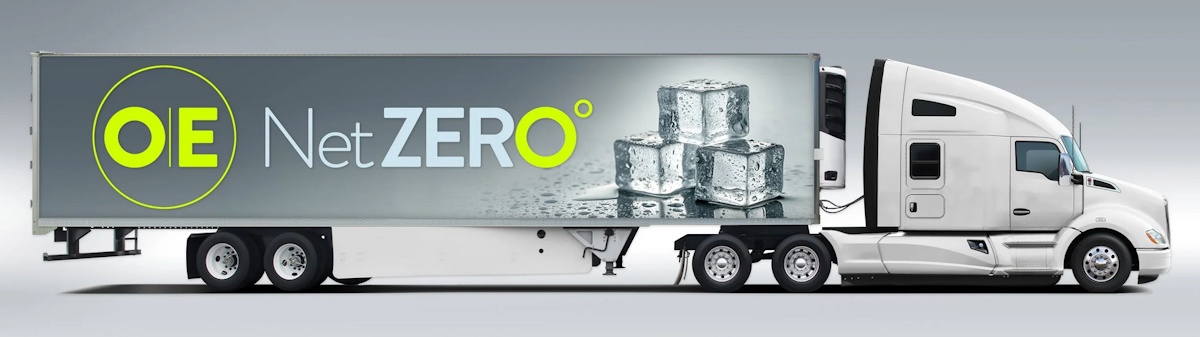
NetZERO is built using Orbis Electric’s HaloDrive axial-flux generator technology, packaged as a retrofit/equipment kit (eTRU) for refrigerated vehicles. It’s “assembly line ready” and “OEM approved for serial production.”
Chance and Marcus informed me that NetZero reduces emissions by 100%, pays for itself in two years, and can save the operator $80,000 per truck over the system’s anticipated 8-year life cycle. Saving money and the planet at the same time—that’s a win-win whichever way you look at it.
There’s so much more I have to say, but I don’t have the time (or energy) to say it (sad face). But turn that frown upside down into a smile, because if you are an automotive manufacturer or a truck operator, or anyone else who needs this type of technology, then the folks at Orbis Electric are quivering in anticipation at the thought of hearing from you (don’t forget to tell them “Max says Hi”).







In-wheel HaloDrive combined with four-wheel independent steering, would permit parallel-parking by driving sideways.
Hi Peter — that would be ideal in Europe and the UK, where parallel parking is pretty much the only option going — I couldn’t believe how different things were when I moved to the USA to discover that even small stores have excellent parking lots so people rarely need to parallel park (most of them here in Alabama don’t even know how to work their indicators LOL)
Small forklifts with hydraulic motors in their wheels have been driving sideways for years.
I just remembered that the folks at Orbis mentioned drones as another target market. Originally, I was thinking of small drones like the ones I play with, but it turns out they were talking about the sort og big hairy drones used for things like agriculture — beasts that are 14-feet from tip to tip — see “Are Agricultural Drones Poised to be the Next Big Thing?” https://www.eejournal.com/article/are-agricultural-drones-poised-to-be-the-next-big-thing/
I think the HaloDrive could be perfect for this sort of thing.
Hi Max,
About time too – I would say.
I have been thinking about this sort of thing for years. I DID pay attention in the electric machines lectures (thank you Mr Robinson) but these days I do firmware with a nod towards VHDL as well! I would have loved to be on the team that developed this. Put the torque as close to the place where the rubber hits the road I say. Torque the torque – now walk the walk! (Sorry about that folks.) More power to Orbis Electric – nice one. Can’t wait to see this widely deployed.
Thank you Max for this article – really fascinating but makes me think “I wish I actually got round to putting a design onto paper (or even into a CAD program) instead of just carrying the design round in my overloaded noggin!”
Keep ’em coming Max.
I don’t have many regrets in my life — but one of them is that I didn’t pay more attention when people were trying to teach me things. I’ll try to do better if I get another spin at the wheel (I recently read Reincarnation Blues, which has given me much food for thought https://www.amazon.com/dp/0399178503)