



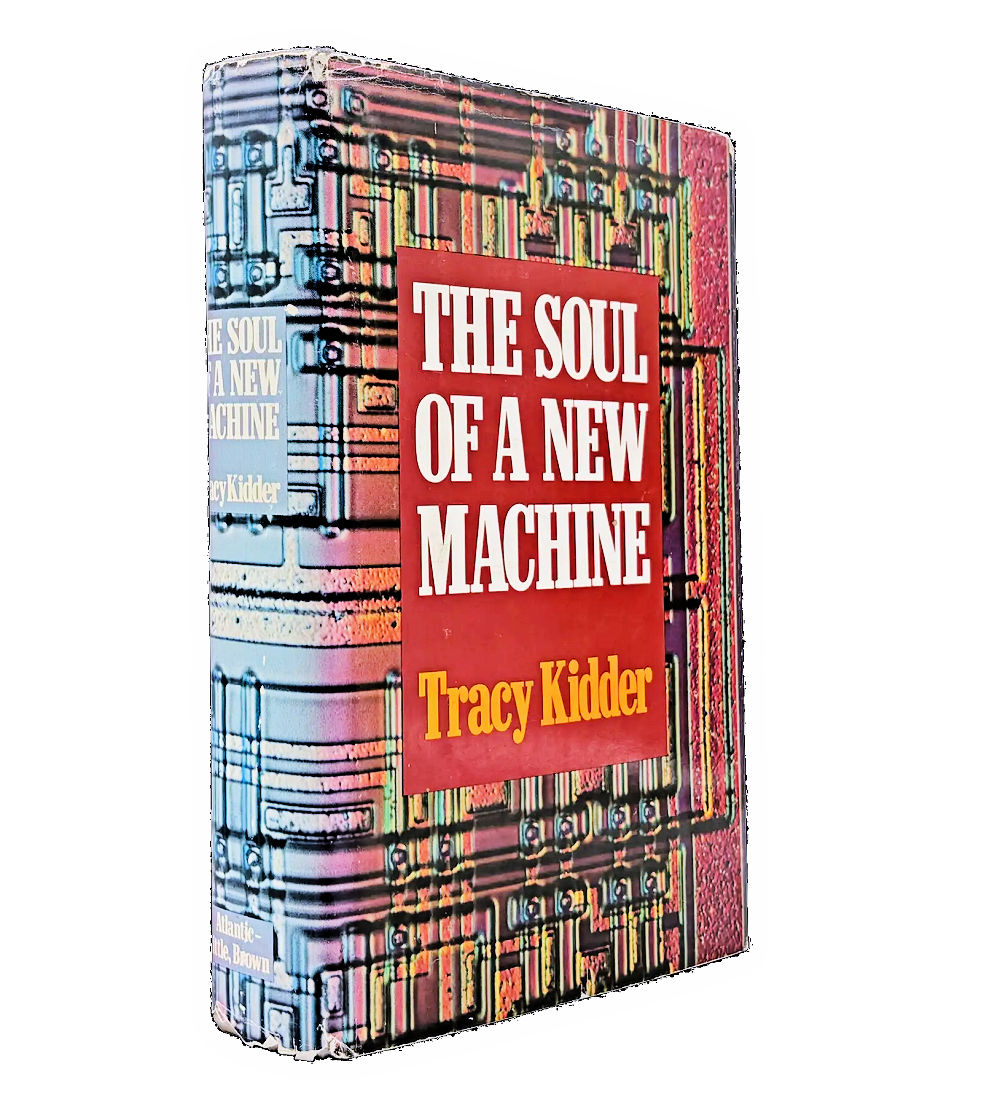
Tracy Kidder, the author of the 1981 best-selling book “The Soul of a New Machine,” has passed away. Kidder wrote many non-fiction books including his first book, “The Road to Yuba City,” and “House,” “Strength in What Remains,” Mountains Beyond Mountains,” “Old Friends,” “Among Schoolchildren,” “Home Town,” and “Good Prose.” “The Soul of a New Machine” was only his second published book and his only book to win a Pulitzer Prize, which is somewhat surprising because the book details the experiences, trials, and tribulations of the computer engineers who designed the first Data General (remember them?) 32-bit minicomputer (remember those?), the Eclipse MV/8000 (code named Eagle). Although this book’s descriptions of the myriad design challenges and the internal politics associated with product development in a high-tech company is right on target for EEJournal readers, it’s a very esoteric book for a general audience. Kidder, a writer with no technical background, embedded himself with Data General’s Eagle design team for many months and saw the project through to the end.

Tracy Kidder in 2013. Image credit: Bill O’Donnell
You might wonder how Kidder, a freelance writer and frequent contributor to “The Atlantic” magazine with no technical background, managed to embed himself in a cutting-edge design team at Data General. Richard Todd, his editor at “The Atlantic,” noted a rising interest in electronics technology during the late 1970s and suggested that Kidder “look into computers.” Todd knew the engineering head for Data General’s Eagle minicomputer project team, Tom West, who’d been Todd’s college roommate. According to Diana ben-Aaron’s article titled “Kidder Bares Soul” which was published on September 27, 1983 in MIT’s student newspaper “The Tech,” Kidder explained that he gathered material for the book “mostly by just hanging around offices and labs in the evenings. It was made clear to me that if I got in the way, I’d be out, so I tried not to get in the way.”
Kidder’s job as the author of “The Soul of a New Machine” was formidable. He first needed to scope the immense task that Tom West’s team was undertaking. Their goal was to develop a new and compatible 32-bit version of the existing 16-bit Data General Eclipse minicomputer to compete with the immensely successful 32-bit VAX minicomputer from Digital Equipment Corporation. West’s team wasn’t considered the first string. Data General had another 32-bit machine called FHP in development. Like many computer development projects of the day, FHP was overly ambitious. It was a Cadillac of computing, while Eagle was an evolutionary project that built upon Data General’s Eclipse and original Nova 16-bit minicomputer architectures. Ultimately, the FHP project failed to produce a working machine and Eagle saved Data General’s bacon.
Explaining 32-bit minicomputer operations and why they’re significantly different from 16-bit minicomputers to a non-technical audience in the early 1980s is no simple task. In these pre-IBM-PC days, most people were not as familiar with computers as they are today. Kidder also needed to explain esoteric concepts including computer instruction-set compatibility (while
describing instruction sets along the way). He had to tackle memory management, caching, paging, segmentation, and protection. None of these computer engineering topics are simple, and at least one or two college classes in computer architecture are generally required to convey the ideas. Kidder’s book did it in less than 300 pages. Surprisingly, that book full of technical computer engineering ideas and jargon became a best seller.
“The Soul of a New Machine” drills down even further however, down to the chip level, and that’s where it hooked me when I read it in 1981. At the time, I was a system design engineer developing computers. I’d just spent five years at HP’s Desktop Computer Division completing six major projects and was at the midpoint of my design career. Kidder’s book introduced me to PALs, the rock-star programmable logic devices of that era. The Eagle team adopted PALs almost from the day that Monolithic Memories Inc. (MMI) introduced them in 1978, and Kidder’s prose accurately describes the risks Tom West’s team took when it incorporated PALs into their designs:
“Looking for a technical advantage, West gambled that the coming thing in chips was a type of circuit known as a PAL. The manufacture of integrated circuits is a fairly risky business; it is said that factories can suddenly become inoperative for no apparent reason – though a small infusion of dust is a common suspect. So the conventional wisdom holds that in making a new computer, you never plan on using any sort of brand-new chip unless at least two companies are making it. At that moment, only one fairly small company was making PALs. But if PALs were really the coming thing, it would be a win to use them. West decided to do so.”
Here in one paragraph, Kidder has encapsulated the preference for second sourcing back in those days. He also accurately describes the risks of adopting new technology acquired from new startups, in this case MMI. Indeed, Data General did have availability problems with MMI’s PALs in late 1979 and into 1980. Eventually, National Semiconductor, AMD, Raytheon, and Texas Instruments all became second or alternate sources for MMI’s PALs.
A few pages later, Kidder succinctly describes of the major benefits of PAL-based design versus TTL-based design back in the late 1970s and early 1980s:
“Designing Eagle, they went far beyond what could yet be done on a single chip. Many of the chips they used came to them ready-made to perform certain operations. This took most of the pure physics from their endeavor. West’s decision to use PALs gave the designers certain advantages. Certainly it helped some of them work swiftly. When Ken Holberger, for instance, came to a tricky part of the design, he could often just draw a box on his diagram and leave that box blank. A single programmable PAL could be made to perform all the functions that the box had to do. ‘PAL here’ he would write on his diagram, in effect. Later, he would come back and program the PAL. In the meantime, prototypes of the new machine could be built. But eventually the designers had to program every PAL. They had to invent the complex internal organization of each of those chips. They had to know what all the chips were meant to do. And there were thousands of chips in Eagle.”
In this one paragraph, Kidder describes one of the programmable PAL’s greatest benefits: deferred logic design. In many cases, a project’s progress was so quick that circuit design and pc board layout jumped ahead of the final functional system definition. Adding a PAL to the design, to be programmed at a later point, helped fold the design cycle back upon itself.
Certainly, this practice added risk to a design because the required function might not fit into a PAL. However, the urgent need to compress the design cycle to meet time-to-market deadlines often outweighed the risk.
Later in the book, Kidder described the hardware team’s creation of an “Honorary PAL Award,” which was a framed citation with an IC socket glued to its center. Kidder wrote, “This being a PAL Award, the socket was empty.” Details like this one authenticate the book’s narrative.
A few short months after reading “The Soul of a New Machine,” I joined the EDA startup Cadnetix and started designing engineering workstations to run the company’s pc-board layout software. The workstations were all based on Motorola’s new 68000 microprocessor and its successors, the 68010 and 68020. I designed the workstation’s CPU/IO board and a dual-ported memory board. Because the software was still under development and was not yet fully defined, I designed both boards using plenty of PALs.
Without doubt, Kidder’s book influenced that design choice. The book had spoken to me with an authenticity that I simply could not ignore, and I suspect that my own design experience was replicated hundreds or thousands of times in many electronics companies around the world. I think that’s an amazing achievement for Kidder, who went into this book project knowing virtually nothing technical about electronics or computer systems.
Tracy Kidder passed away on March 24 at the age of 80. “The Soul of a New Machine” was his only book about technology.
(For an in-depth look at the history of PALs, see “How the FPGA Came To Be, Part 3 MMI’s PALs Opened the Flood Gates for Programmable Logic.”)






