




In many ways, I wish we lived in a simpler world. I’m not talking about regressing to an Arcadian lifestyle, as tempting as that may be. What I’m contemplating is a world in which everyone is kind and honest, and the thought of taking anything that wasn’t theirs simply would not cross their minds. A world, in short, in which we didn’t need to worry about cybersecurity because there were no cybercriminals.
As an aside, just mentioning an Arcadian lifestyle reminded me of when Frodo Baggins first visits Rivendell in The Lord of the Rings. I LOVE that place!!! Its timeless Elvish sanctuary is not so much built upon the landscape as woven into it. Pathways curve organically along the contours of the valley, leading visitors past cascading waterfalls whose mist perfumes the air with the fresh scent of pine and moss. Slender bridges arch gracefully over rushing streams, their stones worn smooth by the passage of centuries. The buildings themselves are light and flowing with tall arched windows, open verandas, and intricate woodwork that echoes the shapes of leaves and branches. Roofs shimmer like overlapping scales, catching sunlight and starlight alike, so the halls seem to glow from within… I’m sorry… I was getting a little carried away there.
I don’t know about you, but close to the end of The Lord of the Rings, when the Elves leave Middle-earth and set sail for Valinor, the Undying Lands—taking Bilbo, Frodo, and Gandalf with them—I can’t help but think of Rivendell lying lonesome and deserted. It seems such a shame to leave it unoccupied. I often picture opening a portal and “emigrating” there with all my friends and family (you’re welcome to come with us if you wish).
As another aside (I’m sorry, I can’t help myself), have you ever seen any of the short How <movie name> Should Have Ended animated parodies on YouTube? These humorously reimagine how popular movies might have ended more logically, or at least more entertainingly, highlighting character inconsistencies and plot holes. For example, consider the ~2-minute How Lord of the Rings Should Have Ended offering.
And, of course, when we talk about inconsistencies and plot holes, we cannot help but remember Season 7, Episode 4 of The Big Bang Theory, The Raiders Minimization, where Amy ruins Indiana Jones and the Lost Ark for Sheldon by pointing out that Indiana Jones plays no role in the outcome of the story, meaning the plot would have been the same even if he wasn’t there.
But we digress…
Returning to how we started this column, it’s a sad fact of life that we do live in a world inhabited by cybercriminals (a.k.a. cyberslime) who are, without doubt, right at the top of Santa’s “Naughty List.” As a result, the designers of electronic systems must do everything in their power to protect themselves and their creations. Some general strategies include the following:
- Secure Boot & Root of Trust: Ensure the system only runs authentic, signed firmware/software. Hardware-based root of trust anchors security from power-up.
- Strong Authentication & Access Control: Enforce cryptographic authentication for devices, users, and peripherals. Use least-privilege access principles.
- Encryption of Data (at rest & in transit): Protect stored data (flash, EEPROM, NVM) with hardware encryption. Secure communication channels (TLS, DTLS, VPNs).
- Hardware Security Modules (HSMs) / Secure Elements: Store cryptographic keys in tamper-resistant hardware. Prevent key extraction even if the rest of the system is compromised.
- Over-the-Air (OTA) Update Security: Digitally signed and verified updates. Rollback protection to prevent attackers from reinstalling old, vulnerable firmware.
- Intrusion Detection & Monitoring: Runtime integrity checks (watchdog + anomaly detection). Logging and alerts for suspicious behavior.
- Physical Security & Tamper Resistance: Coatings, mesh sensors, or epoxy potting to make probing difficult. Anti-tamper switches to detect unauthorized physical access.
- Resilience & Recovery: Secure fail-safe modes if corruption is detected. Backup firmware images for trusted recovery.
- Side-Channel Attack Mitigation: Noise injection, randomization, and shielding to reduce information leakage through power or EM emissions.
- Design-for-Security Lifecycle Practices: Threat modeling during design. Regular code reviews, fuzzing, and penetration testing. Keeping firmware/software patched.
Security was once primarily a concern for processors, but today it extends to all components—including memory devices. All of which brings us to the fact that I was just chatting with Jim Yastic, who is Director of Technical Marketing at Macronix.
The folks at Macronix specialize in non-volatile memory solutions, including NOR and NAND flash, ROM, and e.MMC/embedded storage. Founded in 1989, Macronix develops memory products for a wide range of applications, including consumer electronics, IoT devices, automotive, industrial, and AI systems.
The guys and gals at Macronix are recognized for integrating high performance, low power consumption, and robust security features into their products. The focus of our chat was for Jim to bring me up to date on Macronix’s security suite of products, including ArmorAuthen, ArmorBoot, ArmorFlash, and Armor Quantum, all of which make Macronix a key player in enabling secure and reliable embedded systems.
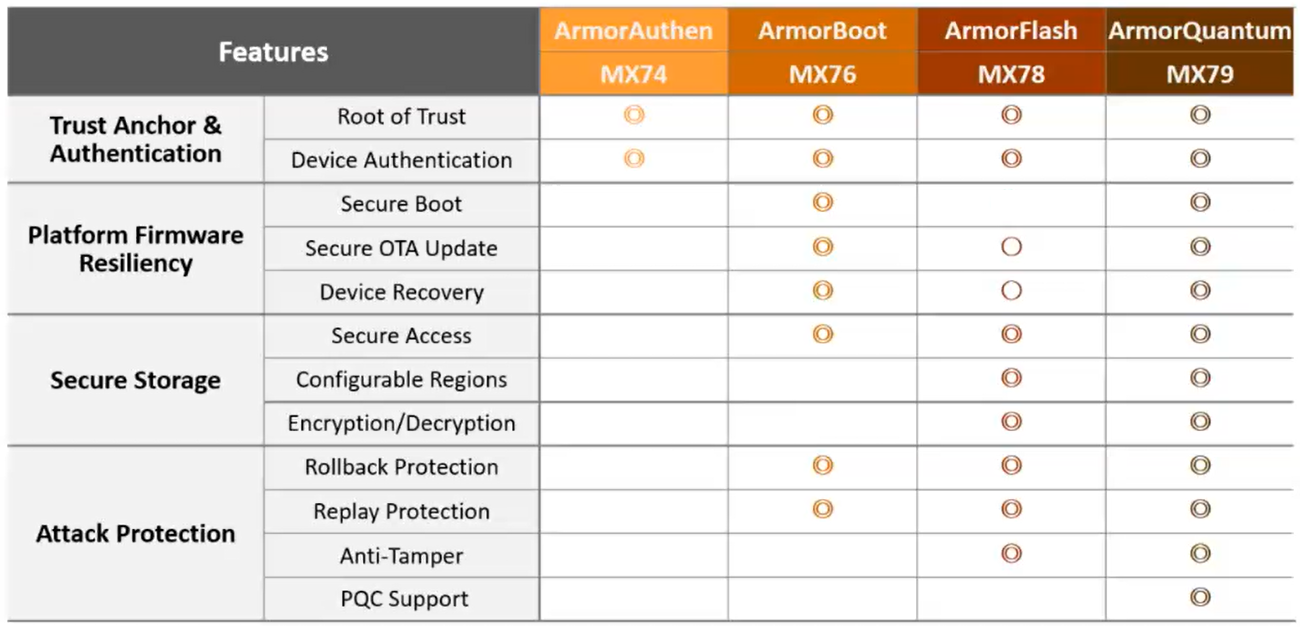
Secure Flash product features (Source: Macronix)
For the purposes of this column, we will focus on the ArmorBoot MX76—a secure NOR flash for fast, authenticated boot and updates—because this was Macronix’s marquee launch earlier this month as I pen these words. I’m sure I will write a follow-up column on the ArmorQuantum MX79 when it becomes available in the future.
Let’s briefly summarize the line items associated with the MX76 column in the illustration above. In a crunchy nutshell:
- Root of Trust (RoT): A foundational security anchor—a small, trusted component (hardware/firmware) that the system can always rely on to behave correctly and securely. The MX76 embeds hardware-based cryptographic primitives, such as a Physical Unclonable Function (PUF) and a unique device ID, to act as the trust anchor from which secure boot and authentication derive.
- Device Authentication: The process of verifying that a device is genuine and not a counterfeit or rogue unit, often using unique IDs, certificates, or cryptographic keys. Each MX76 device has a unique, unclonable identity, allowing the host system to confirm it’s talking to a genuine Macronix flash chip, thereby thwarting counterfeits or board-level attacks.
- Secure Boot: Ensures that only verified, untampered firmware is loaded during system startup, typically by checking digital signatures before execution. Firmware stored in the MX76 is digitally signed and validated before execution. The flash memory itself helps ensure that unverified code cannot be loaded at startup.
- Secure OTA (Over-the-Air) Update: A mechanism to remotely deliver and install firmware/software updates while ensuring the integrity, authenticity, and confidentiality of the update. The MX76 supports authenticated and encrypted update mechanisms, letting IoT, automotive, and AI devices receive patches/upgrades while blocking tampered update files.
- Device Recovery: A safe fallback process that restores the system to a known-good state if the boot process or an update fails. If an update fails (e.g., due to a corrupted image), the MX76 can facilitate a fallback to a known-good firmware image, thereby ensuring the device remains operational.
- Secure Access: Restricts and protects access to device memory, commands, or features—allowing only authorized users or systems to read/write data. The MX76 provides controlled access to memory regions using cryptographic authentication and permissions, allowing only trusted software or users to interact with sensitive code/data.
- Rollback Protection: Prevents an attacker from reinstalling an old, potentially vulnerable version of firmware/software after an update. The MX76 includes monotonic counters and versioning to prevent the installation of older firmware versions, ensuring that attackers can’t reintroduce security holes.
- Replay Protection: Ensures that intercepted legitimate commands or data (such as authentication tokens or update packages) cannot be resent later by an attacker to gain unauthorized access. Built-in “freshness” checks and counters prevent attackers from reusing captured valid commands/updates, thereby ensuring that each transaction is unique and cannot be duplicated.
I hail from the time when semiconductor RAM and ROM devices had only recently been introduced to the market. In those halcyon days, we were as happy as clams if we could read and write data without anything exploding or catching fire. We had no conception of how complicated things were going to get.
To cut a long story short (which is opposite to the way I usually like to do things), the MX76 isn’t just a flash chip that stores bits; instead, it actively participates in the chain of trust from power-up through updates, recovery, and access control, embedding enterprise-grade security directly into memory.
In a world where cyberthreats are as persistent as they are creative, it’s reassuring to know that companies like Macronix are designing memory that isn’t just fast and efficient—but smart, secure, and downright wonderful. For anyone building modern electronics, this combination of performance, protection, and peace of mind is simply invaluable.
What say you? Do you have any thoughts you’d care to share on any of this? Do you ever wish we lived in a world free of cyberslime? And would you be interested in a one-way trip to spend your remaining days living an idyllic life in an abandoned Rivendell?







If you read Tolkien very carefully you’ll notice Elves don’t always have a great reputation – unless you’re another elf, a wizard, royalty, or have a Ring of Power, or such. In fact, normally I wouldn’t trust an Elf “Around a glass corner”, as the Russians say. More of a cultural thing than species-related I assume.
And, “…spend your remaining days living an idyllic life in an abandoned Rivendell?”
Abandoned? Do you have any idea how hard is it to locate enchanted plumbing, much less get it working again? Where ya gonna find parts? And talk about encryption! If they even have a septic system, it probably dumps into an Orc’s cave, or something… And those cliff-hung buildings never got any kinda P.E. stamp either, I’ll wager. Those steep cliffs may mean the area is both geologically recent AND unstable, and slender bridges are a seismic nightmare without elfish spells too.
I still have nightmares from that bunch I found on my property making cookies in “a hollow tree”. I mean, A HOLLOW TREE!!! Try to explain that to the Health Department. I had to get re-zoned!
I must admit that I’d been worrying about potential problems with the plumbing — that’s why I’d take you along. Re the Elves, I agree, they aren’t always cuddly. Take the ones in Shadows Fall by Simon Green (https://www.amazon.com/dp/1932100458) — these bad boys (and girls) come armed with high-tech weapons. Similarly, in Cold Days by Jim Butcher, our hero, the wizard Harry Dresden, finds himself a Winter Knight to Mab, the Queen of the Fairies (https://www.amazon.com/dp/045141912X), and she’s not an easy boss to work for.
“…that’s why I’d take you along.”
Oh no way. No sir. I’m not going through THAT again:
(“Say, does this handkerchief smell like chloroform to you?”, and next thing you know you’re on a eight-month contract job in Azerbaijan).
Ever since your visit to Azerbaijan, I’ve been hearing great things about the plumbing over there 🙂