Call me an old cynic, if you wish (I’ve been called worse), but I’ve learned to live with disappointment over the years after being tempted on countless occasions with promises of technological delight, only to discover that all is not as it first seems when the curtain is finally pulled back to reveal…
I know, I know. “Pay no attention to that man behind the curtain,” I hear you cry, but it’s difficult when the metaphorical man (the trickiest kind, in my experience) is frantically pulling levers, winding wheels, and shouting into a retro-futuristic microphone.
Take LiDAR, for example. Just to remind ourselves and set the scene before we plunge into the fray with gusto and abandon (please ensure you’re dressed appropriately), broadly speaking, most modern LiDAR systems fall into one of two architectural camps: traditional Time-of-Flight (ToF) approaches and newer Frequency-Modulated Continuous Wave (FMCW) techniques.
A ToF LiDAR system sends out short laser pulses and measures the time taken for reflections to return. These readings can be used to determine range directly, but estimating velocity generally requires frame-to-frame processing. The biggest advantages of ToF technology are that it has traditionally been cheaper and easier to commercialize. It’s also mature and widely deployed, meaning we have extensive real-world experience with it. On the downside, ToF systems can struggle with interference from other LiDAR units, ambient lighting, and the detection of low-reflectivity objects at long range.
By comparison, FMCW LiDAR systems transmit a continuously varying (“chirped”) laser signal and measure the frequency difference between transmitted and returned light, including Doppler shifts caused by moving objects. This allows them to measure both distance and radial velocity simultaneously. Compared to ToF, FMCW typically offers superior interference rejection, improved low-light performance, and greater sensitivity to weak reflections. However, these benefits come at the cost of significantly greater optical, electronic, and computational complexity.
In a crunchy nutshell, ToF LiDAR is a relatively mature technology whose rate of improvement is beginning to flatten, while FMCW LiDAR is still much earlier in its development curve, with substantial room for innovation and integration.
Having said this, although FMCW may currently be the darling of the LiDAR world, perhaps we should not yet cry, “Alas, poor ToF, we knew him well,” as the Bard might say. While it’s certainly true that ToF LiDAR may be approaching a relatively mature phase in its evolution, this certainly doesn’t mean it’s going away anytime soon. Quite the contrary. ToF systems are likely to remain the technology of choice for many cost-sensitive, moderate-performance applications for years to come. Examples include robot vacuums, smartphones and tablets, AR/VR headsets, gesture-recognition systems, industrial presence sensing, smart-home devices, parking assistance, security systems, and basic obstacle avoidance for drones and automated guided vehicles (AGVs). In many of these applications, ToF is more than adequate and benefits from lower cost, simpler implementation, and a mature manufacturing ecosystem.
By comparison, FMCW LiDAR is increasingly attractive for systems demanding more sophisticated sensing and environmental awareness. Because FMCW can directly measure both distance and radial velocity simultaneously, it offers significant advantages in dynamic, fast-changing environments. This makes it especially well-suited for autonomous automobiles, robotaxis, advanced driver-assistance systems (ADAS), humanoid robots, autonomous mobile robots (AMRs), industrial robotics, autonomous trucks, agricultural and mining vehicles, delivery robots, smart infrastructure, and high-end drones.
One way to think about the distinction is that ToF primarily answers the question, “Where is it?”, while FMCW also answers, “How fast is it moving, and in which direction?” In many next-generation autonomous systems, this additional layer of perception could prove to be extremely valuable.
Since my main areas of interest in this arena are AI and machine vision, I’m naturally more focused (no pun intended) on FMCW LiDAR technologies. One of the holy grails here is the creation of a truly semiconductor-style solution in which the optical, sensing, and signal-processing functions can all be manufactured using scalable, high-volume semiconductor techniques.
The thing is that many companies begin by proudly proclaiming, “We’ve got a fully semiconductor solution!” When we delve a little deeper, however, this often turns out to mean “apart from the rotating prisms, oscillating mirrors, or other beam-steering mechanisms used to guide the beam(s) and scan the scene.”
The reason I just said “beam(s)” is that some FMCW systems employ a single coherent sensing channel (pixel) combined with a beam-steering mechanism to scan the scene point-by-point. In some cases, this scan may take the form of a 1D line; in others, it may be a full 2D raster scan. Another common approach is to employ a vertical stack (column) of sensing channels in conjunction with some form of horizontal beam steering to sweep the scene from side to side.
The bottom line is that, by the time we’ve taken the semiconductor core and surrounded it with the assorted optical odds and ends needed to steer, shape, align, and calibrate the beams, we often end up with something the size of a shoebox, weighing a couple of pounds, and costing more than many markets can bear.
The dream is to create something resembling a CMOS sensor-based camera, but for FMCW LiDAR. We’re talking about a full 2D pixel array with fully solid-state operation and no moving parts whatsoever. Can you imagine how groundbreaking it would be to combine everything into a single photonics integrated circuit (PIC) costing, say, $20?
The reason I’m waffling on about all this here is that I was just chatting with Clément Nouvel, who is the CEO at Voyant Photonics. Clément commenced by noting that many FMCW LiDAR companies are currently focused on high-end automotive applications involving ranges of hundreds of meters. Unfortunately, the automotive world comes wrapped in layer upon layer of stringent qualification, safety, reliability, thermal, and environmental requirements. Quite apart from the technical challenges, simply complying with all the associated standards can significantly increase system complexity, development time, and cost.
By comparison, Voyant is initially targeting the “physical AI” space: humanoid robots, autonomous mobile robots (AMRs), warehouse automation systems, drones, industrial robotics, and other intelligent machines that must safely navigate and interact with the real world. In many of these applications, sensing ranges of up to around 50 meters are perfectly adequate. Equally importantly, these markets place enormous value on compact size, low weight, manufacturability, low power, and affordability.
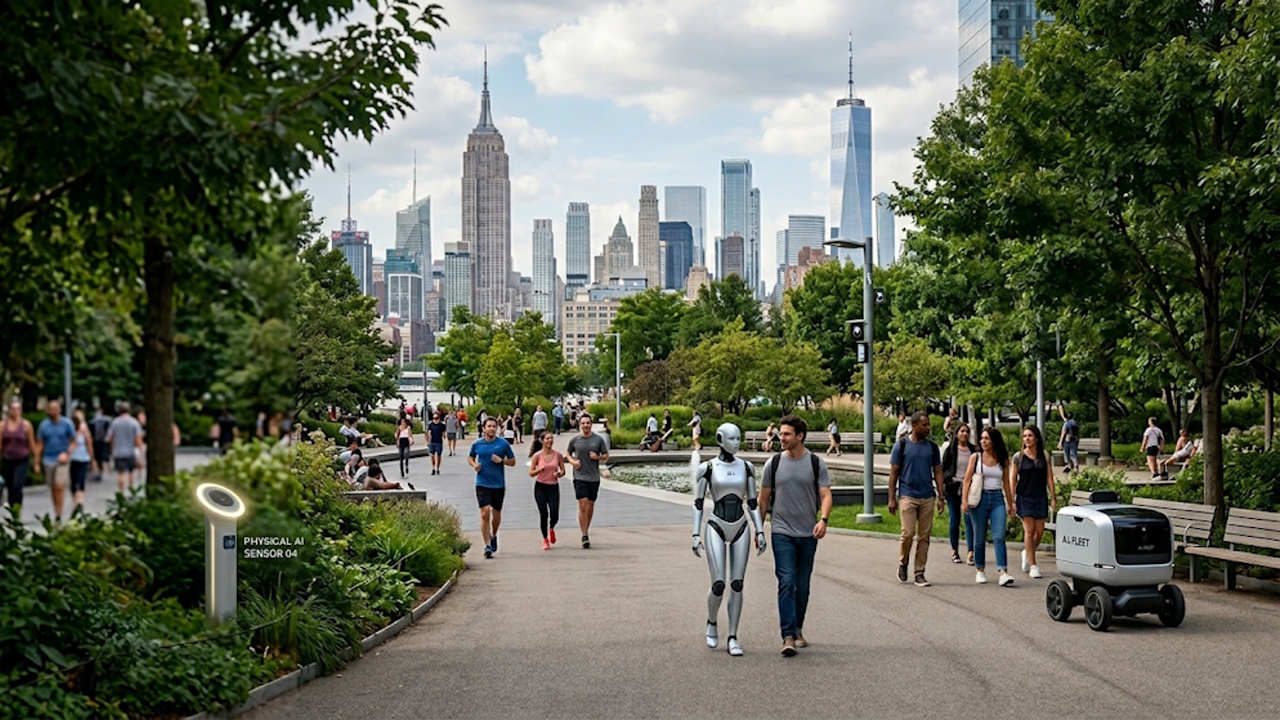
A forward-looking vision (I can’t help myself) of things to come (Source: Voyant).
Clément shared the image above of a possible future to come. Can you guess what caught my eye? You’re right. It’s the little “box-on-wheels” on the right. I hail from the city of Sheffield in the UK. When I was a lad, Sheffield was a gritty steel-and-engineering city, not exactly the sort of place where one expected to encounter autonomous delivery robots trundling along the pavements.
I mention this because my friend Little Steve, whom I’ve known since we were 18 years old, literally sent me a picture just last night of three of these “delivery droids” queuing up to cross the road in Sheffield, along with the caption, “What the What (WTW)” (or words to that effect).
I thought he was joking—they certainly didn’t have anything like that the last time I was there—but I just had a quick Google while no one was looking, only to discover that Sheffield is one of the UK cities where autonomous delivery robots have been trialed and deployed in selected areas.
Systems like these don’t require kilometer-scale sensing ranges, but they do demand compact, affordable, highly reliable perception systems capable of operating safely around people, pets, bicycles, parked cars, wandering toddlers, and—one assumes—the occasional inebriated university student (not that we had any of those in my day, of course).
But we digress… Voyant’s current-generation device, called Carbon, employs a single PIC implementing a vertical column of FMCW sensing pixels. This architecture still requires horizontal beam steering, but it dramatically reduces the amount of external optics and associated complexity compared to many competing solutions.
One particularly clever aspect of the design is that the scanning system can dynamically slow the beam as it passes through regions of interest, effectively increasing angular sampling density and improving spatial resolution where additional detail is most valuable. This allows the system to allocate sensing resources more intelligently, rather than treating every part of the scene equally.
However, the really exciting development is Voyant’s forthcoming Helium device. Instead of relying on a column of pixels combined with horizontal scanning, Helium implements a full 2D FMCW sensing array on a single PIC. The entire device is only slightly larger than a quarter, yet it promises to deliver true solid-state FMCW LiDAR with no moving optical components whatsoever.
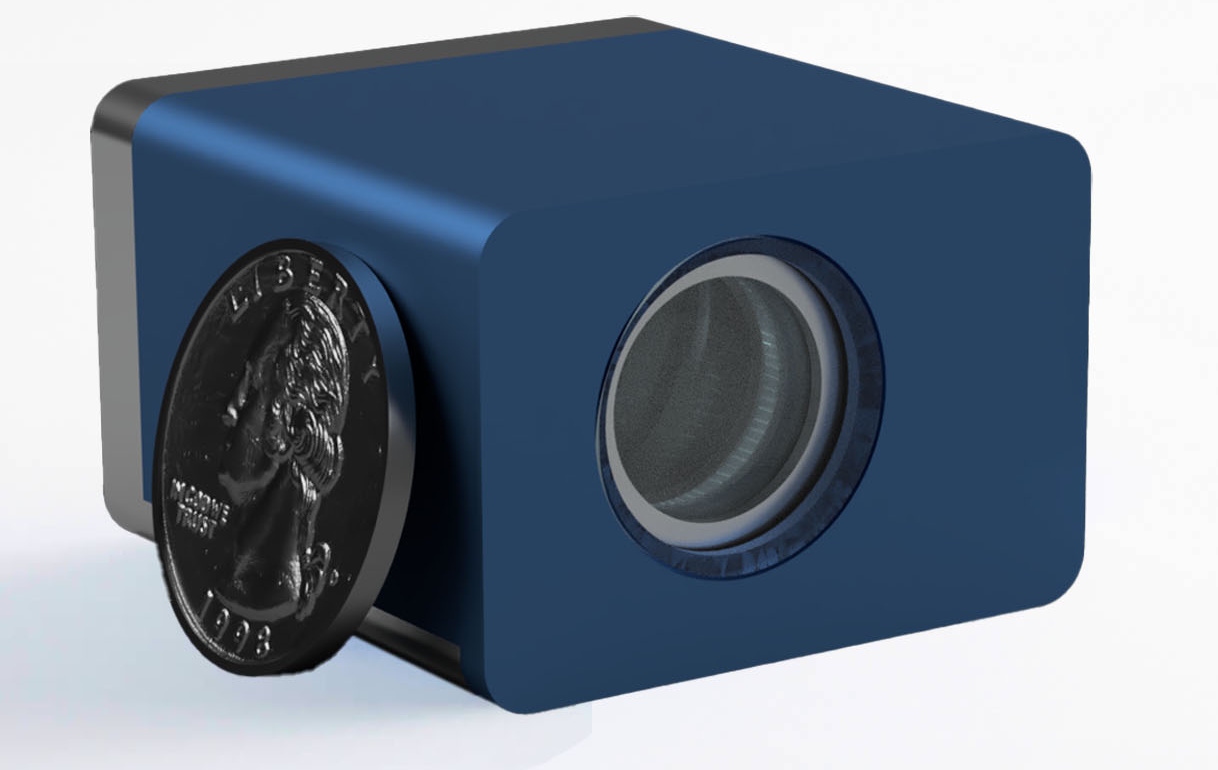
Helium will implement a full 2D FMCW LiDAR pixel array on a single PIC (Source: Voyant).
If Helium delivers on its promise, it could dramatically expand the range of applications for FMCW LiDAR technology, enabling compact humanoid robots, autonomous drones, smart industrial systems, wearable spatial-awareness platforms, consumer robotics, and entirely new categories of machine-perception products that are difficult to envision today.
In much the same way that semiconductor integration transformed computing, imaging, and wireless communications, fully integrated FMCW LiDAR could eventually make sophisticated 3D environmental awareness both ubiquitous and affordable. Perhaps the most exciting thing about Helium is not merely that it shrinks FMCW LiDAR, but that it potentially changes the economics of machine perception altogether.
Whenever a technology becomes simultaneously smaller, cheaper, and easier to deploy, history suggests that widespread disruption is rarely far behind. I don’t know about you, but I’ve just dispatched the butler to fetch my “things are about to get interesting” trousers.