




Things are moving fast in AI space (where no one can hear you scream). For example, I first became aware of the concept of “Agentic AI” only a couple of months ago as I pen these words. Now, I find that this bodacious beauty is already being deployed in factories and semiconductor fabs to transform manufacturing and prevent costly machine downtimes. I tell you, I’m too young for all this excitement.
Before we plunge into the fray with gusto, abandon, and—of course—aplomb, let’s first take a moment to ensure that we’re all tap-dancing to the same skirl of the bagpipes (I don’t want to see anyone falling off the end of the stage like last time).
Regular AI: We can think of this as “classical,” “traditional,” or “narrow” AI. This will provide our baseline. It encompasses AI systems designed to analyze, classify, predict, and act within a limited scope, often under strict supervision or rules. These systems take input and produce output under defined constraints; they typically don’t “invent” novel content or plan over many steps. Examples include image classifiers, speech recognition systems, fraud detection models, recommendation systems, and predictive maintenance models, among others.
Key characteristics of narrow AI systems are that they are reactive or predictive (rather than generative or creative), they are task-limited (they do well in the domain they’re trained for, but don’t generalize broadly), and they have low autonomy (they are typically driven by explicit instructions, rules, or triggers).
Generative AI: This refers to a class of AI systems whose goal is not only to predict or classify, but also to generate new content, including text, images, audio, video, or synthetic data. The emphasis is on creation (or synthesis), not just interpretation. The types of things we’re talking about here are ChatGPT and Leonardo.ai
Agentic AI: We can also think of this as “autonomous” AI. An agentic AI system is one that can not only generate or compute, but can also set goals (or be given high-level goals), plan, decompose tasks, monitor progress, adapt, and take actions with minimal supervision. The notion evokes the idea of an “agent” with agency: something that acts proactively, not just reactively.
The key distinctions between agentic and generative AIs is that agentic AIs can decide what to do next, not just how to do a task; they can break down a high-level objective into subtasks, manage dependencies, and adapt to changing conditions; they often invoke external APIs, tools, or models in service of their goals; and they assess progress, revise actions, and reroute if they hit dead ends.
OK, now that we’ve set the stage, I’ll tell you what I learned in a recent conversation with Nitin Parekh (Chief Executive Officer) and Kiran Karunakaran (Chief Technology Officer) at Via Automation.
Just to set the scene, Nitin has decades of leadership experience across the semiconductor, industrial automation, and enterprise software industries. Earlier in his career, he served as a software architect at Lam Research, where he gained deep expertise in semiconductor process control and automation. He went on to found two companies, Sapphire Software and Sapphire Automation, which were acquired by Synopsys and Clip Automation, respectively.
In 2023, Nitin and Kiran co-founded Via Automation. Their goal was to build an agentic AI platform to address the problem of unplanned downtime in factories and semiconductor fabs, where the costs of such downtime exceed $1.5 trillion globally each year. Now, just two years later, Via Automation tools are already installed in semiconductor fabs, smart manufacturing facilities, automotive plants, and energy utilities, marking just the beginning of what is to come.
The graphic below depicts the factory automation landscape. This reflects the mindboggling complexity associated with just a single facility.
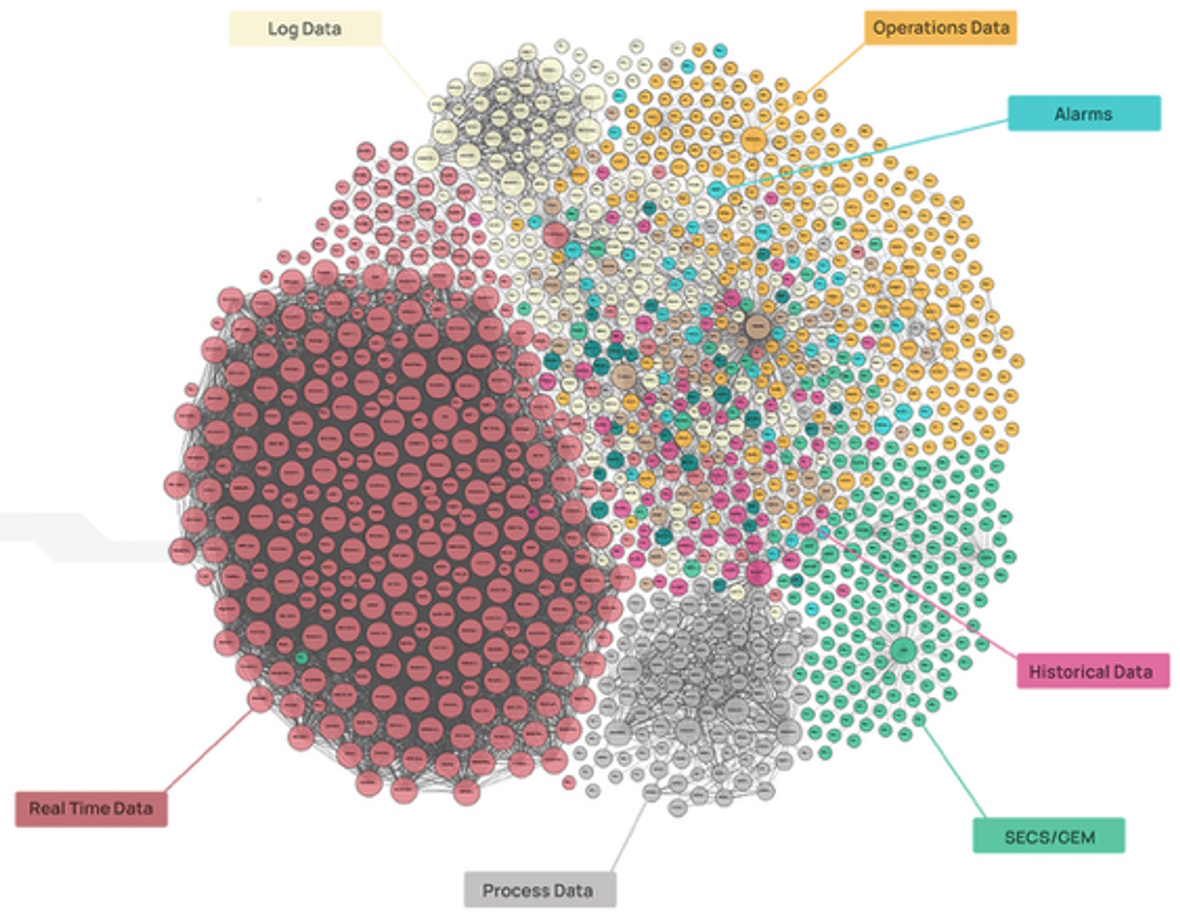
The factory automation landscape (Source: Via Automation)
In an ideal world, we would all be working (one or two hours a day would do me nicely) in futuristic facilities, such as the semiconductor fabs that are expected to come online around the world in the next few years. In the real world, according to the United Nations Industrial Development Organization (UNIDO), there are millions of existing manufacturing establishments worldwide, ranging from tiny workshops to giant plants. Happily, these existing entities have extensive historical data that can be mined for valuable information.
In the fullness of time, agentic AI may well work its way into all of these facilities. In the shorter term, even if we limit ourselves to “big factories” (don’t ask me to define what I mean by this), we are probably talking about 50,000 to 100,000 facilities around the globe—that should keep the guys and gals at Via Automation busy for a while.
The chaps and chapesses at Via Automation frame their offerings as three complementary capabilities—Via Connect, Via Copilot, and Via Control—that work together as layers of an industrial AI platform. Via Connect gathers and unifies the data, Via Copilot makes sense of it and guides users, and Via Control applies those insights directly to equipment and processes. Let’s ponder these in just a little more detail as follows:
Via Connect serves as the data integration and visibility layer. It connects factory equipment through industrial protocols such as Modbus, OPC, TwinCat, and MQTT, pulling in both live telemetry (vibration, flow, temperature, pressure…) and historical datasets (maintenance logs, manuals, work orders, PLM information…). Each asset is modeled digitally with a continuously updated health profile, creating a dynamic digital twin. Via Connect powers dashboards that provide real-time visibility into operations, enabling predictive maintenance modeling, data-driven decision making, and higher uptime and yield. Its agents retrieve knowledge from structured sources, such as MES/ERP databases, and unstructured ones, like manuals and SOPs, to unify all operational context in one place.
Via Copilot is the intelligent assistant for industrial operations. Acting as a multi-agent AI layer, it empowers operators and engineers by continuously monitoring machine performance, automatically flagging anomalies, and guiding users with next-best actions. The Copilot enhances OEE (Overall Equipment Effectiveness) by streamlining troubleshooting, offering predictive recommendations, and reducing the mean time to repair. It accelerates onboarding of new staff by delivering instant access to troubleshooting guides, manuals, and past case histories, effectively democratizing expert-level knowledge. With Via Copilot, even novice operators can act with the insight of seasoned engineers, driving efficiency and minimizing unplanned downtime.
Via Control is the execution and actuation framework. It provides end-to-end process clarity across stations, lines, and entire plants, with real-time monitoring, instant alerts, and actionable KPIs. Interfacing directly with equipment enables fine-grained process control, recipe tuning, and automated adjustments based on AI insights. Control not only detects early warning signs to prevent breakdowns, but also supports event logging, Pareto analysis, and dashboard-based diagnostics that reduce guesswork across teams. In short, it closes the loop from insight to action—ensuring that predictive analytics and Via Copilot guidance can be translated into safe, reliable, equipment-level interventions.
In case you were wondering, all these tools can be deployed on-prem or in a private cloud, so there’s no change of infrastructure, and the facility’s valuable data stays secure. I’ll tell you what, why don’t we all watch a quick video, and then we’ll regroup to consider things further?
My degree was in Control Engineering, and I’ve served my time on the factory floor, so the following facts and figures are of particular interest to me. The impact of Via Automation’s technology can be summarized as follows:
• 30–40% reduction in unplanned downtime.
• 20–25% extension of asset life.
• 15–20% reduction in maintenance costs.
• Improved operator safety and compliance reporting.
The great thing about all this is that this column reflects “Red-hot off the press news!” I say this because the folks at Via Automation formally launched their technology only a week ago at the time of this writing. And the first public demonstration of this technology is scheduled to take place next week at SEMICON West, which will be held from October 7 to 9 in Phoenix, Arizona.
Via Automation will exhibit and demonstrate its tools and technologies in Booth #7438. Also, Kiran will be presenting “Developing Explainable Digital Twins and Connecting to Co-Pilot Agents for Autonomous Tool Operations” on Wednesday in the Smart Manufacturing Pavilion Theater. (If you want to arrange a demonstration or a private meeting, send an email to sales@getvia.ai and tell them “Max says Hi!”)
“Hang on a minute!” I hear you cry, “If Via Automation only launched a week ago, how come you’ve been quoting all these facts and figures and waffling on about where this technology has been deployed?”
These are good questions that show you’ve been paying attention. This all comes down to the fact that Nitin and Kiran have been in the industry for a long time. As a result, they know many people who don the undergarments of authority and stride the corridors of power. It also has to be noted that founding and selling two successful companies doesn’t hurt when it comes to having an abundance of “cred,” as it were.
As a result, companies “in the know” have been lining up to gain early access to Via’s platform. These “friends and family” deployments are already yielding the real-world results I’ve been quoting, which explains how I can discuss this technology with such confidence, even before its official launch.
Agentic AI is still very much in its infancy. As I said earlier, I only learned the term myself a couple of months ago, yet here I am already reporting on real deployments that are saving factories millions of dollars. Today’s story about Via Automation is just one early example of how this new paradigm is taking shape. If history is any guide, agentic AI will soon be popping up in all sorts of unexpected places. One thing’s for sure: we’d better buckle up, because this rollicking roller coaster ride has only just begun!






