

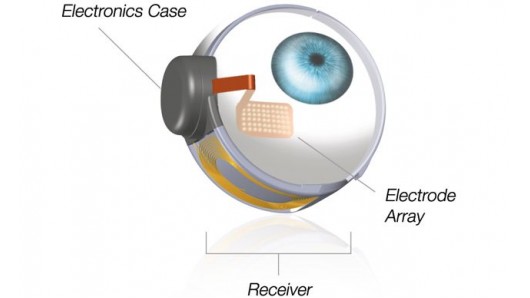
Second Sight’s Argus II Retinal Prosthesis is definitely an interesting piece of technology, allowing a blind user to “see” objects, colors and movement in their environment. Ordinarily, this is done with the help of a video-camera-equipped pair of glasses worn by the user. In a recent experiment, however, researchers bypassed the camera, transmitting visual braille patterns directly to a blind test subject’s retina.
Here’s how the Argus II normally works. The prosthesis itself is implanted in a blind user’s eye, placing an array of 60 electrodes against the surface of the retina. The accompanying video glasses take in the view in front of the user, and convert the video signal into electrical pulses. These pulses are wirelessly transmitted to the implanted electrodes, which respond by selectively stimulating retinal nerve cells.
via gizmag






