

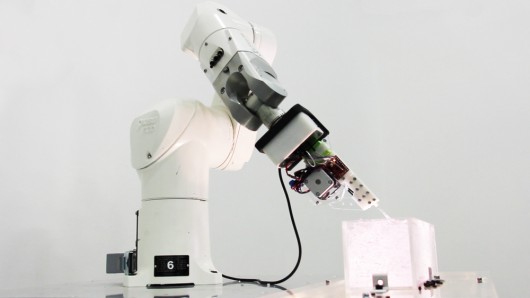
The additive layer process of conventional 3D printers means they are usually limited to bottom up fabrication on three axes. The Mataerial printer managed to defy gravity by using a quick-solidifying print material, but now the LA-based NSTRMNT team led by Brian Harms, a Masters student at the Southern California Institute of Architecture, has created a 3D printing process called suspended disposition that gets around gravity by printing objects within a gel. Not only does this allow freeform additive fabrication on six axes, it also enables an “undo” function.
via Gizmag






