fresh bytes archive
Subscribe Now

Project management for high-performing lazy people

Project management sucks. Yet without it, we fall apart. Dealing with it has historically been an absolute nightmare for me, and my guess is it is for you too.

Prior to launching my latest crowdfunding startup, Fundable.com, I had launched eight Web companies over the past two decades. This gave me tons of opportunities to test project management systems. I’ve tried everything from super complex, expensive systems to the latest lightweight Web apps. Time and time again, they failed me.

When you get into very large teams, typically over a … Read More → "Project management for high-performing lazy people"
Here’s exactly where Mars Curiosity landed—and the NASA engineer who won that bet

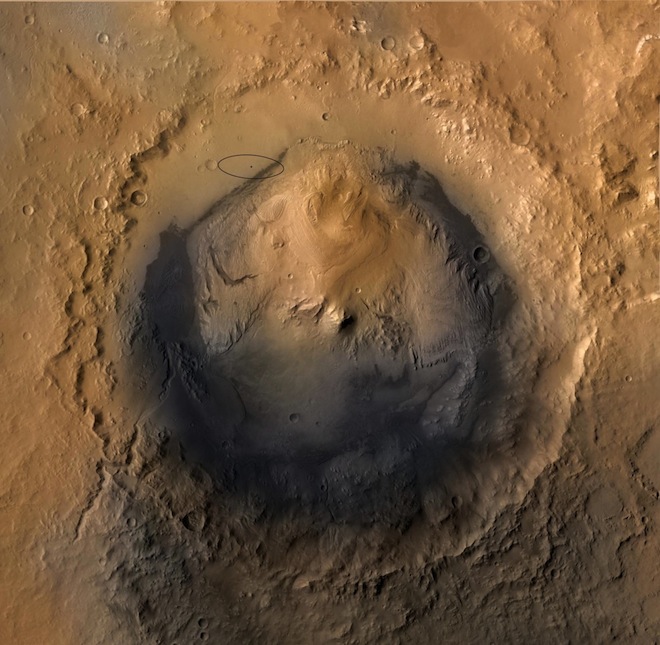
A friend at NASA has sent us this exclusive document that reveals two things for the first time. One, it shows exactly where Curiosity landed yesterday, something that hasn’t been officially disclosed yet. The accuracy of the actual landing site compared to the target is impressive!*

And two, the NASA guys had a pool on where it would land, called Mars Madness 2012:

Because we’re nerds and don’t really know anything about basketball, our office pools look a little different around here.

Olympic physics: how pole vaulters go over the top

When you think about it, the pole vault is quite interesting. There is a bar 4 to 5 meters high that you want to clear. Jumping won’t cut it. Your only option is to run as fast as you can and use a long pole to vault over the bar.

Historically, the pole vault was first used to get over canals and marshes. It was simply a matter of maximizing your horizontal distance. In the mid-1800s, some bright guy thought he’d see how high he might get pole vaulting. The modern pole vault … Read More → "Olympic physics: how pole vaulters go over the top"

Wired Science space photo of the day: Curiosity’s landing site

galecrater.jpg

As of June 2012, the target landing area for NASA’s Mars Science Laboratory mission is the ellipse marked on this image of Gale Crater. The ellipse is about 12 miles long and 4 miles wide (20 kilometers by 7 kilometers).

This view of Gale Crater is derived from a combination of data from three Mars orbiters. The view is looking straight down on the crater from orbit. Gale Crater is 96 miles (154 kilometers) in diameter. Mount Sharp rises about 3.4 … Read More → "Wired Science space photo of the day: Curiosity’s landing site"

Where did the Internet really come from?

Steve Crocker is chairman of the Internet Corporation for Assigned Names and Numbers. In the late 1960s, he was a UCLA graduate student who helped create the ARPANET, a precursor to the Internet.

During the early and mid 1960s – about a half a century ago – computers were physically very big. Only big companies, universities and governments had computers, storing them in special air-conditioned rooms. And they were expensive. On IBM’s flagship mainframe computer, the IBM 7094, the memory unit – what you would now call the RAM – held one megabit, … Read More → "Where did the Internet really come from?"

Mars Reconnaissance Orbiter captures amazing image of Curiosity Rover’s descent

MRO-hires.jpeg

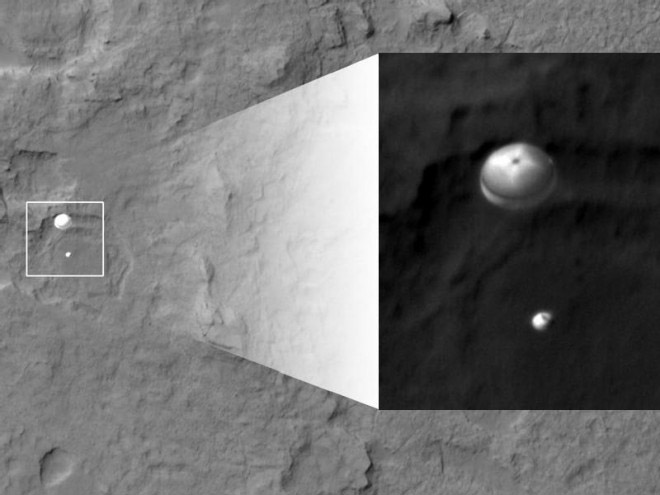
MRO is a satellite flying high above the Martian surface and beaming back amazing data about the planet. Before the descent, engineers were hoping to line up the orbiter in the right spot to capture a few quick shots of Curiosity’s landing sequence and it appears they were able to. The image shows Curiosity’s supersonic parachute — the largest ever used on an interplanetary mission — with the rover tucked beneath … Read More → "Mars Reconnaissance Orbiter captures amazing image of Curiosity Rover’s descent"

‘Hexacopter’ being developed to map the inside of radioactive silos as part of the decommissioning and cleaning process

A small drone is being developed for use at some of the oldest radioactive silos at the Sellafield nuclear reprocessing site because scientists are not sure what is inside them, the Guardian can reveal.

The hope is that an unmanned aerial vehicle (UAV) could use laser profiling to map the inside of the chambers and make work easier for experts who are trying to make them safe as part of a decommissioning and cleaning process.
via the guardian

< … Read More → "‘Hexacopter’ being developed to map the inside of radioactive silos as part of the decommissioning and cleaning process"

How to watch NASA’s Mars Rover land on Sunday

curiostyrover.jpeg

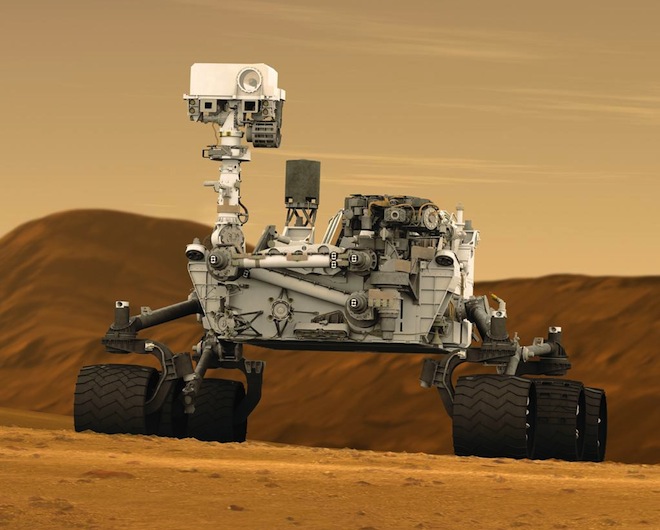
The moment is almost here. In just a couple days, NASA’s new Mars rover, Curiosity, will begin its descent to the Martian surface and hopefully start beaming back amazing images and data.A lot is riding on the 1-ton, $2.5-billion Curiosity, which will drill and poke the Martian soil to study the planet’s geologic history and search for signs of habitability. The flagship rover mission is scheduled to land on Mars … Read More → "How to watch NASA’s Mars Rover land on Sunday"

featured blogs
Feb 18, 2026
Because sometimes the best replacement part'¦ is the one you already have!...