

Imagining the cop car of the future
As the Los Angeles Auto Show gets ready to open its doors next week they’ve given the public an advance look at their annual design challenge. This year’s theme, chosen by the Design Los Angeles Board of Directors, tackles what kind of vehicle we might be seeing in our rear view mirrors in the future — namely the cop car.
The challenge was called Highway Patrol Vehicle 2025. It’s a timely topic as the cars civilians are driving are advancing and self-driving cars are becoming a reality; the police vehicle needs to … Read More → "Imagining the cop car of the future"
Researchers transmit braille directly to the retina of blind test subject
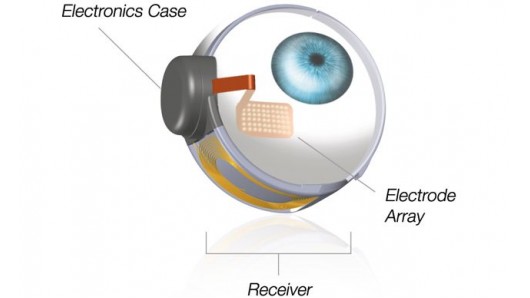
Second Sight’s Argus II Retinal Prosthesis is definitely an interesting piece of technology, allowing a blind user to “see” objects, colors and movement in their environment. Ordinarily, this is done with the help of a video-camera-equipped pair of glasses worn by the user. In a recent experiment, however, researchers bypassed the camera, transmitting visual braille patterns directly to a blind test subject’s retina.
Here’s … Read More → "Researchers transmit braille directly to the retina of blind test subject"
Coming soon: Tabletop molecular movies
One of the most urgently sought-after goals in modern science is the ability to observe the detailed dynamics of chemical reactions as they happen – that is, on the spatial scale of molecules, atoms, and electrons, and on the time scale of picoseconds or even shorter.
That is a formidable challenge. But as a successful 2010 proposal for an ambitious NIST project explains, “it is critical to the development of next-generation nanomaterials ranging from industrial catalysts to renewable energy devices that harvest sunlight, store electricity, and make hydrogen and other fuels from splitting water or recycling … Read More → "Coming soon: Tabletop molecular movies"
Scientists make light travel infinitely fast
A team of scientists is claiming to have achieved the seemingly impossible: it’s managed to create a nanoscale device whichallows light to travel infinitely fast. But how the hell did they do it, and what does it mean?
In empty space, light travels at 300,000,000 meters per second—the maximum speed possible, according to Einstein’s theory of relativity. However, in some materials—say, water or glass—it travels slower. The difference in speeds can be expressed as a ratio, which scientists refer to as the “index of refraction”: basically, a measure of … Read More → "Scientists make light travel infinitely fast"
Nanoscale observations lead to growing understanding of superconductivity
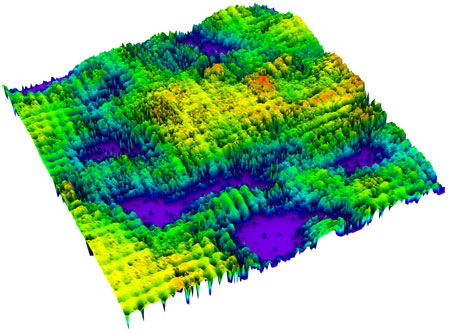
Superconductivity describes the state of certain materials when they conduct electric currents without any resistance. For superconductivity to develop, these materials generally have to be cooled to temperatures below roughly –140 °C, depending on the material. The family of materials that requires the least amount of cooling is known as cuprate superconductors. These compounds are therefore technologically interesting, but scientists are still working to understand the fundamental mechanism underlying superconductivity in these materials. In fact, determining what makes cuprate superconductors … Read More → "Nanoscale observations lead to growing understanding of superconductivity"
Harvard’s Wyss Institute develops ‘lung-on-a-chip’
Researchers at Harvard University’s Wyss Institute for Biologically Inspired Engineering have developed “lung-on-a-chip” technology that mimics the effects of pulmonary edema, a medical condition caused by fluid build up in the lung’s air sacs.
The engineered organ-on-a-microchip technology – along with the presence of cultured living human cells, mirrors the effects of the condition including human oxygen transport, fluid barrier functions, compound production which enables air sacs to open and close and airborne particulate absorption and inflammatory responses to bacteria and toxins, according to Geraldine Hamilton, Ph. … Read More → "Harvard’s Wyss Institute develops ‘lung-on-a-chip’"
Honeywell’s Kitchen Computer: the 1969 behemoth that didn’t sell a single unit
Wired’s Daniela Hernandez has an in-depth history of the Honeywell Kitchen Computer, a minicomputer that could track recipes and offer meal plans, which was listed in the 1969 Neiman-Marcus Christmas catalog, though none ever sold. Not only were the technical challenges associated with installing one of these were formidable, they were also pitched for solving a problem that wasn’t really much of a problem.
via Boing Boing
Contineue reading</ … Read More → "Honeywell’s Kitchen Computer: the 1969 behemoth that didn’t sell a single unit"
Encyclopedia of Electronic Components – a terrific reference for beginners and experienced hobbyists and circuit designers

Three years ago, MAKE published Charles Platt’s book Make: Electronics, which I consider the best book on learning electronics I’ve ever come across. As Gareth Branwyn, the editor of the book said, “we decided to make it our mission to create a book that would patiently guide readers into the world of electronics in a way that was fun, clear-spoken, graphical, and experiential.” (Disclosure: I’m … Read More → "Encyclopedia of Electronic Components – a terrific reference for beginners and experienced hobbyists and circuit designers"
V3Solar’s spinning cone-shaped solar cells generate 20 times more electricity than flat photovoltaics
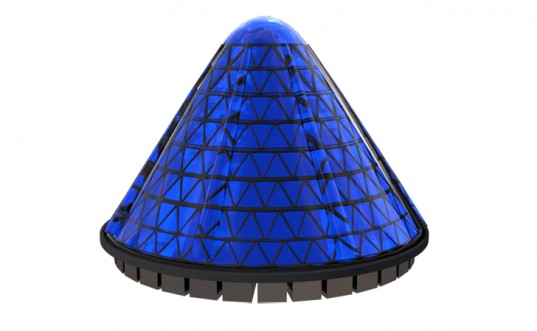
If there’s one constant among the vast majority of solar panel designs, it’s flatness; while solar panels can be equipped to tilt to follow the sun’s path through the course of the day, there are still significant efficiency limitations to this basic design. V3Solar’s rather elegant photovoltaic Spin Cell cones aim to address that, and their … Read More → "V3Solar’s spinning cone-shaped solar cells generate 20 times more electricity than flat photovoltaics"





