

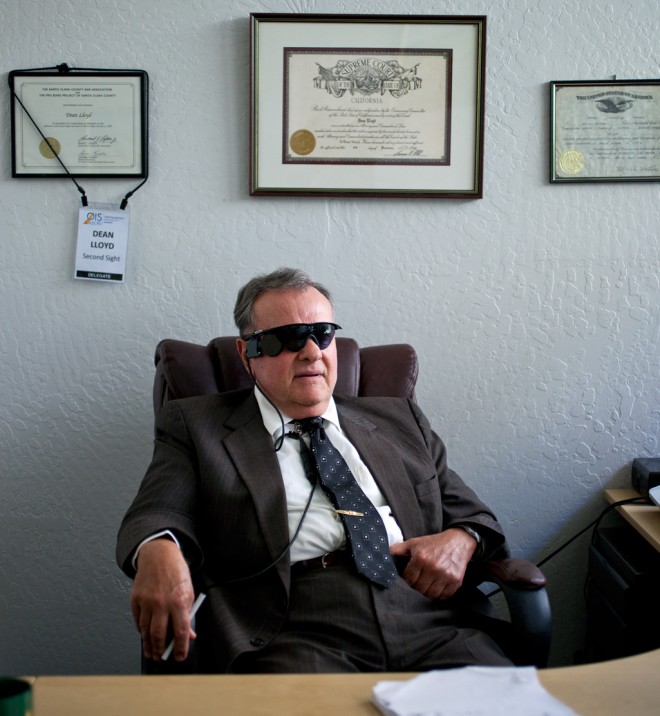
The Argus, named after the all-seeing Greek god with 100 eyes, is a wearable computer that helps blind people see borders and boundaries at very low resolution. We first reported on the device some eight years ago, when it was still in testing. Now, at long last, the Food and Drug Administration has approved its use in the U.S. for people with Lloyd’s condition, and the device will begin selling shortly at select medical centers, including the University of California, San Francisco.
The Argus is not a true “eyes for the blind” device — patients can’t see objects in the same way people with normal eyesight can. Instead, they see black-and-white edges and contrast points, and the brain can be trained to use this artificial data as a visual guide. It provides enough visual information for the patient to gain some independence, allowing them to cross a street safely, or navigate an unfamiliar room.
via Wired
Image: Ariel Zambelich/WIRED






