

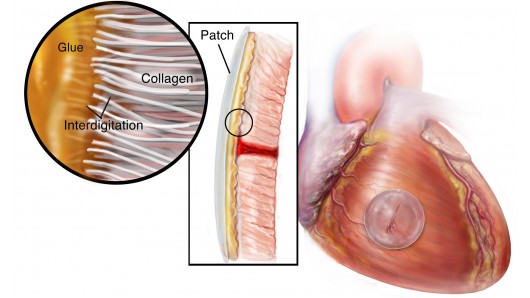
A hole in the heart is never a good thing, so when an infant is born with such a defect, doctors have to act quickly to fix it. Unfortunately, both sutures and staples can damage the heart tissue, plus it takes too long to apply sutures. Existing surgical adhesives have their own drawbacks in that they can be toxic, and they typically become unstuck in wet, dynamic environments such as the heart. As a result, infants often require subsequent operations to “replug” the hole. Now, however, scientists have developed a sort of superglue for the heart, that quickly and securely bonds patches to holes.
Officially known as hydrophobic light-activated adhesive (HLAA), the glue was developed in a collaboration between Boston Children’s Hospital, MIT, and Harvard-affiliated Brigham and Women’s Hospital. It was inspired by the viscous, water-repellant fluids secreted by animals such as slugs.
via Gizmag






