

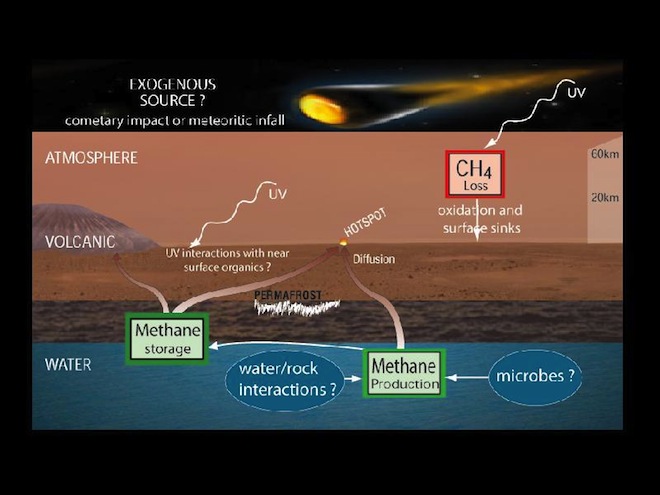
Hypothetical sources and sinks of methane on Mars. The simple organic gas could be produced by microbes or active geological processes. So far, Curiosity has not detected methane in the Martian atmosphere. Image: NASA/JPL-Caltech, SAM/GSFC
NASA’s Curiosity rover has sniffed the Martian atmosphere for methane and, so far, turned up empty. The much-anticipated measurement strikes a blow to the hope that previous hints of methane could have been an indication of life on Mars.
Methane, made of one carbon and four hydrogen atoms, is one of the simplest organic compounds. On Earth, 90 to 95 percent of methane in the atmosphere comes from biological activity, mainly methanogenic bacteria and cow farts. Geological activity such as water-rock interactions could have also produced the methane, which would also have overturned astronomers’ view that Mars is geologically dead in the modern age. Curiosity’s latest measurements seem to refute both ideas.
“So far we have no definitive detection of methane,” said chemist Chris Webster, instrument lead on Curiosity’s Sample Analysis at Mars (SAM) laser spectrometer, during at NASA press conference today. SAM is like the rover’s “nose,” able to test the Martian atmosphere and determine what chemicals are present.
via Wired






