

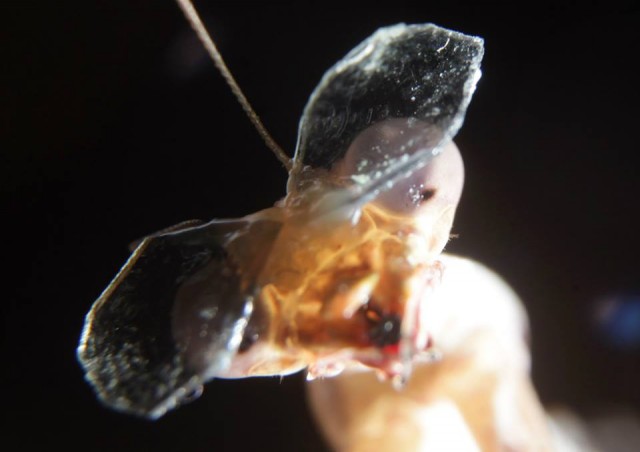
Praying mantises aren’t just unusually large insects; they’re extremely efficient predators that have even been known to catch and eat birds. This requires both a lightning-quick strike and the visual acuity to direct the strike towards the prey. Researchers at Newcastle University, led by Jennifer Read, want to test out the limits of the mantis’ vision. To do that, they’ll try to determine how the animals reconstruct a 3D scene…
[T]hat involves placing a mantis (glued to a stick so it doesn’t move around) in front of a television monitor and filming its strikes. But the lab is now attaching the world’s smallest 3D goggles to a mantis and attempting to manipulate the 3D scene by sending each of its eyes slightly different images. It may turn out that the insect’s brain operates much like a vertebrate’s, using the physical separation of the eyes and the difference in perspective it involves to figure out locations in 3D. If so, it would indicate that the amount of neural horsepower needed to do so is much more limited than we might have thought.
via Ars Technica
Image: Newcastle University






