

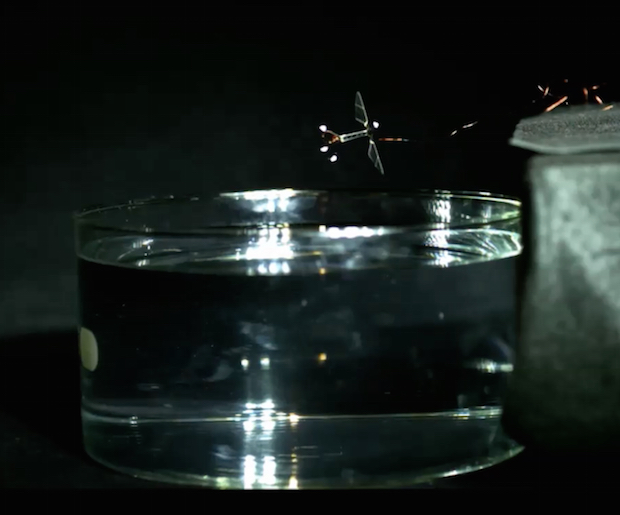
Tiny robotic bugs have lots of potential for search and rescue, surveillance, and exploration, but what’s been all the rage recently is adaptive multi-modal robotics: robots that can creatively handle a combination of terrains, making them much more versatile. With some exceptions, robots are usually pretty bad at this, and with some exceptions, humans and animals are too. There are ground robots that can handle water, and a few flying robots that aren’t totally helpless on the ground, but so far, we haven’t seen much in the way of flying robots that are good swimmers.
Yesterday at IROS, Harvard researchers presented a paper describing how they managed to get their robotic bee to swim, which I’m pretty sure is not a thing that even real bees are known for doing. With no hardware modifications at all, Harvard’s RoboBee can fly through the air, crash land in the water, and turn into a little submarine. You know what that means: nowhere is safe from robot bees.
via IEEE Spectrum
Image: Wyss Institute/Harvard University






