

fresh bytes
Subscribe Now

Giving a robot an origin story makes you more likely to trust it

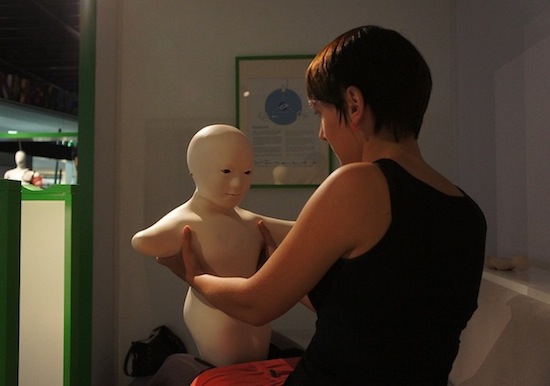
Telenoid.jpg

An study conducted at the Ars Electronica Museum in Austria, though, suggests a surprising way to make humanoid robots seem more friendly — by giving them a backstory. Specifically, a backstory in which they are aliens.

The museum ran an expirment in which it introduced a small Telenoid robot to visitors in one of three ways — without any backstory, with its real backstory — Telenoid is designed to make telepresence communication easier and smoother — or with the following sci-fi narrative:

As a communication robot of the new interstellar time, one of Telenoid’s main tasks is to help people from planet Earth to maintain their human relationships. If two people on Earth would like to talk to each other or sense each other despite living far from each other—maybe even on different continents—then a robot of the Telenoid species is called from Telvikos and sent to the right time and place via Chronoportation.

When they were quizzed on their attitudes toward the Telenoid robot later, visitors who got the sci-fi narrative were a third more likely to want to adopt the robot and bring it home with them. They also rated the Telenoid as more likely to be useful than other visitors.
via Geekosystem


Continue reading 

Leave a Reply

featured blogs
Feb 24, 2026
How a perfectly good Bosch HVAC system was undermined by preventable mistakes, and a thermostat interface that defies logic....

featured video

Cadence Chiplets Solutions | Helping you realize your chiplet ambitions

Sponsored by Cadence Design Systems

In this webinar, David Glasco, VP of Compute Solutions at Cadence, discusses how Cadence enables customers to transition from traditional monolithic SoC architectures to modular, scalable chiplet-based solutions, essential for meeting the growing demands of physical AI applications and high-performance computing.

Read eBook: Helping You Realize Your Chiplet Ambitions

featured chalk talk

BMV080: World’s Smallest Particulate Matter (PM) Sensor
In this episode of Chalk Talk, Liaisan Khismatova from Bosch Sensortec and I explore the benefits of the Bosch BMV080, the world’s smallest particulate matter (PM) sensor. They also investigate the fanless innovation at the heart of the BMV080 Particulate Matter Sensor and how the silent and maintenance-free operation and ultra-compact size of this sensor makes it a game changer for next generation air quality monitoring applications. 
Jan 29, 2026
36,915 views



