

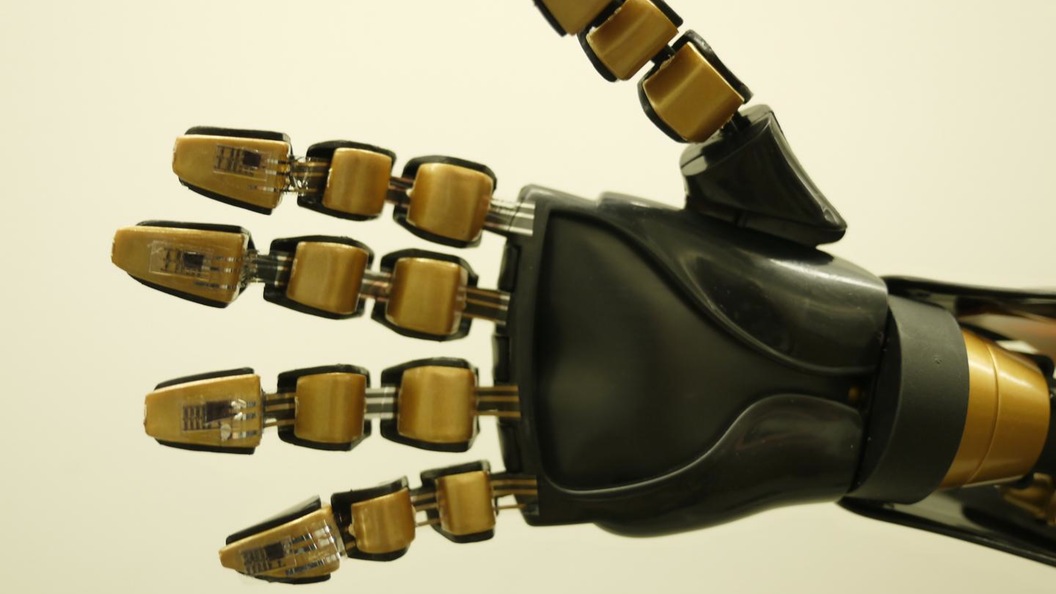
Our sense of touch is made possible thanks to thousands of “mechanoreceptors,” which are distributed throughout our skin. The more pressure that’s applied to one of these sensors, the more electrical pulses it sends to the brain, thus increasing the tactile sensation that we experience. Led by Prof. Zhenan Bao, scientists at Stanford University have now created synthetic skin that containselectronic mechanoreceptors, which could give prosthetic limbs or robots a sense of touch.
The flexible plastic skin is made up of multiple layers – one of those serves as a pressure sensor, while another houses an ink jet-printed organic electrical circuit. Embedded on the sensory layer is an array of tiny rubber pyramids, each one filled with electrically-conductive carbon nanotubes. When pressure is applied to the skin, those pyramids compress, causing the nanotubes within them to move closer together.
via Gizmag
Image: Bao Research Group, Stanford University






