

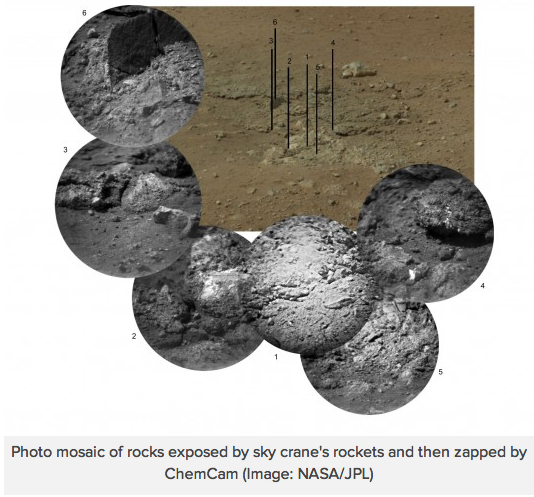
NASA’s Mars rover Curiosity has already fired its laser over 500 times as it studies its surroundings as engineers at the Jet Propulsion Laboratory (JPL) calibrate its sensors. In a classic example of “waste not, want not” Curiosity concentrated its activity on a patch of rocks that were uncovered by the rocket backwash of the sky crane that delivered the unmanned explorer to the Martian surface on August 6.
The outcrop of rocks, designated “Goulburn,” is about 16 to 20 feet (5 to 6 m) from where Curiosity landed and is of particular interest to scientists because the sky crane’s rocket blast cleared the patch of dust, allowing the laser a clean shot at the rocks. The results have been welcomed by the mission control at JPL.
“The spectrum we have received back from Curiosity is as good as anything we looked at on Earth,” said Los Alamos National Laboratory planetary scientist Roger Wiens, Principal Investigator of the ChemCam Team.
via Gizmag






