

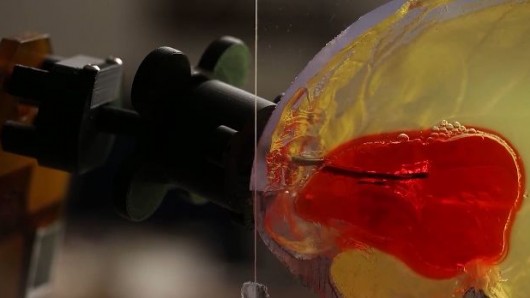
Designed by a team of physicians and engineers led by Professors Robert J. Webster III and Kyle Weaver, the business end of the device consists of a tube-within-a tube. The straight outer tube is less than one-twentieth of an inch in diameter, and is inserted through a similarly-small hole made in the skull, adjacent to the clot.
Using a CT scan for reference, the cannula’s robotic control unit carefully pushes that very thin tube into the brain, until its tip has entered the clot. At that point, the curved tip of the needle-like inner tube emerges from within the outer one – the other end of the inner tube is attached to an external suction pump. By selectively extending, withdrawing and rotating the inner tube, the control unit is then able to suck the clot out from the inside.
In lab tests, the system was able to remove up to 92 percent of a simulated blood clot.
via Gizmag






