

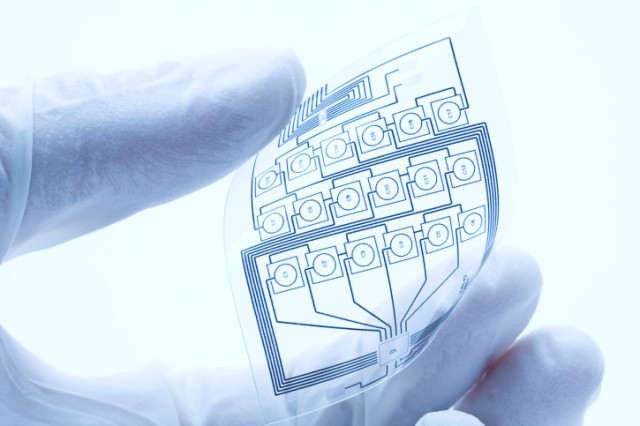
Who doesn’t want thin and lightweight electronic devices? From flexible computer displays to printable solar cells to medical equipment, the possibilities are myriad. However, testing the durability of nanoscale electronics under strain—twisting, bending, folding, etc.—provides a challenge. The substrate (the layer upon which electronic components are assembled) as well as the electronics must endure stresses, meaning the entire device needs to perform adequately under the same adverse conditions.
Sungjun Park et al. constructed single-molecule thick electronic components on a flexible substrate. By testing the charge-transport properties under a variety of stresses and repetitive bending, they determined that their devices maintain stability, even after more than 1000 bending and straightening cycles. While the simple electronics they tested are not equivalent to complex modern devices, they demonstrate in principle that flexible electronics are workable.
via ars technica






