

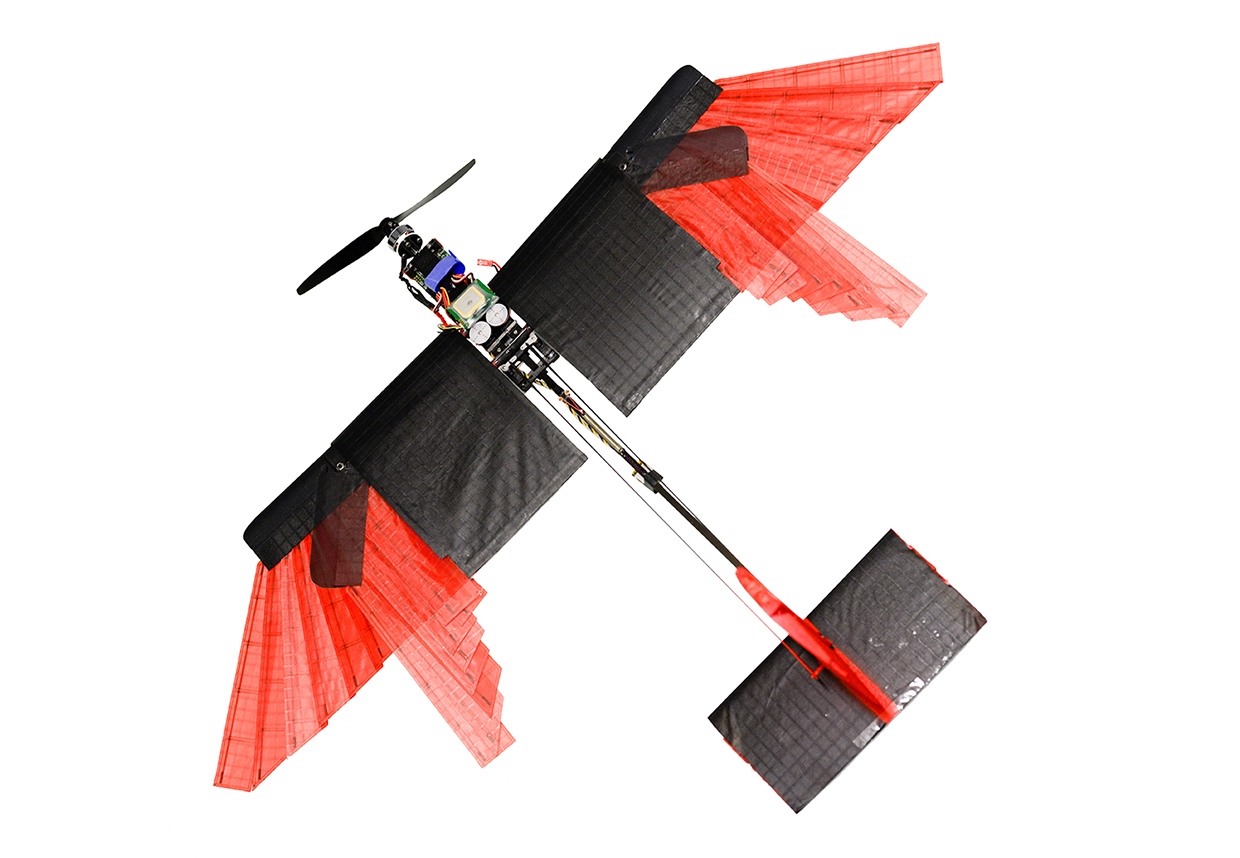
Humans have been a bit slow at catching up with birds on this—the best we’ve been able to do are some mechanically complicated and presumably very expensive wings that ponderously swing back and forth a little bit, but isn’t it about time we catch up to this technology that’s over a hundred million years old? At the École Polytechnique Fédérale de Lausanne (EPFL), in Switzerland, Dario Floreano’s lab certainly thinks so, and they’ve been flight testing a small drone with feathered, folding wings that can maneuver like real birds do.
These folding wings can vary their surface area by 41 percent: When the wing is completely retracted, lift decreases by 32 percent, and drag decreases by 40 percent, boosting the top speed of the drone from 6.3 meters per second to 7.6 meters per second. However, the loss of wing area makes the drone less maneuverable, increasing its turning radius from 3.9 meters to 6.6 meters. This is the trade-off inherent to all wings, and it’s why morphing wings are so important: You can choose to trade maneuverability for speed whenever you want, and it’s much more common to need one significantly more than the other than to need both at the same time.
via IEEE Spectrum






