

fresh bytes
Subscribe Now

A robotic tattoo artist

tattoo1.jpg

Here’s something we thought we’d never see: a robot that turns a computer drawing into a tattoo on the user’s arm.

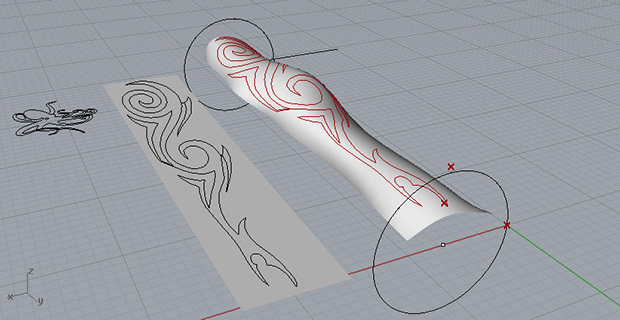
The basic design of the robot is a frame that moves linearly along two axes, and rotates around a third. The tattoo design is imported into a 3D modeling program, and with the help of a few motors and microcontrollers a tattoo can be robotically inked on an arm.

Since the arm isn’t a regular surface, [Luke] needed a way to calibrate his forearm-drawing robot to the weird curves and bends of his ar.  The solution to this problem is a simple calibration process where the mechanism scans along the length of [Luke]‘s arm, while the ‘depth’ servo is manually adjusted. This data is imported into Rhino 3D and the robot takes the curve of the arm into account when inking the new tat.
via Hack a Day


Continue reading 

Leave a Reply

featured blogs
Feb 24, 2026
How a perfectly good Bosch HVAC system was undermined by preventable mistakes, and a thermostat interface that defies logic....

featured video

Cadence Chiplets Solutions | Helping you realize your chiplet ambitions

Sponsored by Cadence Design Systems

In this webinar, David Glasco, VP of Compute Solutions at Cadence, discusses how Cadence enables customers to transition from traditional monolithic SoC architectures to modular, scalable chiplet-based solutions, essential for meeting the growing demands of physical AI applications and high-performance computing.

Read eBook: Helping You Realize Your Chiplet Ambitions

featured chalk talk

BMV080: World’s Smallest Particulate Matter (PM) Sensor
In this episode of Chalk Talk, Liaisan Khismatova from Bosch Sensortec and I explore the benefits of the Bosch BMV080, the world’s smallest particulate matter (PM) sensor. They also investigate the fanless innovation at the heart of the BMV080 Particulate Matter Sensor and how the silent and maintenance-free operation and ultra-compact size of this sensor makes it a game changer for next generation air quality monitoring applications. 
Jan 29, 2026
35,996 views



