



Way back in the mists of time, in those halcyon days we used to call 2010, I was fortunate enough to be invited to speak at the Embedded Systems Conference (ESC) in Bangalore (now Bengaluru), India. Formally founded as a fort in 1537, Bengaluru offers an eclectic mix of stone watchtowers and ancient temples, spectacular colonial-era architecture, and gleaming technology parks and skyscrapers.
Something else I just remembered about my brush with Bengaluru was the sensory overload associated with the tumultuous traffic. Two-lane-each-way roads routinely hosted six or more de facto lanes of vehicles jostling for position. Cars, scooters, and auto-rickshaws weaved their way through intersections where traffic lights were treated as more of a polite suggestion than the law. Painted trucks in vivid colors blazed past like rolling art galleries, and every horn seemed to be part of a running commentary (“I’m here,” “I’m passing,” “You’re drifting”) rather than a complaint. Suffice it to say that the sheer bedlam of Bengaluru’s traffic makes French drivers in Paris and Italian drivers in Rome look like models of restraint and order.
I had an awesome time. The people were great, and the food was incredible. I hope to go back one day. As I write this, I just realized that my trip took place 15 years ago. On the one hand, this really doesn’t seem long at all. On the other hand, it’s a lifetime away in terms of technology. In 2010, for instance, the term “artificial intelligence” (AI) was largely unknown and unused outside of academic and research institutions. Today, by comparison, it’s a topic that’s on everybody’s lips, including those of my dear 95-year-old mother, for goodness’ sake.
The reason for my meandering musings is that I was just chatting with Gajendra Prasad “GP” Singh, who is the Founder and CEO of Ambient Scientific, which is co-headquartered in Bengaluru and Silicon Valley.
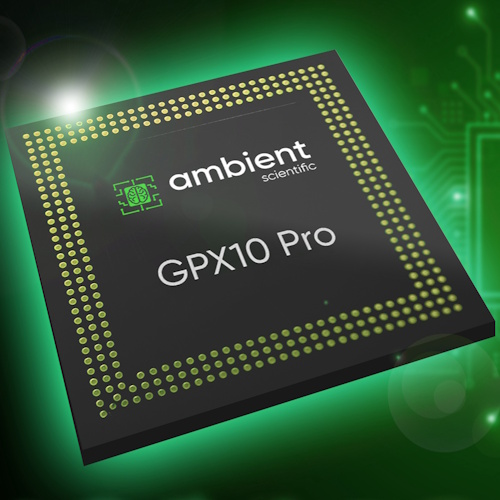
GP kindly brought me up to date with Ambient’s newly announced GPX10 Pro processor, which blurs the line between traditional microcontrollers and dedicated AI accelerators.
As GP noted, traditional microcontrollers are well-suited for their primary functions: running control loops, communicating with sensors, and toggling GPIOs, but they were never designed to crunch neural networks. Today’s AI workloads are dominated by matrix multiplications, and that’s where conventional digital architectures come unstuck. In a typical 32-bit MCU, less than 10 percent of the silicon area is dedicated to mathematics, and only a fraction of that to the multiply-accumulate (MAC) operations that are the lifeblood of deep learning.
Enter Ambient’s DigAn (Digital-Analog) architecture. Rather than force AI through a digital bottleneck, Ambient embeds analog MAC units directly inside SRAM. The result is a hybrid “in-memory computing” engine that performs entire matrix multiplications in a single cycle. That’s not a figure of speech—each MX8 core can perform 256 MACs per cycle, dynamically reconfigurable at 4-, 8-, 16-, or 32-bit precision.
GP explains this elegantly: “Digital computing is good for everything except multiplication. Analog computing is bad for everything except multiplication. We combined the two and kept the best parts of both.”
The GPX10 Pro integrates ten MX8 cores, organized as two clusters of five. One cluster forms the always-on domain—essentially a subconscious brain idling at under 100 microwatts—while the other cluster wakes up only when needed to perform the “heavy lifting.”
Analog computing has been around longer than digital, but it fell out of favor for one very good reason: unreliability. Temperature, voltage drift, and noise are the enemies of precision. Rather than the Flash transistors used by some of the other experimental AI chips, Ambient’s “secret sauce” (Ooh, yummy) is to use standard foundry SRAM bit cells as the analog compute medium. Flash cells are notorious for variability (neighboring transistors can differ in resistance by as much as 300 percent!). SRAM, by contrast, varies by only about one percent, which means consistent, repeatable math.
The result is a hybrid architecture that delivers 80 percent of the power savings of analog while retaining 100 percent of the digital accuracy engineers expect. And here’s the kicker: this technology is fabricated entirely in standard 40nm CMOS using an unmodified TSMC process. No exotic materials, no custom masks, and no yield headaches. All of which makes it cheap to build and easy to scale.
I bet you’re thinking, “This sure sounds good, but what’s the performance?” Well, buckle up, because the GPX10 Pro delivers 512 GOPS (0.5 TOPS) of peak AI performance while sipping just 80 microwatts of active power. That works out to 7.3 TOPS per watt—in a 40nm process, mind you! Competing edge NPUs often boast about hitting just 1 TOPS/W at far finer geometries. And even the best 32-bit MCUs can only aspire to such efficiency.
In practical terms, this means you can run real, full-blown CNNs, RNNs, LSTMs, and GRUs directly on the device—no cloud connection, no fan, no fuss. This isn’t a rule-based toy or a glorified DSP; it’s a genuine AI processor small enough to fit in a 3.2 mm × 3.2 mm chip-scale package (CSP) while drawing less power than a blinking LED.
One of the cleverest aspects of this device is that the guys and gals at Ambient didn’t focus solely on the compute core; instead, they built an entire energy-aware ecosystem around it. For example, the GPX10 Pro features an 8-channel, 16-bit ADC, a separate high-precision audio ADC, and hardware-level sensor fusion (SenseMesh), which is capable of blending inputs from up to 20 sensors.
To support all this, there’s a low-power oscillator consuming about 20 microwatts, custom-built because conventional PLLs were too power-hungry. Even the analog front end was re-imagined: when the team realized that microphones’ internal ADCs were burning milliwatts, they designed their own mixed Sigma-Delta/SAR converter that digitizes audio at 20µW.
Every stage of the signal chain—sensing, conversion, fusion, inference, and system wake-up—has been re-engineered to consume as little power as possible. In effect, the GPX10 Pro doesn’t just think about data; it thinks about when to think.
Like any modern SoC, the GPX10 Pro separates the control plane and data plane. The control plane is handled by an ARM M4F processor that runs the RTOS, manages peripherals, and executes post-inference logic (“turn on this LED,” “send that alert,” and so on). The data plane—where all the AI heavy lifting occurs—runs in the MX8 clusters using Ambient’s CubicCore compute fabric.
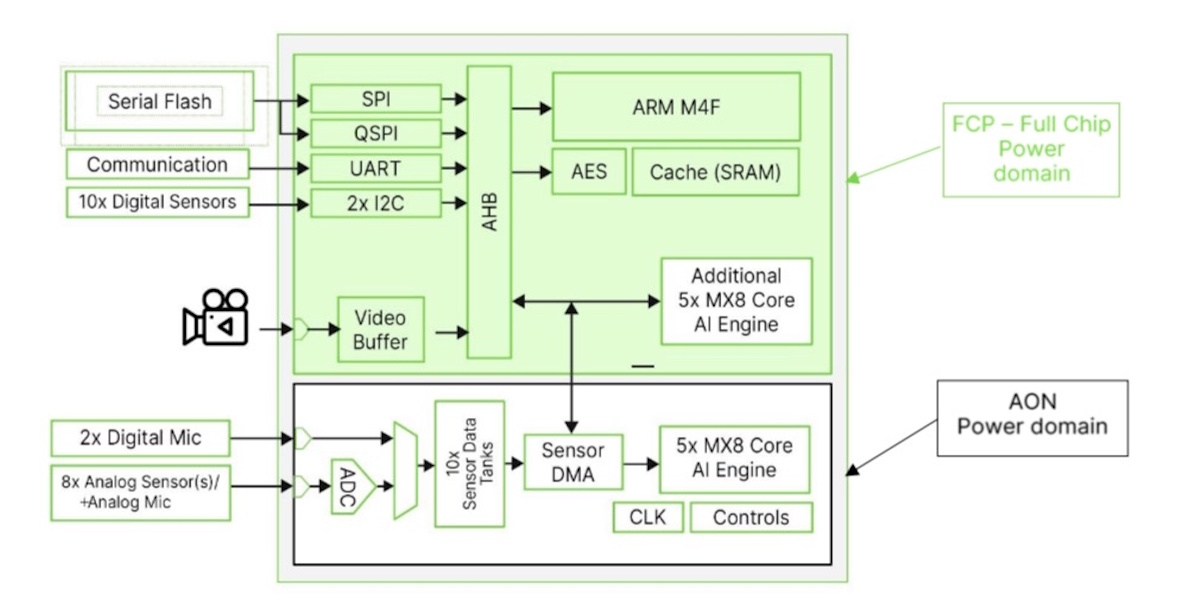
GPX10 Pro block diagram (Source: Ambient Scientific)
By dividing the architecture into two power domains—“Always On” and “Extended/Full Chip”—Ambient can turn off entire sections of silicon when idle, which is how the chip manages to maintain its astonishingly low “subconscious” power state.
The allegorical dollop of whipped cream on top of the metaphorical cake is Ambient’s Nebula Toolchain. Rather than inventing a proprietary programming model, they embraced existing AI frameworks. You can design your network in TensorFlow, PyTorch, Keras, or ONNX, and then feed it directly into Nebula. The compiler handles partitioning, quantization, and code generation, automatically producing binaries for both the ARM and MX8 cores.
Developers can even adjust power and latency trade-offs by selecting the number of cores to activate or by dynamically scaling voltage and frequency. It’s essentially CUDA for Edge AI, but tuned for microwatts instead of megawatts.
So, what can you actually do with this little marvel? The short answer: almost anything that needs a brain but can’t afford a battery drain (I’m a poet, but I never “knew-it”).
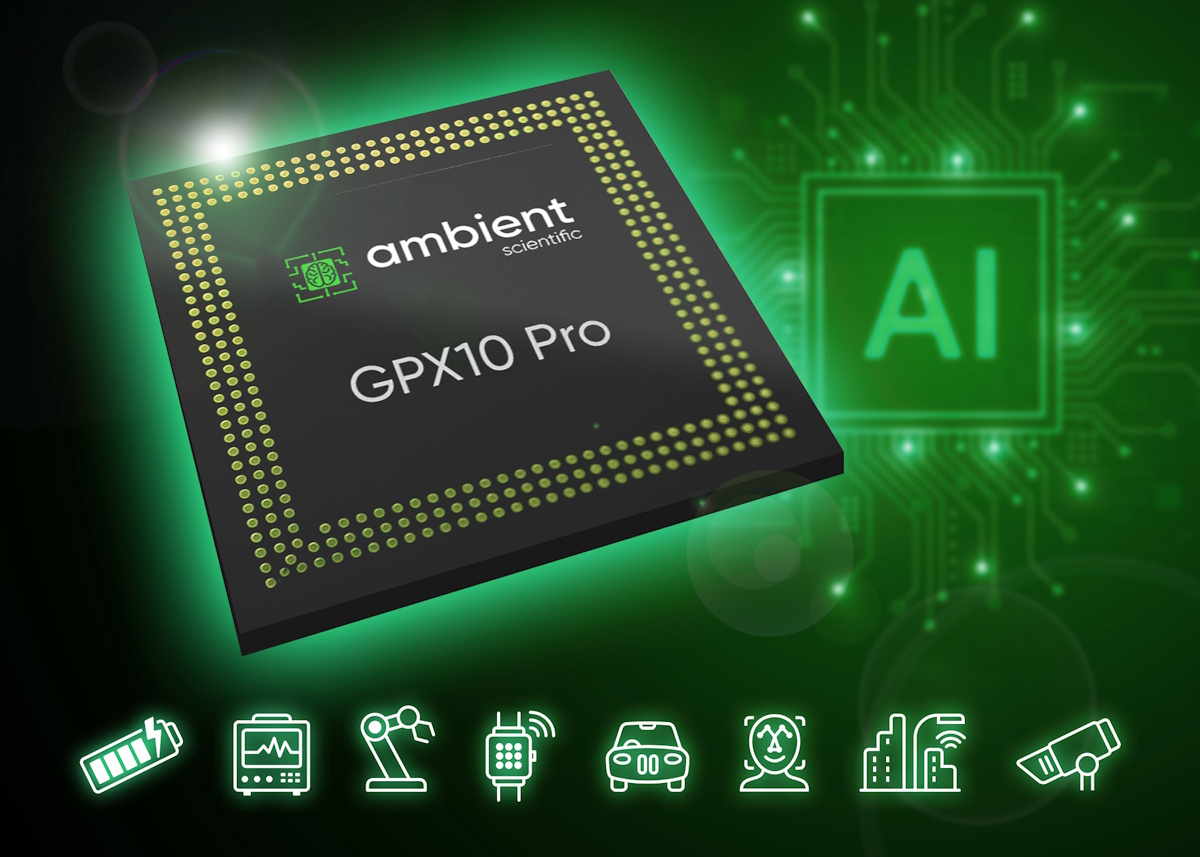
The GPX10 Pro, along with some suggested app arenas (Source: Ambient Scientific)
Examples include wearables that monitor falls, heart rhythms, or other activities continuously for months on a coin cell; smart cameras that recognize faces or detect motion locally, without sending video to the cloud; acoustic monitors that wake only when a specific sound pattern occurs; and industrial sensors that spot anomalies in vibration or temperature long before a failure happens.
The GPX10 Pro isn’t a one-off. It’s the middle child in a growing family. Next up is the GPX64, a 64-core device implemented on 12nm technology that adds floating-point support and external DRAM. Beyond that lies the GPX2000, a 4nm, 2000-core monster already in design for customers who need laptop- and drone-class performance at a fraction of the power.
The really clever bit isn’t just the chip; it’s the shift in mindset. Ambient Scientific isn’t chasing headline TOPS numbers or beating GPUs at their own game. They’re redefining what AI at the edge means. Instead of forcing data to the cloud, the GPX10 Pro brings cognition to the data.
Think of it as moving from “connected devices” to “thinking devices.” Your smart watch doesn’t just sense your pulse—it interprets it. Your industrial node doesn’t just detect vibration—it predicts failure. And all of this happens without a network connection, without a data center, and without eye-watering energy consumption.
Back in the early ’80s, when I was coaxing 1 MHz microprocessors to blink LEDs, the idea that we’d one day run neural networks on something smaller than a fingernail would have seemed preposterous—not least because I wouldn’t have known a neural network if it had crawled up my leg and bitten me in a very unfortunate place. Yet here we are: AI literally in the palm of your hand (or on the tip of your finger). If this is the future of edge computing, it’s looking very bright indeed—or should I say, brilliantly energy-aware?







As fate would have it, I just heard the news that DigiKey today announced the official launch of its Indian subsidiary in Bengaluru.