



I don’t know about you, but it seems to me that breathless commentators, marketing messengers, press release pundits, headline and hype merchants, and technology evangelists are constantly bombarding us with claims and commentaries telling us how lucky we are to be surrounded by technologies that would have been beyond our wildest dreams just a few short years ago.
If we aren’t careful, we might be beguiled into thinking that we are living in a golden age of technology. But is this really the case, or are we collectively trying to convince ourselves of just how advanced we really are and our supposed place at the pinnacle of progress?
Take human machine interfaces (HMIs), for example. When you stop to think about it, the way most of us interact with machines hasn’t changed all that much in decades. We still spend an inordinate amount of time toggling switches, pressing buttons, and turning knobs.
Even on our desktops, laptops, and notepads, where software sophistication has skyrocketed, the dominant input methods remain the humble keyboard and the mighty mouse. While it’s true that smartphones and tablet computers provide us with tasty touchscreens, these are essentially just more modern variations on the same theme—we’re still left poking at a surface to make something happen.
Happily, things are starting to change. The machines surrounding us are becoming increasingly capable, which is advantageous because the environments in which they operate are becoming more varied and demanding, ranging from factory floors and hospital wards to cars, offices, homes, and wearable devices.
The promise of artificial intelligence (AI) and machine learning (ML) is for HMIs that feel natural, respond instantly, and adapt to context. A smarter HMI won’t simply wait for a button to be pressed—it will interpret intent, learn patterns, and deliver feedback in ways that reduce friction and boost productivity. Achieving this requires processing closer to where the interaction occurs—at the edge—with hardware and software that are agile, efficient, and intelligent.
If we pause for a moment, I’m sure you can think of all sorts of areas where HMIs could be improved. In my case, I started close to home. I can easily imagine walking into the family room and simply clicking my fingers in the general direction of the TV to turn it on. How about a cooking stove that refuses to activate if it realizes the person fiddling with the controls is too young? Or a coffee machine that won’t brew unless there’s a mug in place to catch the liquid gold (I can’t imagine a world without coffee).
How about lights that dim automatically if you’ve nodded off on the sofa, or HVAC systems that quietly adapt based on your presence and body temperature? These are exactly the kinds of context-aware interactions that smarter HMIs can bring into everyday life.
The reason for my waffling here is that I was just chatting with Ricardo Shiroma, who is Director of Business Development at Lattice Semiconductor. As part of our conversation, Ricardo opened my eyes to all sorts of possibilities, including the following:
Safer Cars and Smarter Mobility: Some automobiles already feature Driver Monitoring Systems (DMS) to check whether the driver is awake and attentive to the road. But things are advancing quickly toward more sophisticated Occupant Monitoring Systems (OMS). These systems utilize cameras, sensors, and AI to monitor everyone in the cabin, checking for seatbelt use, spotting medical emergencies, and even alerting you to items left behind. Pair this with gaze tracking and infotainment screens that can dim the moment a driver looks away. Gesture recognition lets passengers adjust music or climate with a wave of the hand. Audio AI ensures voice commands are understood even in noisy traffic. Together, DMS and OMS deliver comprehensive in-cabin safety solutions that make vehicles not just smarter, but genuinely safer.
Industry on the Edge: Now, picture the factory floor. Machines could refuse to start unless they recognize the operator’s face, guaranteeing only authorized staff can use them. They could check for personal protective equipment (PPE), such as safety glasses, gloves, and hard hats, before allowing work to proceed. If the wrong component is loaded, the system won’t run. Context-aware HMIs could pause a process if the operator’s attention drifts, and they could shut down immediately if someone else wanders into the danger zone. They could even detect if an operator suffers a medical emergency and trigger an alarm. Considering that 70% of manufacturing downtime is attributed to human error, these capabilities provide a powerful path to enhanced safety and efficiency. For example, this video shows an example of a a cutting-edge industrial HMI that features advanced operator attention sensing and identification.
Office Intelligence: Even our office computers stand to benefit. Imagine systems that respond only to designated users—no more shared logins or shoulder surfing. If you look away, the display automatically dims to conserve power. If you stand up and leave, the PC locks itself. If someone peers over your shoulder, the screen blurs. This isn’t science fiction. It’s here and now! For example, many Tier 1 PC vendors already integrate Lattice FPGAs that work in conjunction with the machines’ existing cameras, running AI models that detect presence, track gaze, and interpret user intent. These systems can dim the display, lock the PC, wake it, or obscure sensitive information—all in real time and at ultra-low power.
All this brings us to the enabling technology. At the heart of these scenarios is the Lattice sensAI Edge Vision Engine—a complete software development kit (SDK) with pre-trained AI models for vision and audio. It supports everything from gesture and gaze tracking to face ID and voice commands. Because these models run on Lattice’s low-power FPGAs, they can deliver always-on context awareness at less than 500mW—a tenfold improvement over GPU-based alternatives.
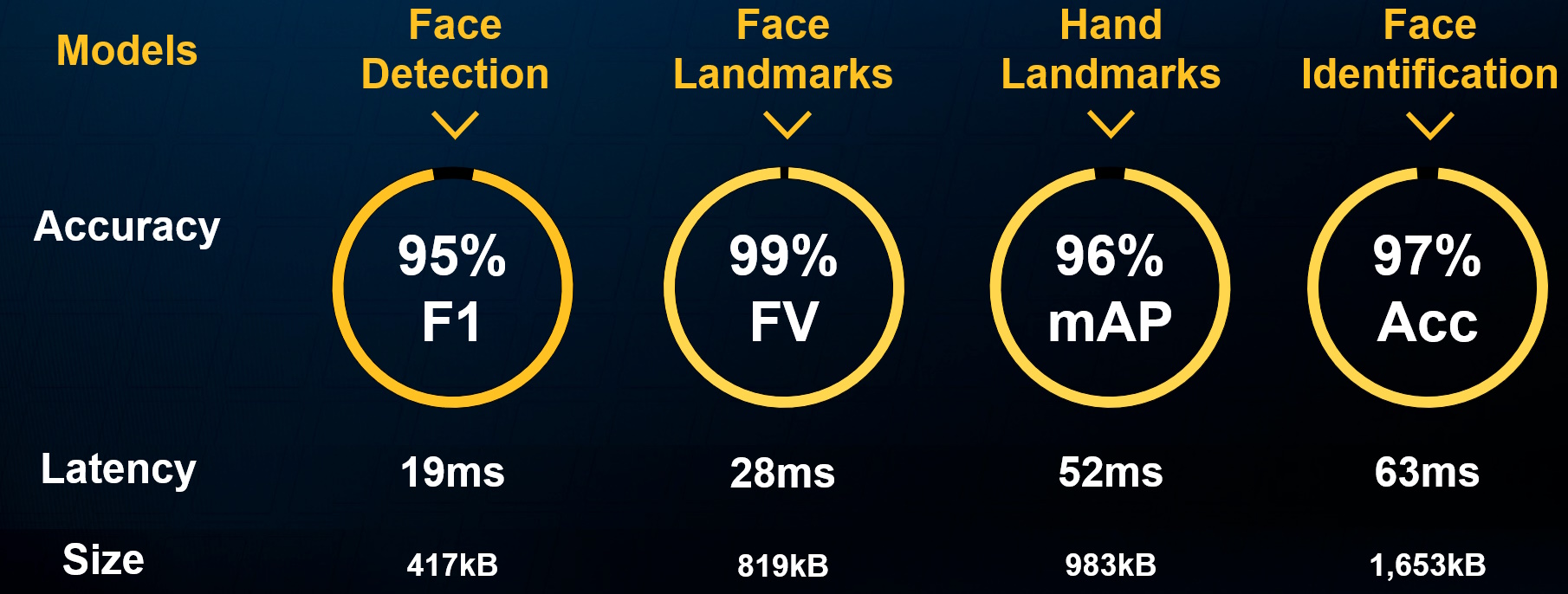
Compact models with state-of-the-art performance (Source: Lattice)
To put this into perspective, it’s been reported that Tesla’s “Sentry Mode” can drain up to 14% of a car’s battery in 24 hours. By contrast, Lattice has demonstrated systems that run four cameras continuously on a low-power FPGA, consuming less than 25mW per camera. That’s the difference between a feature you occasionally enable and one that you can leave on all the time without a second thought.
And best of all, these models are hardware-agnostic. They’re optimized for Lattice FPGAs but also run on x86 and ARM CPUs, GPUs, and NPUs, providing developers with maximum flexibility to deploy more innovative, safer, and more sustainable HMIs wherever needed.
Since time immemorial (well, certainly before I can “memorial”), we’ve been toggling switches, pressing buttons, turning knobs, and pecking away at keyboards. But the future of human–machine interaction won’t be defined by knobs and clicks. “No!” I cry, “A thousand times no!” Instead, it will be shaped by context awareness, adaptability, and intelligence at the edge.
With their ultra-low-power FPGAs, pre-trained AI models, and developer-friendly tools, the guys and gals at Lattice are helping to make that future a reality. The result is smarter HMIs that don’t just wait for us to act, but anticipate our needs, keep us safe, and conserve energy—quietly transforming the way we interact with the machines all around us. Speaking for myself, I feel that a “Tra-la!” is in order. What say you?






