



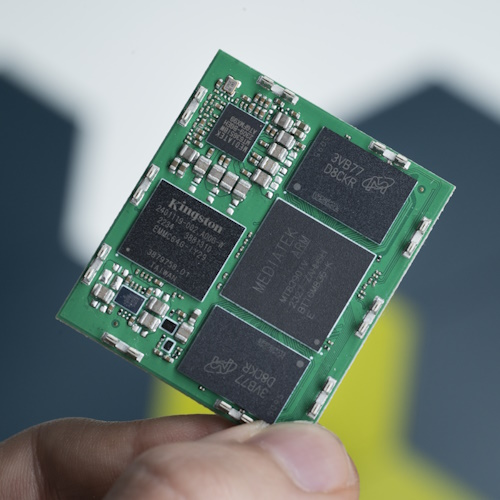
The purpose of this column is to waffle (as is my wont) about some super System-on-Module (SOM) units that recently leaped onto the center of the stage with a fanfare of flügelhorns (once heard, never forgotten), but first…
As usual, my poor old noggin is raucously reverberating with new nuggets of knowledge and tempting tidbits of trivia. I know from experience that the only way for me to quieten down inside my head so I can think about the things I should be thinking about is to share my newfound news with someone else. By the luck of the draw, that someone else is you—congratulations!
Let’s start with the fact that someone whom we will call Michael (because that’s his name) just sent me a link to a Saturday Morning Breakfast Cereal (SMBC) comic strip about measurement that gave me food for thought. In turn, this reminded me of one of my own Cool Bean Blogs from yesteryear, How to Measure Things Like a Canadian, which brought a wry smile to the faces of my cousins who hail from Canada.
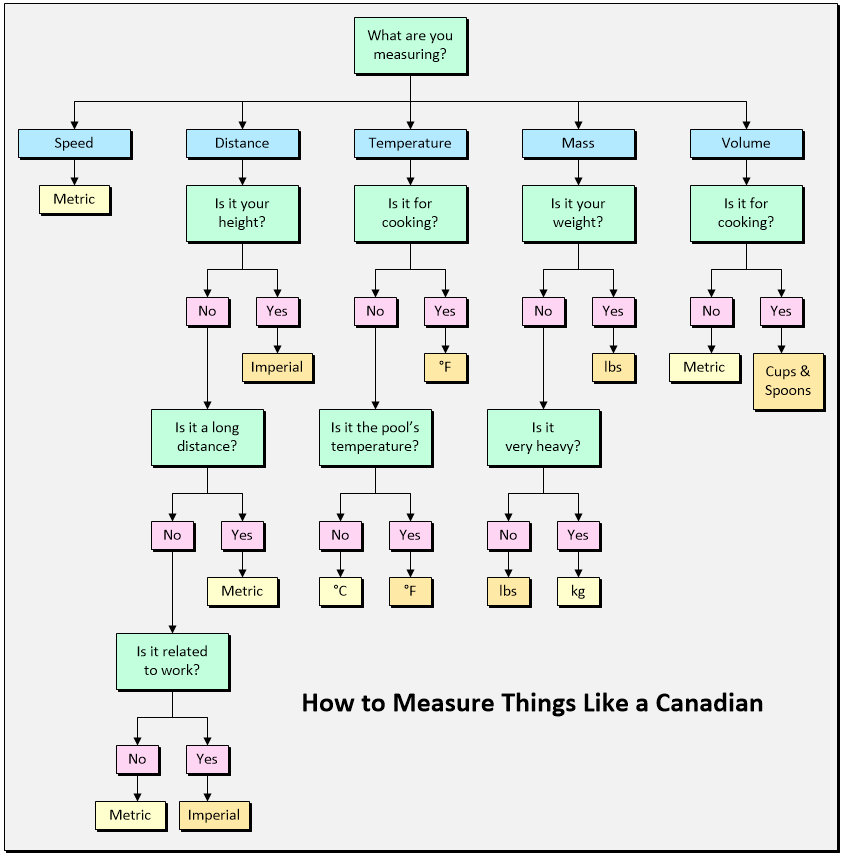
How to measure things like a Canadian (Source: Internet meme)
Leaping from topic to topic with the agility of a young mountain goat, the Milky Way is a barred spiral galaxy. This means that instead of its spiral arms emerging directly from the hub, they spring from the ends of a central bar-shaped structure composed of stars. It’s one of the most common galaxy types in the universe. Well, I just read an article on Futurism.com that says: “…our home galaxy also has a colossal wave rippling through it, pulling and pushing an ocean of stars and cosmic dust in its wake.”

Visualization based on data from the European Space Agency’s Gaia mission and the corresponding Astronomy & Astrophysics study by Eloisa Poggio and collaborators (Source: ESA/Gaia/DPAC, S. Payne-Wardenaar, E. Poggio et al. (2025))
I don’t know about you, but one of my (many) problems is that every random thought triggers a cascade of evermore random remembrances. For example, just thinking of the word “wave” reminded me of the American peace activist Wavy Gravy. Due to his frequent arrests at demonstrations in the 1960s, Wavy decided that dressing as a clown would make him less likely to be arrested. In turn, this led to him becoming the official clown of the American rock band the Grateful Dead (I couldn’t make this stuff up if I tried).
What? Do I hear you cry, “One more!” Well, if you insist. In an earlier Cool Beans Blog (Is Time Truly an Illusion?), I mentioned how time may be an illusion and how we may be swimming in a sea of quantum foam. Further to this, I recently read an interesting article on Space.com suggesting that information may be an integral part of the universe’s underlying fabric. Apart from anything else, this may explain both dark energy and dark matter.
A couple of months ago, I penned a column here on EEJournal about a New FPGA Conference and Exhibition. Known as FPGA Horizons, the inaugural annual UK event took place last week, while the inaugural USA counterpart is scheduled to occur in April 2026.
Conferences are a bit like airplanes in that their organizers know that not everyone who books will actually show up on the day. To accommodate this, conference organizers and airlines tend to overbook in the hope that they will end up meeting (but not exceeding) capacity.
Prior to the UK event, I had a chat with the founder/organizer/driving force behind FPGA Horizons, the inimitable Adam Taylor (see also Adam’s story about how he became an engineer in the first place). As you can imagine, Adam managed to be simultaneously worried that (a) not enough people would turn up to justify the effort and (b) too many people would turn up with respect to the amount of space available.
Happily, it turns out that they got things just right. Over 80% of the ticket holders turned up, which left the conference just a hair under capacity. This is an incredibly strong showing for a first-time technical conference, especially in a niche domain. The buzz I’m hearing on the street is that there was a great mix of vendors and technical content, the rooms were packed, and—based on their social media feeds—everyone (attendees, presenters, and vendors) has been very enthusiastic about the outcome.
But wait, there’s more, because a new publication called FPGA Horizons Journal was announced in conjunction with the conference. According to Adam, this publication will be released quarterly, primarily as an online resource, augmented with print copies at the conferences (each attendee at the UK event was presented with a copy in their “swag bag”).
I just read the first issue of the publication, which is hosted on the Issuu platform. It’s jam-packed with great articles, including “But it worked in simulation,” by Matt Hilbert, “Better and faster FPGA verification with UVVM,” by Espen Tallaksen, and “Embedded processing in FPGAs,” by Adam himself.
Well, I don’t know about you, but I feel a lot better now that I’ve got all that off my chest (or, rather, out of—what I laughingly call—my mind). Now we can return to the point at hand, which is that I was just chatting with Robert Otręba, who is the CEO at Grinn.
Grinn is an electronics design company that is based in Poland. Apropos of nothing at all, one of my uncles is Polish. In the context of what we’re about to talk about, it’s worth noting that Poland has long punched above its weight in science, mathematics, and engineering. From the groundbreaking logic of Jan Łukasiewicz, who pioneered multi-valued logic and Polish notation (which is still used in programming and calculators today, along with its reverse, Reverse Polish Notation), to the wartime cryptanalysts Marian Rejewski, Jerzy Różycki, and Henryk Zygalski, whose mathematical brilliance cracked the German Enigma cipher before Bletchley Park even entered the game, Polish minds have shaped the very foundations of computing and information theory.
That spirit of analytical ingenuity continues to this day. Poland’s universities produce some of Europe’s top software engineers and embedded designers, and its technology companies have earned a global reputation for combining mathematical rigor with practical craftsmanship. Firms like Grinn, which fuse deep expertise in electronics, firmware, and AI integration, exemplify this tradition—blending academic precision with entrepreneurial energy.
Founded in 2008, Grinn is dedicated to building IoT solutions from scratch. They can handle everything from hardware design and mechanical engineering to embedded software development and production management tasks. Furthermore, they handle everything in-house, including their PCBA (printed circuit board assembly).
The guys and gals at Grinn built their first SOM about 10 years ago, but this was mainly intended for use in the systems they were developing. About two years ago, they decided it made sense to offer a portfolio of SOMs dedicated to Edge AI computing, and to make these SOMs available to customers as stand-alone products.
When I say “standalone,” Grinn also offers single-board computers (SBCs), which employ their SOMs as the main processing element. Customers can use these fully certified SBCs “as is.” Alternatively, Grinn also offers schematics, Gerber files, and reference designs for the SBCs for free, thereby facilitating users to quickly develop their own custom SBCs.
All of which leads us to the fact that, just a few weeks ago, the folks at Grinn announced the availability of their GenioSOM-700.
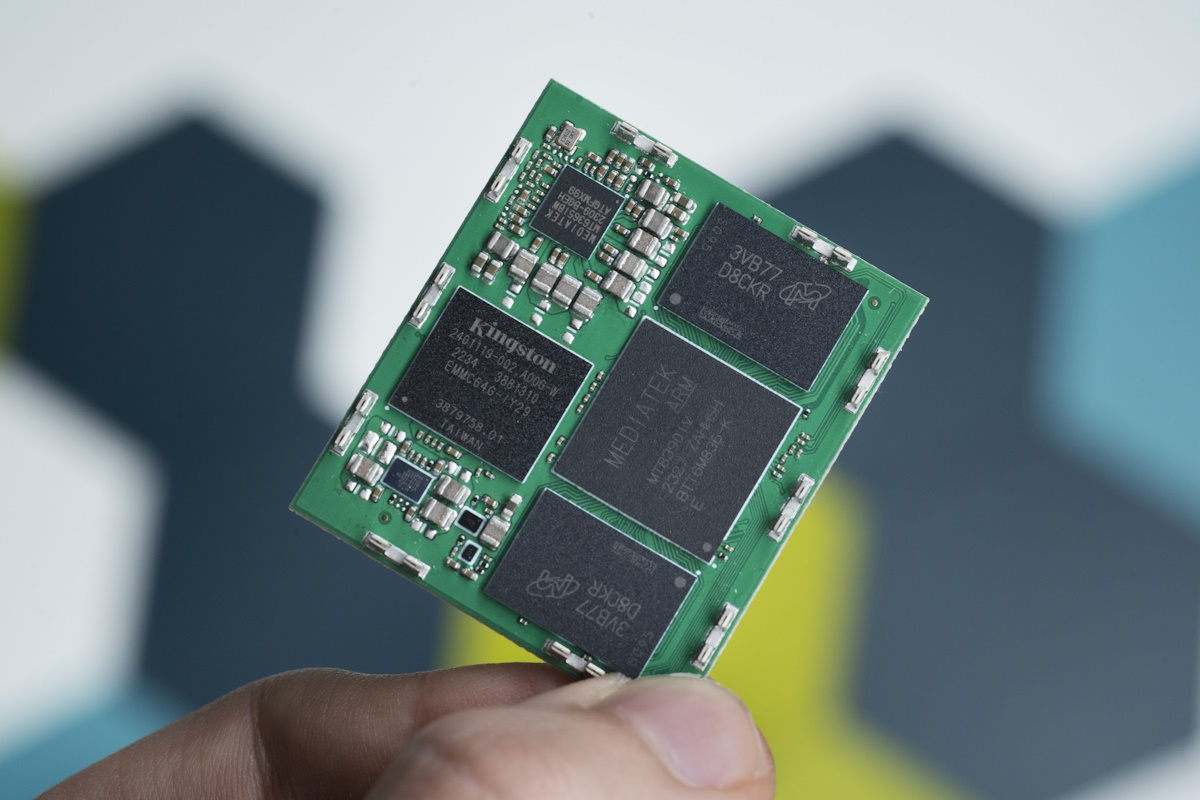
The GenioSOM-700 (Source: Grinn)
Much like its country of origin, this bodacious beauty punches above its weight in terms of raw computing power with the smallest form factor at an affordable price point. Designed for AI at the edge, this bodacious beauty boasts the following:
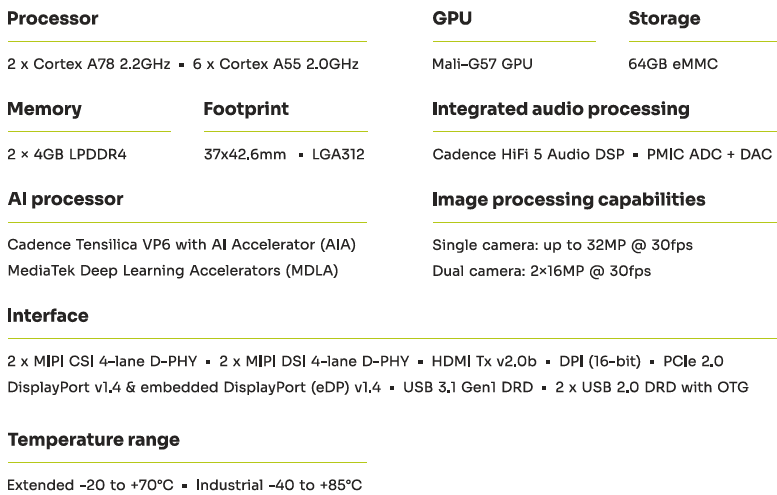
The GenioSOM-700 features the MediaTek MT8390 processor, which is an entire processor subsystem presented as a System-on-Chip (SoC). The MediaTek MT8390 is implemented at the 6µm process node, which is very advanced for a processor used in Edge AI for industrial applications and smart home/office/city deployments.
It’s said that genius can’t be manufactured—but in Grinn’s case, it can most definitely be surface-mounted! The GenioSOM-700 embodies the best of Poland’s intellectual heritage: logic, precision, and a healthy dose of cleverness. When you hold one of these tiny titans in your hand, you’re not just handling any old system-on-module; rather, you’re flourishing the distilled spirit of Polish engineering—bold, brainy, and ready to take on the world (said Max, excitedly)!






