



Suppose you were creating a sensor intended to measure one phenomenon we’ll call A, and you spent years ensuring that its readings weren’t affected by another phenomenon we’ll call B. Now suppose you finally achieve your goal, only for your customers to tell you, “We love your A sensor… but we’d really like one that can measure B.”
Funnily enough, this is just what happened to the folks at a company I’m poised to pontificate about, but first…
As I’ve mentioned on occasion, my degree is in Control Engineering (often called Systems Engineering these days). This involved a core of mathematics combined with electronics, mechanics, and fluidics (hydraulics and pneumatics). This was a co-op course (short for cooperative education) that alternates classroom study with paid, real-world work experience.
We affectionately referred to these as “sandwich courses” in England back in the day. Some college courses were “thin sandwiches,” alternating 6 weeks in and 6 weeks out (yes, really). Mine was of the “thick sandwich” flavor (ooh, tasty), rotating 9 months in and 6 months out. My first 6-month industry placement was at a Rolls-Royce Aerospace facility, where we students raced through a highly compressed version of the company’s regular 4-year apprenticeship.
I learned so many things during that placement, including how to use machine tools (mills, drills, lathes, grinders…), how to weld (oxyacetylene, electric arc, argon arc…), and how to spray hydraulic fluid all over the place if we neglected to adequately secure all the fixtures.
I also picked up myriad nuggets of knowledge and tidbits of trivia while on this placement. For example, the final stop for the turbine blades used in aircraft engines involved some visually challenged inspectors (i.e., they were 100% blind). The surface of these blades looked like highly polished mirrors to me. The blind guys would run a fingernail down the blade and, based on almost infinitesimal vibrations, proclaim “Yay” or “Nay.”
This is a tribute to human tactile sensitivity, which, when highly trained and
uncompromised by visual bias, can detect surface defects and changes in roughness on the order of a few microns, or even less, especially when the inspector is trained to feel vibration rather than shape. The rejected blades were subsequently analyzed to determine what had failed during manufacturing. All this had to be seen to be believed (no pun intended).
We also learned how to measure force using strain gauges, which were about the size of small band-aids (“plasters” in the UK). These have grown smaller over the years, with typical lengths of 3 mm to 10 mm and widths of 1 mm to 4 mm. This may be reasonably-sized for many applications, like some folks I was talking to recently who used 10,000 of these gauges to measure the forces on a passenger aircraft’s wing, but it’s ginormous for certain use cases.
All of which brings us to the fact that I was just chatting with Dr. Konstantin Kloppstech, who is the CTO, and Dr. Malte Köhler, who is the Head of Technologies (including fabrication and implementation) at Digid.
Konstantin and Malte were telling me about their recent successful unveiling at CES 2026, where they blew the minds of sensor aficionados by announcing that Digid’s nanoscale force and temperature sensors are now ready for mass deployment. (The “mass” part of the preceding sentence is ironic, now that I come to think about it, because these sensors have almost no physical or thermal mass to speak of.)
How small are these sensors? I’m glad you asked. Consider the incredibly thin hypodermic needles doctors use to give us injections. These are typically around 0.5 mm in diameter. I still can’t believe we can make hollow needles this small (though I’m very thankful we can).
Today’s hypodermic needles are made from drawn stainless-steel tubing that’s electropolished on the outside (and often the inside) to reduce surface roughness, tissue drag, insertion force, and pain, leaving typical surface roughness well below a micron.
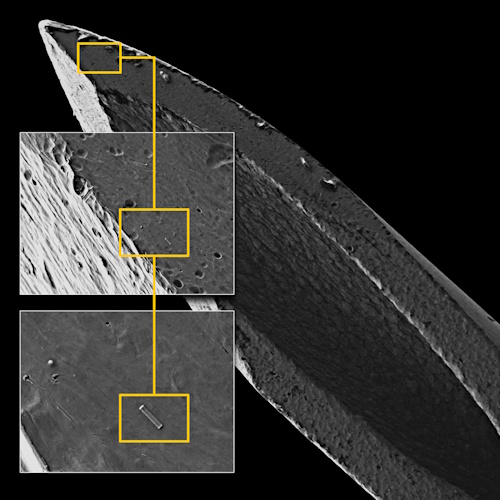
To the naked eye, hypodermic needles are as smooth as mirrors, but things get a little “lumpier” when we zoom in for a close-up view, like the image of the tip of such a needle, as seen below.
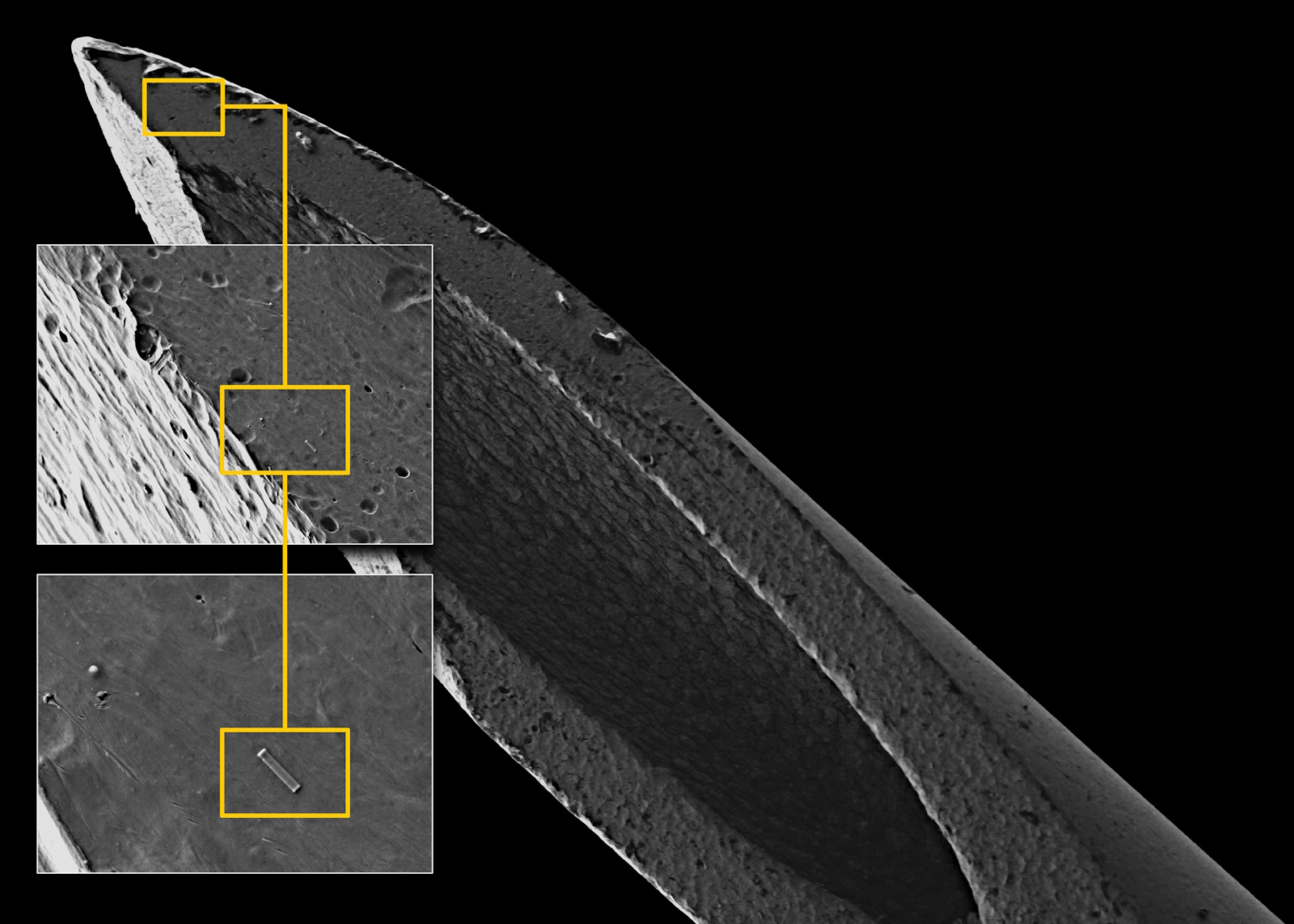
Sensor printed on the tip of a hypodermic needle (Source: Digid)
This sensor is 1 micron (µm) long, about 0.1 µm (100 nm) wide, and so thin it’s not worth talking about. Konstantin and Malte say they can use their patented additive process to print force and temperature sensors of this type on a wide range of substrates, including metals, polymers, ceramics, glasses, and semiconductors. While this already looks impressive in the image above, it looks even more impressive in a short (9-second) YouTube video.
As an aside, this returns us to the beginning of this column when I said, “Suppose you were creating a sensor intended to measure one phenomenon we’ll call A, and you spent years ensuring that its readings weren’t affected by another phenomenon we’ll call B. Now suppose you finally achieve your goal, only for your customers to tell you, ‘We love your A sensor… but we’d really like one that can measure B.’” This is because the folks at Digid spent two years making sure that their nanoscale force sensors weren’t susceptible to changes in temperature, only to be asked to make nanoscale temperature sensors that were. But we digress…
Digid’s teeny-tiny sensors fling open the doors to a tremendous range of applications. For example, consider a medical device as shown on the right-hand side of the image below. We don’t need to discuss what this device is for (suffice it to say that I don’t want it inserted in me). The point is that it would be advantageous to know the temperature at the tip.
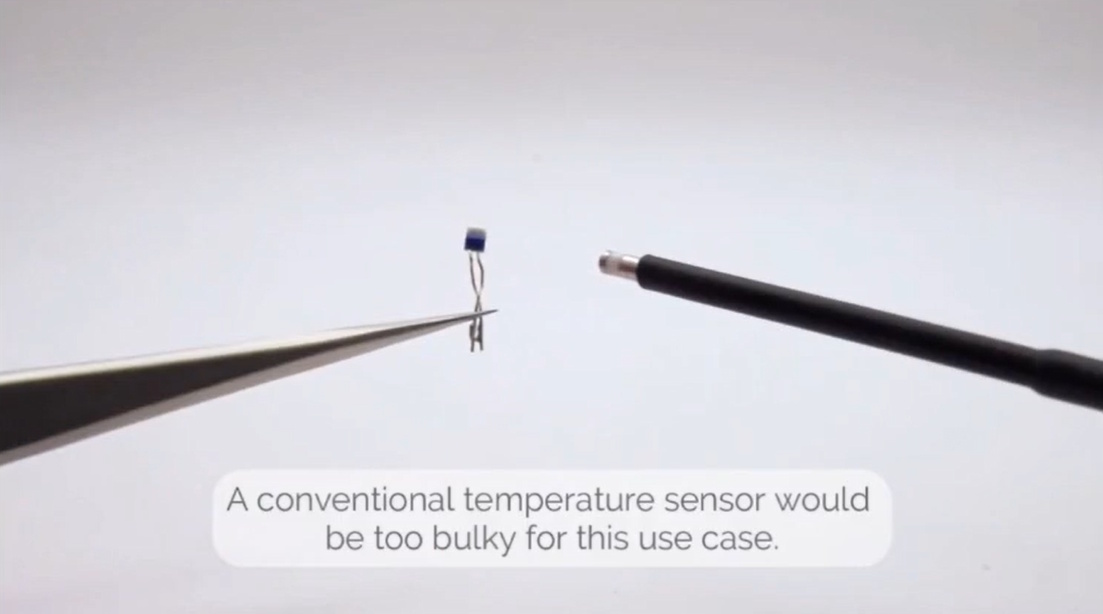
Conventional temperature sensor (left) next to an “ask no questions if you don’t want your eyes to water” (Source: Digid)
As Konstantin told me, suppose a surgeon is using this tool to operate on a shoulder joint. The beaker in the image below holds 2 milliliters of fluid, which is the amount found in the shoulder joint during surgery. It’s important that the temperature at the tip of the instrument doesn’t exceed about 38.5°C, otherwise the surrounding tissue will be damaged.
Unfortunately, without having an accurate temperature sensor in the tip of the instrument to form part of a control loop, it’s possible for the liquid to quickly exceed the safe temperature.

It’s all bad news without a temperature sensor and control loop (Source: Digid)
By comparison, Digid’s sensors are so small that they can be printed outside or inside the tip and be used as part of a control loop to ensure the unsafe temperature is never reached, as illustrated below.
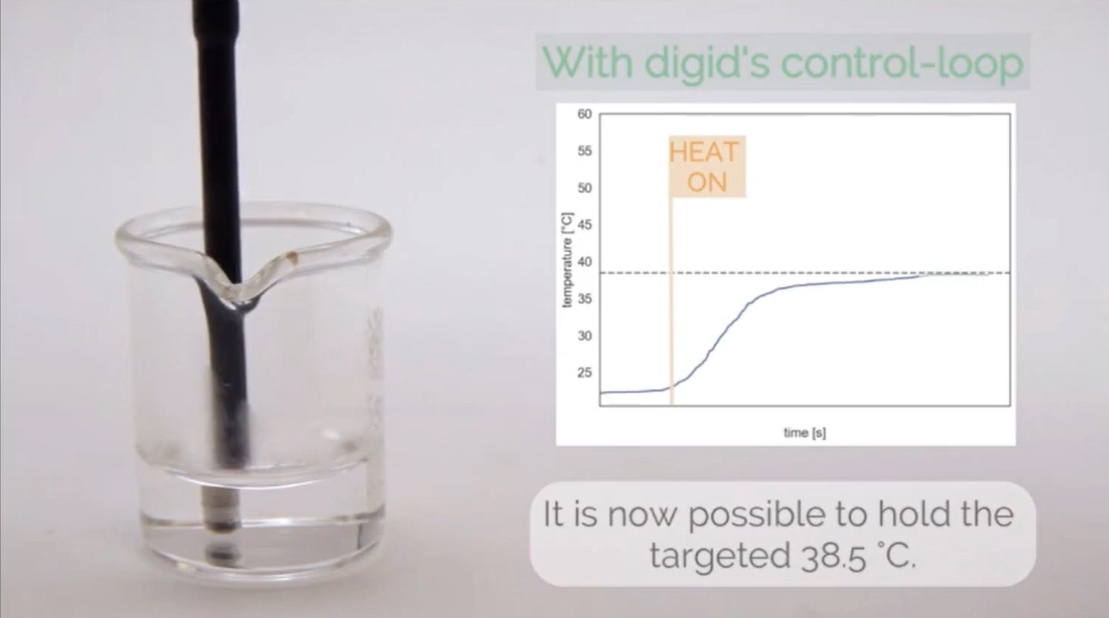
It’s all good news with a temperature sensor and control loop (Source: Digid)
The situation is similar with respect to force sensors. Consider a conventional force sensor next to a scalpel, as shown below. While it would certainly be possible to attach such a sensor to the scalpel, the surgeon would find it extremely difficult to insert such a scalpel into your humble narrator (I’d fix him with my steely glare).
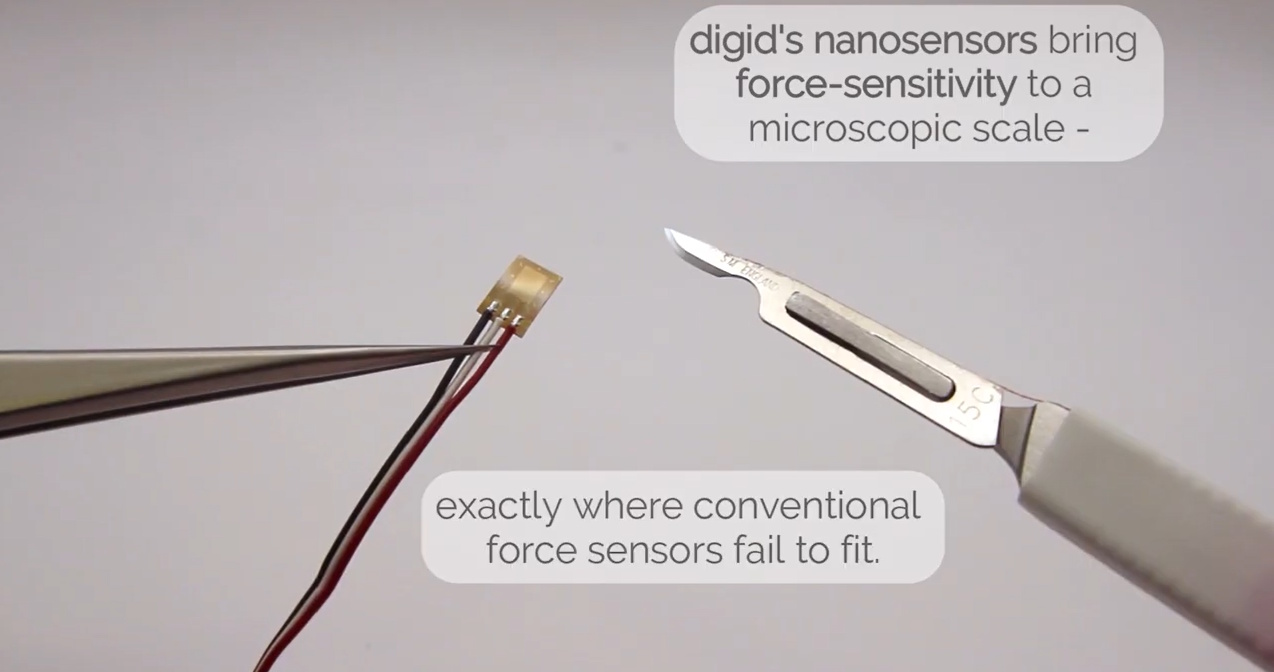
Conventional force sensor (left) and scalpel (Source: Digid)
Now consider the same scalpel equipped with one (or more) of Digid’s force sensors, as shown below. What do you mean you can’t see the sensor? That’s sort of the point, isn’t it?
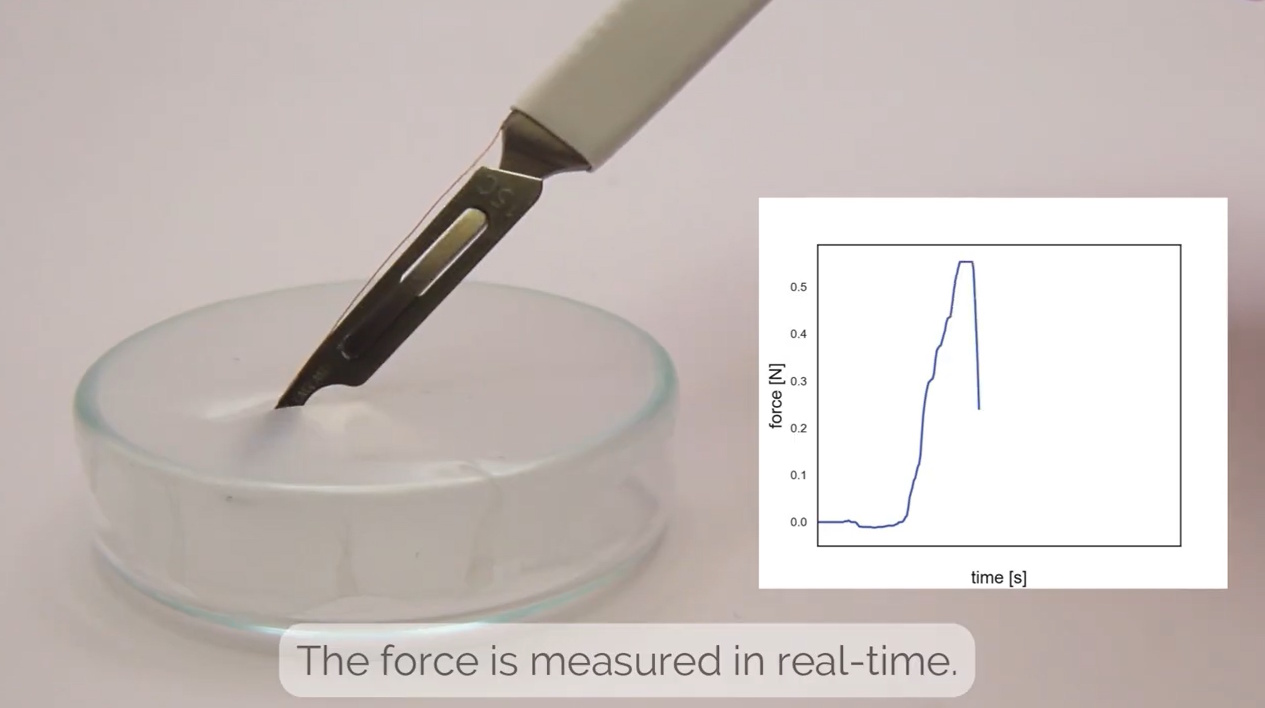
Nanoscale force sensor and scalpel combo (Source: Digid)
The point here is that data from thousands of scalpels wielded by a squadron of human surgeons could be used to train the artificial intelligences controlling robotic surgeons in the future, where these robotic surgeons have similar sensors embedded in their fingertips. You can see a video of this scalpel in action below, along with many other videos on Digid’s YouTube channel.
Another point of interest is that Digid’s nanoscale sensors have minuscule physical and thermal mass and inertia, which means they respond incredibly quickly, limited only by the properties of the substrates upon which they are mounted.
Also of interest is that these sensors are effectively immune to the type of
electromagnetic interference (EMI) that concerns many of Digid’s customers. This is because the sensors are too small, electrically speaking, to function as antennas. For example, one of Digid’s customers was experiencing sensor problems caused by a powerful plasma arc, struck by nearly ten kilovolts and sustained by a high-frequency drive in the tens of kilohertz. By comparison, Digid’s sensors are unaffected by this
electrical noise. (Konstantin and Malte told me that this wasn’t designed in —it was a happy occurrence that “fell out,” as it were.
As usual, I fear I’ve only touched on this technology and the myriad applications it will enable. The point of all this is that when sensors become small enough to vanish, sensing itself becomes ubiquitous. Tools, tissues, structures, and machines can all be measured from the inside out, feeding data into control loops, digital twins, and AI systems that learn not from models, but from reality. If the last century was about making materials strong, light, and cheap, the next may be about making them perceptive. And once materials can feel, respond, and adapt, we’ll wonder how we ever managed to build anything blind.






