




I’ve said it before, and I’ll say it again: I’m a digital logic design engineer by trade. I bask in the certainty of the digital 0 and 1 domain, my mind lurches on its gimbals when faced with the wibbly-wobbly world of analog, and it cowers at the thought of radio frequency (RF) design, which—in my humble opinion—is best left to those who are already unhinged to start with.
For reasons that will be made apparent shortly, what I laughingly call “my mind” is currently filled with thoughts pertaining to antennas. For the purposes of these discussions, a general definition of an antenna is a device that converts electrical signals into electromagnetic waves (for transmission) and electromagnetic waves back into electrical signals (for reception).
Back in the 1960s, when I was a little lad, most electronic devices were standalone. Radio and television sets received broadcasts, telephones were tethered to a wall, and computers (the few that existed) sat in isolation. Antennas were primarily used for TVs, large radios, or amateur radio setups.
I recall people employing bent wire coat hangers as makeshift TV antennas, adjusting the shape and orientation as needed to select between the limited number of available stations. If you were lucky, you had one or more external antennas mounted on the roof (typically attached to the chimney). The funny thing is that each house seemed to have a completely different antenna in terms of size and shape, with various combinations of “straight bits” and “curved bits” (I hope I’m not getting too technical).
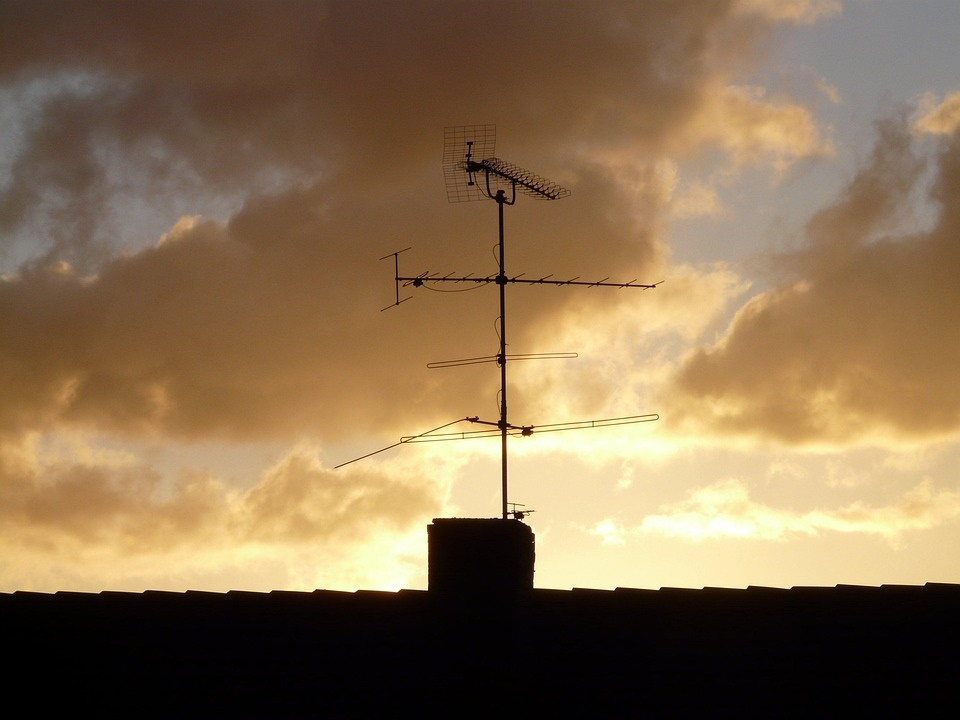
A typical rooftop sight circa the 1960s (Source: Pixabay.com)
Fast-forward to today. We live in a connected world where almost every gadget we own has a way to communicate wirelessly—to the internet, to other devices, or to us. None of this would be possible without antennas, which enable ubiquitous connectivity. Smartphones are packed with multiple antennas for 4G/5G, Wi-Fi, GPS, Bluetooth, and NFC; smart homes boast thermostats, light bulbs, speakers, and even refrigerators that “chat” via Wi-Fi or Zigbee antennas; cars and trucks bristle with antennas for key fobs, satellite radio, GPS, cellular, radar, and now V2X (vehicle-to-everything); wearables such as fitness trackers, earbuds, and smartwatches use tiny embedded antennas; and… the list goes on.
One of the primary characteristics of the antennas of yesteryear is that they were physically large and had a certain “presence.” For example, I recall the early cell phones from the 1980s and 1990s that featured pull-out telescoping antennas (we thought they looked cool… until you poked someone in the eye). By comparison, today’s Wi-Fi routers, smartphones, and IoT devices manage to get by with tiny antennas, oftentimes hidden inside the case. How can this be?
Well, antenna size depends on wavelength. Antennas work best when they’re some fraction (often ¼) of the wavelength of the signal, and wavelength is tied to frequency. In the 1960s, ham and CB radios often used frequencies around 3–30 MHz (shortwave) or ~27 MHz for CB. The wavelength there is 10–100 meters. A quarter-wave antenna could be 2.5–25 m long! Today, by comparison, Wi-Fi and Bluetooth run at 2.4 GHz (wavelength ~12.5 cm) or 5 GHz (~6 cm). This means that a quarter-wave antenna is just a few centimeters long, which is perfect for fitting inside a small device.
Another aspect of all this is better materials. In the past, antennas were usually implemented using big metal rods or wires. Today, we can use printed antennas (flat patterns on a printed circuit board, or PCB), chip antennas, or ceramic antennas that are miniaturized yet still resonate at the correct frequency.
Furthermore, today’s engineers also use sophisticated circuit design techniques, including impedance matching networks (inductors and capacitors) that make a physically small antenna look “electrically” like a bigger one; fractal antennas and meander-line antennas that fold long electrical paths into tiny spaces; and multiple antennas (MIMO in Wi-Fi/5G) that let small devices work even better than the giant whips of the past. With respect to what I just said, on the off chance you were wondering:
- A fractal antenna is an antenna that utilizes fractal geometry to achieve a compact size while maintaining or even enhancing its performance. Instead of using traditional straight wires or simple shapes, fractal antennas are constructed using self-similar patterns, meaning they repeat the same shape at different scales. This design enables them to resonate at multiple frequencies, potentially offering advantages such as a smaller size, wider bandwidth, and improved performance compared to conventional antennas.
- Meander-line antennas are compact, electrically small antennas created by folding a conductive dipole or monopole antenna into a series of right-angle turns, known as meanders. This “meandering” or bending process reduces the antenna’s physical size by increasing its electrical length, allowing for efficient operation in a smaller footprint than a traditional straight antenna of equivalent length. The number of turns and spacing between the meanders influence the antenna’s resonant frequency and efficiency, making them a versatile design for devices with limited space, such as mobile phones and wearable electronics.
The reason for my antenna-centric cogitations is that I recently had the opportunity to converse with Dermot O’Shea, Co-Founder and CEO of Taoglas.
I have a friend whose background is mechanical engineering and aerospace, but who ended up designing electronic systems for submarines. Dermot is somewhat similar in that his background is in math and physics, but he began his career in sales and business development (both of which would make my brain leak out of my ears).
In 2003, while working in Taiwan, Dermot met his co-founder, Ronan Quinlan. Recognizing a gap in the market for high-performance, application-specific antennas, they launched Taoglas in 2004 with a mission to make antenna integration easier and more reliable for engineers.
As an aside, this explains the origin of the company name. “Tao” is the Chinese word for “way,” “path,” or “principle.” It’s a fundamental concept in Taoism and Confucianism, referring to the natural order of the universe and the way of living in harmony with it. Meanwhile, “glas” is the Irish word for “green,” so Taoglas translates to “Green Way,” but we digress…
After founding the company, Dermot returned to Ireland to establish global operations, while Ronan led manufacturing in Asia, a model that helped them scale quickly. Today, Taoglas serves over 25,000 customers across more than 100 countries, offering a portfolio of over 2,000 products and a growing services portfolio that spans antenna design, testing, certification, and RF integration.
With over 325 employees across eight global sites, including key engineering hubs in Ireland, the US, Taiwan, India, and Vietnam, Toaglas has evolved into a vertically integrated organization with rapid prototyping, testing labs, and logistics infrastructure. As a result, Taoglas is a trusted design partner for applications spanning automotive, IoT, public safety, infrastructure, industrial, medical, robotics, and next-generation satellite systems.

RF testing chamber: Taoglas does everything in-house, including all antenna design, prototyping, mechanical design, RF testing, assembly, and manufacturing (Source: Taoglas)
I must admit to being somewhat naive in all this. I keep hearing about tools that are explicitly intended for antenna design, and that can model things like signal reflections, refractions, multiple paths, and…
So, I asked Dermot if this meant anyone could design an antenna. He replied that, in fairness, anyone can—but not necessarily a good antenna. It’s one thing when you have an IoT device that requires only a simple trace antenna for Bluetooth or WiFi connectivity. And, even then, a poor design can negatively impact power consumption and be susceptible to picking up noise and emissions from the rest of the device.
It’s a completely different kettle of fish when you have a device that boasts, say, eight cellular antennas, four WiFi antennas, and multiple GNSS antennas. With the best will in the world, antenna design remains something of a black art; sophisticated simulations can take you only so far, and there’s currently no substitute for human antenna design expertise, with which Taoglas is bursting at the seams.
This explains the recent press release that crossed my desk, Taoglas and Semtech Partner to Optimize Antenna Selection for AirLink Routers, which is what prompted me to reach out to Taoglas in the first place. Semtech is a leading provider of high-performance IoT systems and cloud connectivity service solutions. Hearing that Semtech is partnering with Taoglas regarding antennas prompted me to want to learn more.
Moving on… Dermot tells me that many of their current customers started by creating the initial antenna design for a product themselves, only to end up knocking on Taoglas’s door because the battery ran down much faster than predicted, or the product failed certification, or the product failed to work at all. He also said that it was amazing how many people assume they have the necessary antenna design know-how because “I did it at university” or “I Googled it” (I laughed out loud).
While not wishing to boast, Dermot says that Taoglas has the best and most thorough design methodology in the industry, including the fact that they do everything in-house—a rare approach these days. For example, following initial simulations, many antenna design houses will send out for 3D printed prototypes and then twiddle their metaphorical thumbs waiting for them to arrive. Much of the time, these prototypes need tweaking and re-spinning. As previously noted, Taoglas does everything in-house, including all antenna design, prototyping, mechanical design, RF testing, assembly, and manufacturing.
The fact that the folks at Taoglas do everything themselves gives their customers flexibility, reliability, and speed. As Dermot told me, “It’s all about speed these days, especially in the kind of Amazon culture we live in. If our customers need it now, then we can do it now. If you’re in a real hurry, just come to our office and we’ll do it for you today.”
If you wish to hear Dermot discuss all this in his dulcet Irish tones, my colleague Amelia Dalton recently interviewed him on one of her weekly Fish Fry podcasts: The Trials and Tribulations of Connectivity Integration (and How Taoglas Can Help!).
All I know is that if I ever need an antenna for one of my own projects, there is no chance whatsoever of my attempting to design it myself. Happily, I now have Dermot on speed dial (be afraid, Dermot, be very afraid). How about you? Do you have any thoughts you’d care to share on any of this?







NOTES:
“…best left to those who are already unhinged to start with.”
I’m blushing! I wasn’t going to answer this article after my “Letters To The Writer” of yesterday, but when you practically name me, well…
First, I should point out that analog actually IS digital, just in very small packages all smushed together. (I’m pretty sure “smushed” is a German technical term and that Heisenberg, or someone like him, used it first…).
I remember trying a coat-hanger antenna on my old bag-phone once. It didn’t poke people in the eye, but they’d still move away from me on the bus…
“…various combinations of “straight bits” and “curved bits” (I hope I’m not getting too technical)”
That depends on what you mean by curved bits – or actually what you mean by straight bits for that matter which can get REAL technical!
I’ve said it before, It’s not the size of the antenna, it’s how well you use it (I mean, we can’t all have huge antennas, can we)!
I see you used the word “resonate” several times (but admittedly not “harmonics”) without even once mentioning Leon Theremin, the Nicoli Tesla of Russia? I’m gobsmacked!
“…but they’d still move away from me on the bus…”
Are you sure the only reason for this was your antenna?
540 to 1710 kHz AM broadcast receivers (except in cars) use loop antennas. Loop antennas from 1941 used flat spirals of wire glued to flat cardboard or masonite panels. Modern loop antennas are coils wound on ferrite rods.
Loop antennas have parallel tuning capacitors tuned to resonance at the specific frequency the receiver is tuned to, so are built into the receivers.
Loop antennas are tiny compared to the wavelength, and respond only to the magnetic field of the transmitted wave. Nearby interference sources (such as digital circuitry) tend to emit lots of electric field and little magnetic field.
The tuning requirement is why loop antennas are not used in cars, where the antenna must be remote from the receiver. Instead, car radios use outside electric-field whip antennas which don’t need to be tuned, but are sensitive to the RF noise emitted by the digital electronics in the car. This is likely why car makers want to eliminate AM radios.
I remember when FM radios in cars in the UK started to become more widely available in the mid-1960s. Even though they have many advantages over AM, I still have a nostalgic regard for AM transmissions…