



In England in 1969, what’s now known as British Telecom (BT) didn’t exist. In those days of yore, UK telecommunications (including telephones, exchanges, wiring, and equipment) were operated by the Post Office Telecommunications Department, which was part of the General Post Office (GPO).
The unabridged story of how the Post Office ended up in charge of telephones is wonderfully Victorian and slightly bonkers. To cut a long story short (which is opposite to the way I usually like to do things), this all came about because telephones were initially treated as a form of “electrical telegraph.” Since the UK government, as embodied by the Post Office, already had a legal monopoly on telegraphs, the Post Office simply absorbed telephones when they arrived on the scene.
The reason I seemingly plucked the year 1969 out of a metaphorical hat earlier is that this was the year I purchased my first surplus rotary-dial telephone at the tender age of 12. I acquired this bodacious beauty from the now-legendary Bardwells electronic store in Sheffield, England. I dismantled the little scamp (as you do) as soon as I got it home to see what was inside.
When I unscrewed the mouthpiece, I discovered a mysterious circular cartridge of sound-capturing magic. I later learned that this was called a carbon granule transmitter (also known as a carbon granule microphone). Inside this mini-puck-shaped self- contained module was a small cavity filled with carbon granules. When you spoke, the diaphragm compressed and loosened the granules, changing their electrical resistance and modulating the current in the telephone line.
These microphones had a narrow (300Hz to 3,500Hz), lumpy, and highly non-linear frequency response, which was perfect for telephone speech, but terrible for anything resembling Hi-Fi. On the bright side, they were wonderfully robust and lasted for decades.
As an aside, the word “microphone” was coined by the brilliant English physicist Sir Charles Wheatstone in 1827. Wheatstone combined micro– (Greek for “small”) with –phone (meaning “sound” or “voice”), and he used this word to describe a mechanical acoustic device that amplified faint sounds. This was long before electrical microphones existed.
Prior to the term microphone becoming standard for an electrical sound-to-signal sensor, early telephone inventors overwhelmingly used the word “transmitter” (also “speaking transmitter”, “telephone transmitter”, and “vocal transmitter”). This was true of Alexander Graham Bell, Thomas Edison, Emile Berliner, and other 19th-century telephone pioneers.
Speaking of Alexander Graham Bell (we weren’t, but we are now), his first practical “transmitter” was a water–acid mixture microphone. The way this worked was that a diaphragm (a thin membrane) vibrated when a person spoke. Attached to the diaphragm was a small needle or rod, which dipped into the conductive liquid. As the diaphragm moved, it changed how deeply the rod dipped into the liquid, thereby altering the resistance of the electrical circuit. The resistance changes modulated a current, and it was these modulations that were used to reproduce sound at the receiving end.
But we digress…
Over the years, as people sought to capture sound with ever-greater fidelity, a wide variety of microphone technologies emerged, including condenser microphones, moving-coil microphones, ribbon microphones… the list goes on.
These days, there’s no shortage of affordable microphone technologies—piezoelectric, electret condenser, and, more recently, the MEMS microphones used in phones and IoT gizmos. They’re small, cheap, robust, and perfectly adequate for everyday applications. But none of them come close to the performance of professional studio-quality microphones, which offer vastly lower noise floors, wider frequency response, far superior linearity, and orders of magnitude better dynamic range.
In modern professional recording, the most common studio-quality microphone is the large-diaphragm condenser microphone (LDC). These dominate modern studios because they offer high sensitivity, low noise, wide, smooth frequency response, strong transient response, and beautiful reproduction of vocals. But perfection comes with a price. Mid-range “all-rounder” studio mics can easily cost $500 to $1,200, while high- end professional studio standard mics can deplete your financial resources by $2,000 to $4,000+, to which I squeak “Eeek!” (and I mean that most sincerely).
The reason I’m waffling on about all this is that I was just chatting with Jakob Vennerød, co-founder and head of product development, and Mike Tuttle, applications engineering lead at sensiBel (I love this name because it “works” on so many levels… no pun intended).
Earlier this year, the folks at sensiBel announced the world’s first optical MEMS microphone—the SBM100B. Unfortunately, they chose to announce this at the Sensors Converge 2025 technical conference and industry exhibition, where, ironically, it was “lost in the noise,” so to speak.

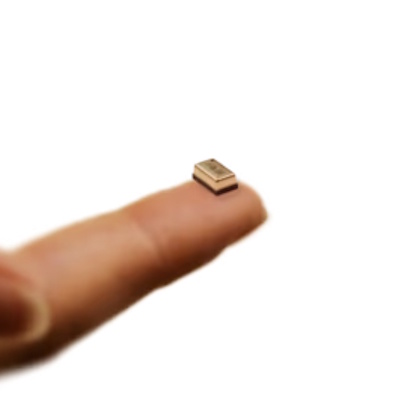
Meet the SBM1000B (Source: sensiBel)
A high-level physical comparison of existing capacitive MEMS vs. sensiBel’s optical MEMS microphone technologies is presented below. Note that the “soundport” (i.e., the hole where the sound comes in) has a diameter of only around 1mm.
Observe that in the traditional capacitive MEMS device, the diaphragm forms one of the capacitor’s plates while a rigid backplate forms the other. Detecting the tiny changes in capacitance requires that these plates be close together (2µm), which limits the sound pressure level (SPL)—i.e., how loud the air is “wobbling” (I hope I’m not getting too technical)—that can be achieved before clipping starts.
Also, the backplate in a traditional capacitive MEMS microphone is perforated with many tiny holes. These are required to allow air to flow and the diaphragm to vibrate freely. Unfortunately, this air movement is also a significant source of noise.
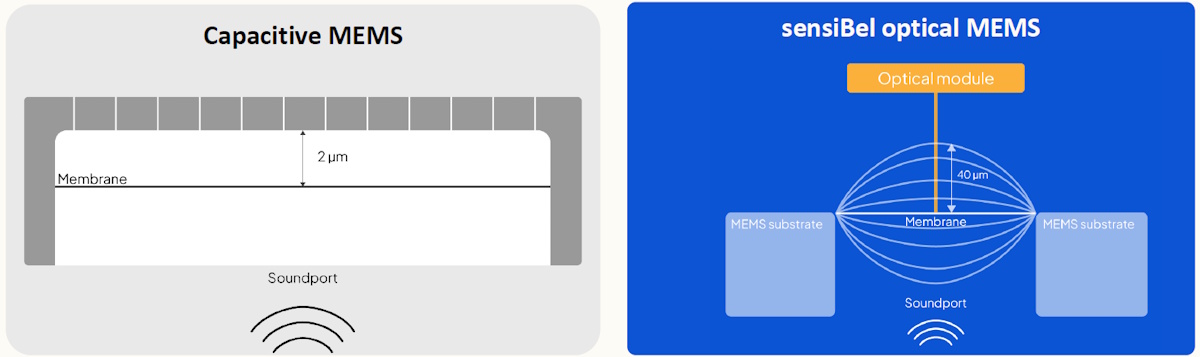
Capacitive (left) vs. optical MEMS (right) microphones (Source: sensiBel)
By comparison, sensiBel’s optical MEMS doesn’t require a backplate, thereby removing the main source of noise. Furthermore, this allows 20X more membrane movement. As a result, sensiBel’s optical MEMS microphones can operate with 250X stronger sound signals, resulting in a higher acoustic overload point (AOP). At the same time, these optical beauties have a 5X lower noise floor, resulting in a higher signal-to-noise ratio (SNR).
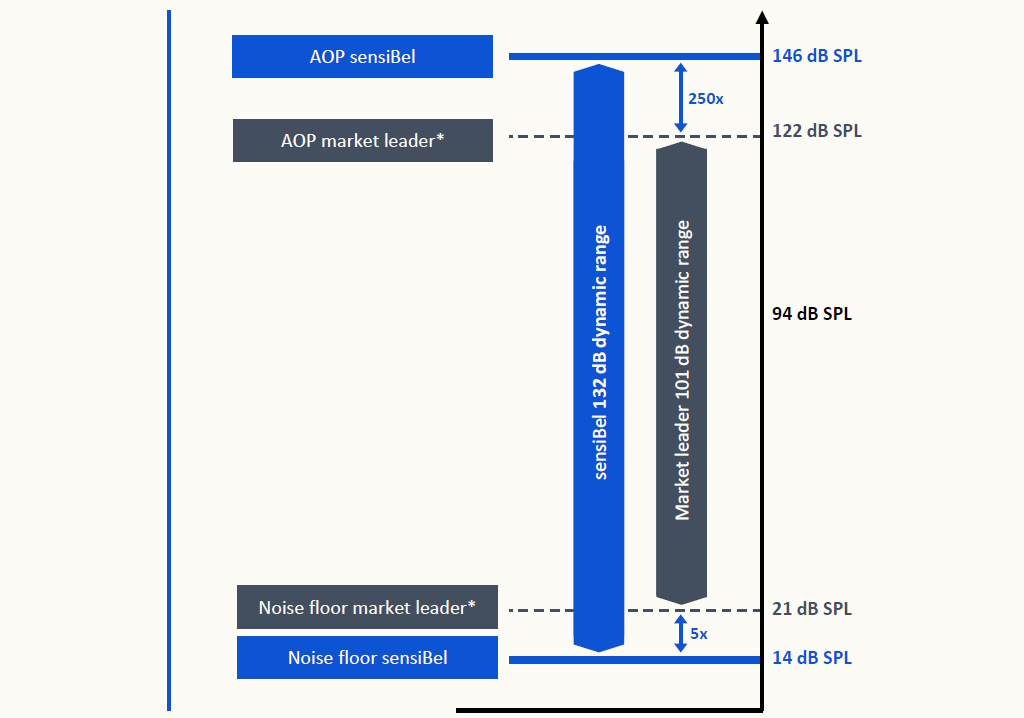
Better SNR and AOP; what’s not to love? (Source: sensiBel)
The first commercial MEMS microphone appeared on the scene circa 2001. Since that time, the incumbents in the market have struggled to deliver high SNR and high AOP in the same package.
Analog electret condenser microphones (ECMs) have been the only option available in this market for a high-SNR microphone, but they suffer from large part-to-part variation and are unsuitable for industry-standard production (sad face).
But turn that frown upside down into a smile, because sensiBel’s optical MEMS microphone technology is a game changer.

sensiBel dominates in the two critical SNR and AOP metrics (Source: sensiBel)
The SBM100B flaunts a 24-bit audio signal, which doesn’t require a separate audio codec for DSP processing, reducing footprint and simplifying the signal chain, and it delivers true studio-quality performance in a very small package, making it the technology of choice for a vast range of applications, from aircraft to automotive, and from high-end consumer electronics to high-performance beamforming conferencing arrays.
I bet I know what you are saying to yourself. You’re saying, “That previous single-unit paragraph could have been broken up into multiple sentences.” You are right. What’s your point? I bet you are also saying, “How can I lay my hands on these little beauties and evaluate them for use in my own products so that I can start to eat my competitors’ lunches?” (or words to that effect). Well, I have awesome news, because just yesterday, as I pen these words, the guys and gals at sensiBle announced AURORA and POLARIS.
These little rascals are complete plug-and-play evaluation and recording solutions that connect to a laptop or phone via USB-C, allowing designers to start recording within minutes—without requiring any soldering or specialized tools. AURORA includes two SBM100B microphones to form a stereo recording solution, as illustrated below.
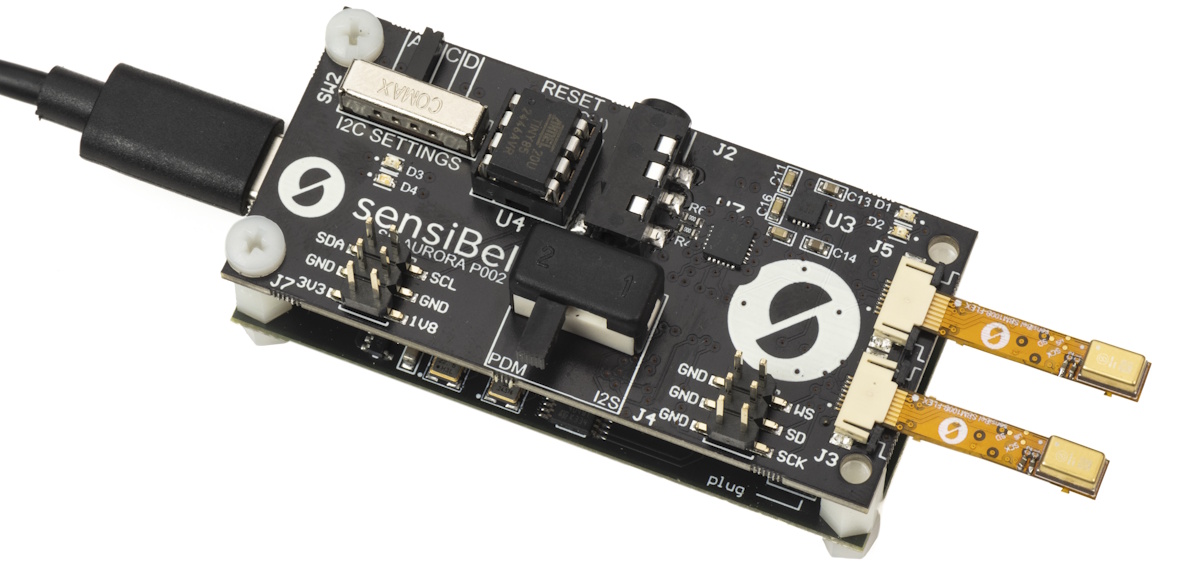
The AURORA evaluation platform (Source: sensiBel)
The SBM100Bs are the two little golden packages on the extreme right-hand side of this picture. Meanwhile, the POLARIS features an eight-microphone circular array of high-performance SBM100Bs, providing a beamforming-ready solution, as illustrated below.
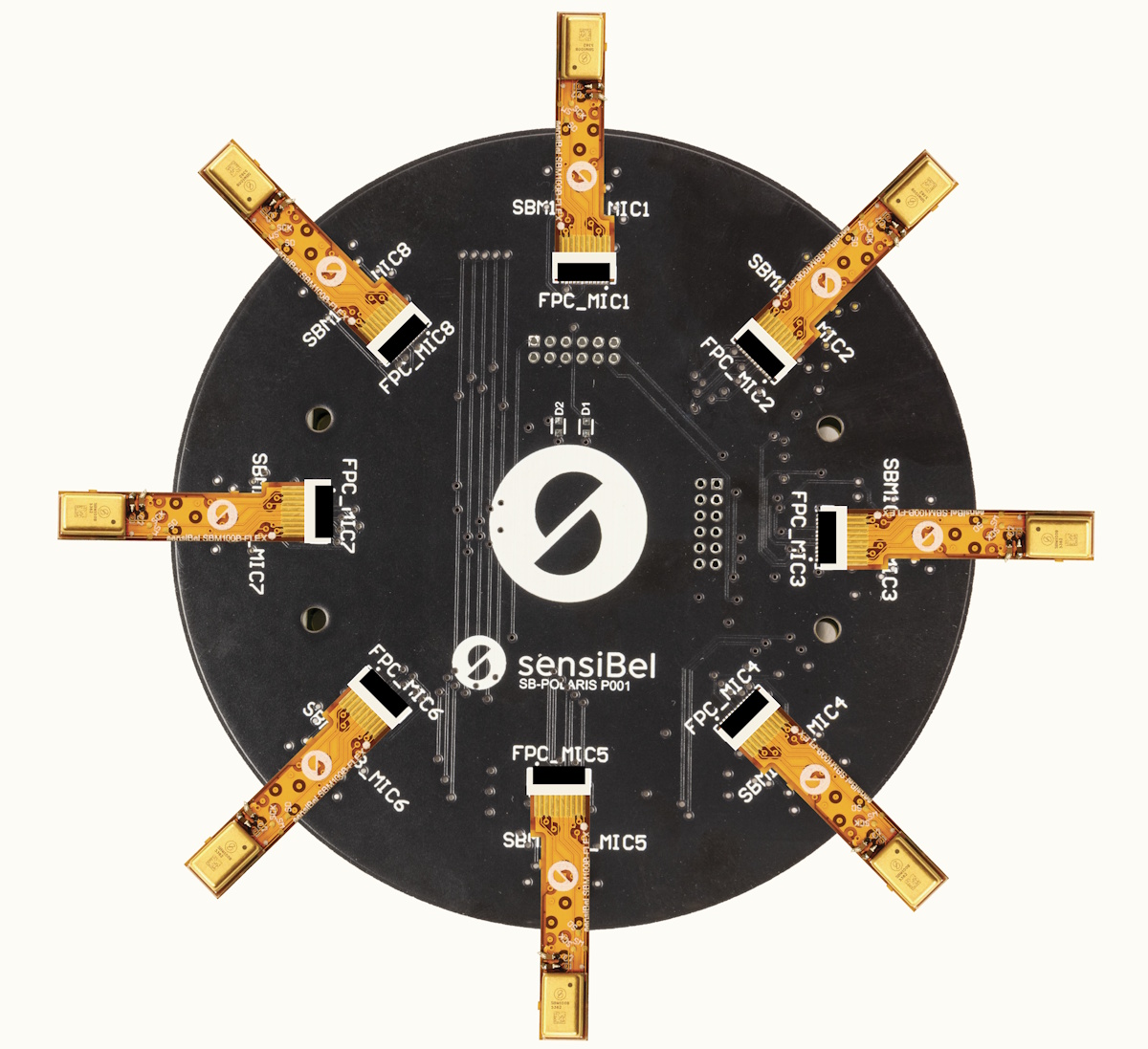
The POLARIS evaluation platform (Source: sensiBel)
Compatibility with Windows, macOS, Android, iOS, RPi OS, and Ubuntu Linux devices provides flexibility in choice of operating system, and support for popular microphone interfaces, including pulse density modulation (PDM), time-division multiplexing (TDM), and Inter-IC Sound (I2S), offers flexible interface choices to design engineers.
According to the Status of the MEMS Industry 2025 report from the Yole Group, the MEMS microphone market was ~$1.4B in 2024 and is expected to reach ~$1.8B by 2030, with a CAGR of 4.6%. All I can say is it seems to me that the chaps and chapesses at sensiBel have a good chance of grabbing a substantial share of this market.
As someone who once marveled at a carbon granule microphone rattling away inside a surplus GPO telephone, I find it nothing short of astonishing that we can now hold true studio-quality performance on the tip of a finger. If sensiBel’s optical MEMS is any indication, the next revolution in sound capture won’t come from something bigger, heavier, or more expensive; instead, it will come from something smaller, smarter, and downright magical. The age of the teeny-tiny titans of audio has arrived, and I, for one, can’t wait to hear what the future sounds like.






