



The launch of NASA’s Artemis II mission to circle the Earth’s moon seemed to go off with nary a hitch during the last hour of the countdown. However, shortly after reaching orbit, the Orion space capsule developed a fault in a critical system: the Universal Waste Management System (UWMS), also known as the space toilet. It may seem grin-worthy, but waste management is an essential part of space travel for any crewed mission. Faults can be expected in any shakedown cruise for a new spacecraft, and, fortunately, NASA astronaut and Mission Specialist Christina Kock (pronounced “Cook”) was able to troubleshoot the space toilet and bring it back online with the help of the ground support staff. Prior to the Artemis II mission, Koch accumulated nearly a year of space experience, serving as flight engineer on the International Space Station (ISS) during Expeditions 59, 60, and 61.
According to her official NASA bio, Koch has extensive experience in space science instrument development and remote scientific field engineering. After earning her BSEE and MSEE from North Carolina State University in Raleigh – and later receiving an Honorary PhD from North Carolina State University — Koch began her career working as an electrical engineer at NASA Goddard Space Flight Center, helping to develop scientific instruments for several NASA space science missions. She then joined the US Antarctic Program, with a year-long stay at the Amundsen-Scott South Pole and Palmer Stations, serving as a member of the firefighting and search-and-rescue teams. Koch then returned to instrument development at the Johns Hopkins University Applied Physics Laboratory’s Space Department, contributing to the development of instruments for the Juno and the Van Allen Probe missions. Koch then did more technical field tours at Antarctica’s Palmer Station and Greenland’s Summit Station, followed by work at remote scientific bases for the National Oceanic and Atmospheric Administration, serving as a field engineer in Utqiagvik, Alaska and as station chief of the American Samoa Observatory.

The Artemis II moon mission crew includes (left to right): NASA astronaut and Mission Specialist 1 Christina Hammock Koch, Commander Reid Wiseman (seated), Pilot Victor Glover, and Canadian Space Agency astronaut and Mission Specialist 2 Jeremy Hansen. Image credit: NASA
Collins Aerospace developed different versions of the UWMS for the Orion capsule. Artemis I was an uncrewed flight, and its Orion capsule did not carry the space toilet. The UWMS in the Orion capsule is based on a similar design installed in the ISS a few years ago. The toilet portion of the UWMS has separate paths for liquid and solid wastes. The solid waste is collected, packed in canisters, and returned to Earth. For the UWMS on the ISS, the canisters are packed into disposable spacecraft that burn up in the atmosphere upon reentry while liquid wastes are treated, distilled, and turned back into potable water. Artemis II is a short mission, so the solid wastes return to Earth with the crew while liquid wastes are vented into space several times per day.
Waste management consists of a complex set of processes on a spacecraft. There’s only microgravity in space, so fans must be used to direct waste products. According to NASA, the space toilet in the Orion capsule is 65% smaller and 40% lighter than the model used in the ISS. Part of that size reduction is due to the combining of the solid and liquid waste impeller fans into one machined rotor, as shown in the image below.
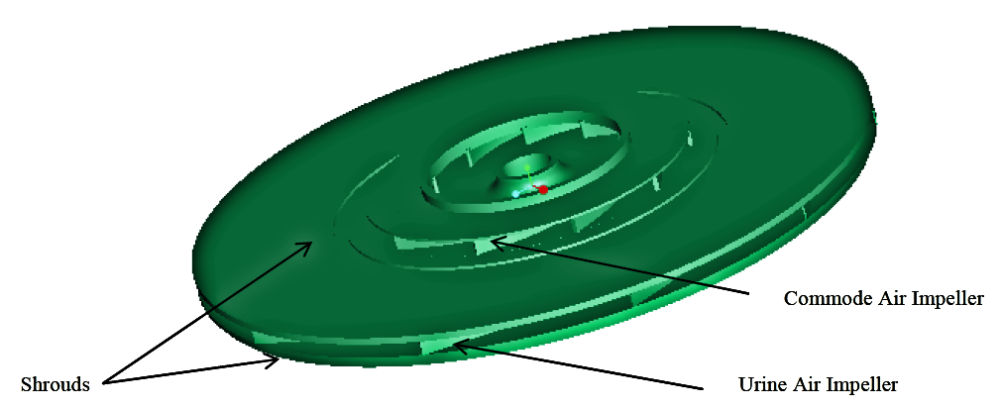
By combining the space toilet’s two air impellers into one machined rotor, engineers were able to reduce the size and weight of the space toilet in the Orion capsule by 65% and 40%, relative to a similar design used in the ISS. Image credit: Tom Stapleton, United Technology Aerospace Systems
Air flow provided by a dual fan separator in the UWMS replaces gravity in the collection of liquid and solid waste, provides odor control, and removes air from the waste streams. Combining the two fan impellers used by previous space toilet designs into a single fan housing driven by one motor provides much of the resultant reduction in mass and volume. The dual-fan impeller machined into one rotor is driven by one axle and one motor and is enclosed in a 3D printed titanium housing.
An image of the Orion capsule’s space toilet appears below. Clearly, it’s a complex electromechanical system. The controller board sits in a gray metal box situated in the center of the photo below, just under the yellow callout number 5.
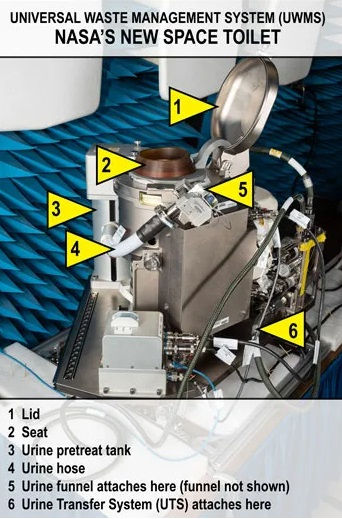
The Orion capsule’s space toilet is a complex electromechanical system. Its controller board sits in a gray metal box situated just under the yellow callout numbered “5.” Image credit: NASA
When astronauts reported a blinking fault light for the space toilet, NASA suspected that the toilet’s dual impeller had jammed. Koch troubleshot the problem by field stripping the toilet, checking the dual-bladed impeller, and then reassembling the unit and rebooting the UWMS controller to restore the toilet’s operation. During a press conference from space, Koch said that it appears that the impeller’s rotor was not jammed but just a little stiff, likely due to a long period of inactivity before launch. The stiffness caused the impeller to spin up more slowly than expected by the controller software.
(Note: Fans of “The Big Bang Theory” television series may see some similarity between the situation on Artemis II and a “Big Bang” episode titled “The Classified Materials Turbulence,” in which a space toilet designed for the ISS by main character Howard Wolowitz fails catastrophically after only a few flushes.)
Because of the successful UWMS fix, several mentions in media ranging from “Scientific American” to “The Late Show with Stephen Colbert” have referred to Koch as a “space plumber.” During a live press conference from the Orion capsule as it sped to the moon on April 3, Koch proudly applied the term to herself. At the time of the repair, the Orion capsule was in an extremely elliptical Earth orbit. Its perigee was only 115 miles, but its apogee was 43,500 miles, making Koch’s the most distant plumbing repair call in history. I would not be surprised if some smart plumbers’ organization here on Earth didn’t make Koch an honorary member. I think it would be a brilliant PR move.
After the space toilet was returned to service, the mission control crew at NASA recommended that astronauts start up the UWMS fans and give them time to reach full speed before “making a donation.” That’s NASA-speak for using the space toilet. Unfortunately, at full speed the fans are loud enough that astronauts need hearing protection while using the toilet. Clearly, more development is needed in this area.
A sophisticated electronic controller supervises the various waste-management processes in the UWMS through a sensor array and communicates with the rest of the Orion telemetry system via an RS-422 interface, as described in a technical paper titled “NASA Exploration Toilet Hardware Technical Challenges and Accomplishments”:
“The UWMS Controller determines the actions that the system takes and controls the responses and indications required by the user. It is therefore a key part of the system’s fault detection, isolation, and indication scheme. There are two UWMS configurations: the -1 configuration which is the ISS unit, and the -2 configuration which is the Orion unit. The Controller Field Programmable Gate Arrays (FPGAs) differ for the two configurations; version -006 is the ISS FPGA, while version -004 is the Orion FPGA.”
Melissa McKinley, who works at NASA’s Advanced Exploration Systems and led the new space toilet project for the International Space Station and the Artemis missions, participated in an online Reddit interview, where she wrote:
“A big part of the project is talking very frankly about human biological processes. In order to make the system work as well as possible for the crew, it’s important to get very real comments from the users of the system. However, I can say that as excited as I am about this project, I do tend to talk about it a lot. I have had members of my family get up from a holiday dinner table in protest! And potty jokes are inevitable and make it fun.”
Public documents say that the UWMS controller is based on an FPGA but do not specify which FPGA. However, there are only a few choices because the Orion capsule is designed for deep-space missions of long duration, so radiation hardness or radiation tolerance is required. This requirement narrows the choice of FPGA vendor to AMD’s (formerly Xilinx’s) Kintex UltraScale FPGAs, Microchip’s PolarFire FPGA SoCs and RTAX FPGAs, and CAES (Cobham Advanced Electronic Solutions), which partners with Lattice Semiconductor to produce Certus-NX-RT and CertusPro-NX-RT FPGAs. All these FPGA providers are known to have supplied ICs for various Orion systems. (Honeywell Aerospace purchased CAES from Advent International in 2024.)
The tasks performed by NASA’s UWMS appear to be light duty for a microprocessor-based embedded system, so why use an FPGA? I found no answer in the public documentation, but space agencies are quite concerned with radiation damage to electronic systems fielded in space, and there’s a growing business in SoCs destined for space missions and applications that are designed around radiation-tolerant and radiation-hardened FPGAs.
(Note: Yet another radiation-hardened FPGA vendor, Aeroflex, purchased Gaisler Research in 2008 and was itself acquired by Cobham Advanced Electronic Solutions in 2014. Advent International acquired Cobham in 2020 and rebranded it as CAES. The company was renamed Frontgrade Gaisler after it was acquired in 2024 by Veritas Capital. I found an Aeroflex Gaisler FPGA roadmap from 2013, but CAES is now part of Honeywell Aerospace, and Frontgrade Gaisler seems to be operating separately and independently. Frontgrade Gaisler’s Website no longer mentions FPGAs. If you can mentally traverse this acquisition labyrinth, you’re better at this than I am.)
References
Melissa K. McKinley, et al, “NASA Exploration Toilet Hardware Technical Challenges and Accomplishments,” ICES-2025-094
Melissa K. McKinley, et al, “Evolution of the Next Exploration Toilet through Human-in-the-Loop (HITL) Testing,” ICES-2023-043
Melissa McKinley, et al, “NASA Universal Waste Management System and Toilet Integration Hardware Operations on ISS – Issues, Modifications and Accomplishments,” ICES-2022-073
Melissa McKinley, et al, “NASA Universal Waste Management System and Toilet Integration Hardware Delivery and Planned Operation on ISS,” ICES-2021-403
David E. Autrey, et al, “Development of the Universal Waste Management System” ICES-2020-278
Tom Stapleton, et al, “Dual Fan Separator within the Universal Waste Management System,” ICES-2020-278
R. Callaway, “Artemis II’s toilet is a moon mission milestone,” Scientific American, April 1, 2026






