




It just struck me that we are rapidly approaching the end of 2025. In turn, this means we’re poised to plunge headfirst into 2Q 21C, which is a notation I’ve just invented to indicate “The second quarter of the 21st century.” Feel free to share this nugget of knowledge and tidbit of trivia with your family and friends (you’re welcome).
As I’ve mentioned before, I graduated from high school in 1975. Now, 50 years later, those days make fleeting appearances in the rearview mirror of my life—close enough to touch in memory, even though half a century has passed. As this thought crossed (what I laughingly call) my mind, so too did the phrase: “Events in memory may be closer than they appear,” which was closely followed by its counterpointing corollary: “Events in memory may appear closer than they actually are.”
I fear I’m feeling perilously philosophical at the present point. I may need to re-read A Phenomenally Phrank History of Philosophy (Without the Poncy Bits) by John Farman and You Kant Make It Up (Strange Ideas from History’s Great Philosophers) by Gary Hayden, but we digress…
Throughout the late 1960s and early 1970s, I was an avid fan of the British TV program Tomorrow’s World. Each week, we were introduced to the latest and greatest developments in science and technology. I’m talking about things that seem trivial today (breathalyzers, home computers, audio synthesizers, pocket calculators, digital watches…), but that we regarded as being Jetson-level futuristic at that time.
Consider the segment on Nellie the School Computer, if you will. This formed part of the Tomorrow’s World episode that was broadcast on 15 February 1969.
Oh, how things have changed. I’ll tell you what, the weather’s fine, so why don’t you humor me by joining me in a brief stroll down memory lane, contrasting the years 1975, 2000, and 2025, which perfectly capture the evolution from the analog-to-digital transition, the height of the dot-com era, and the age of intelligence and autonomy.
1975: The Birth of Personal Computing: The theme of 1975 was “Democratizing the Machine.” Technology was moving out of corporate labs and into the hands of hobbyists.
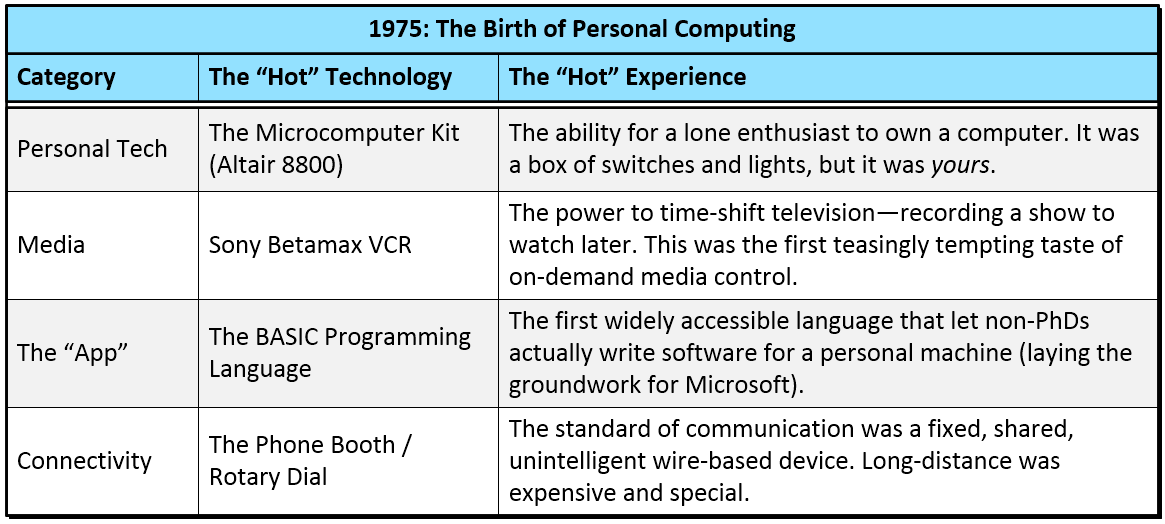 1975: The birth of personal computing (Source: Max Maxfield)
In 1975, the Altair 8800 bade the world a cheery “Hello!”, sparking the personal computing revolution. For the first time, ordinary hobbyists—folks tinkering away in garages and spare bedrooms—could own a machine that would previously have belonged only to entities like corporations, universities, and governments. The Altair 8800 wasn’t pretty,* involving rows of toggle switches for input on the front panel, blinking LEDs for output, and programs laboriously keyed in by hand, but it lit a fire. (*I tell a lie—it was gorgeous!)
Magazines like Popular Electronics inspired thousands to build kits, and two young fellows named Gates and Allen formed a small outfit called Microsoft to supply software. Suddenly, “the computer” wasn’t a mysterious, room-sized contraption—it was something you could actually touch, hack, and dream with.
2000: The Internet Takes Over: The theme of 2000 was “Connecting the World (and You) Online.” The focus shifted from the machine itself to the networks it enabled.
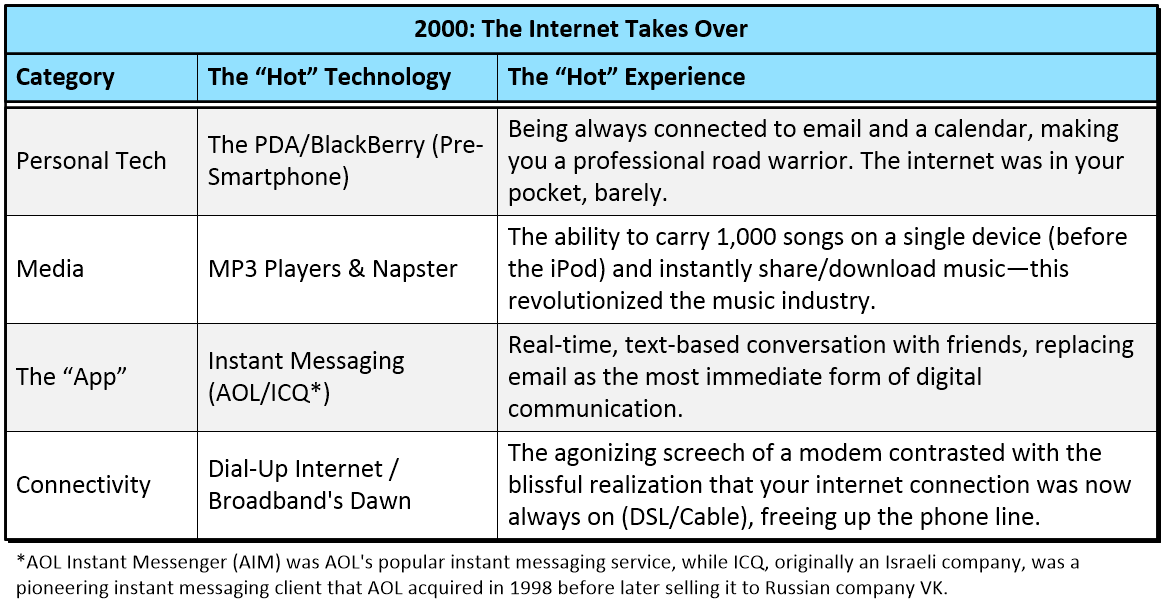 2000: The internet takes over (Source: Max Maxfield)
By the turn of the millennium, the defining force was no longer computers themselves, but rather the networks to which they were connected. The dot-com boom was in full swing—websites were springing up like mushrooms after rain, venture capital was flowing freely, and everyone seemed convinced that “clicks” were as good as currency.
Home PCs had become commonplace, mobile phones were spreading, and the idea of being “online” was no longer exotic. Email, instant messaging, and e-commerce were reshaping how people worked, shopped, and socialized. The Y2K scare came and went with little more than a shrug, but the sense remained that humanity had stepped decisively into the digital age—interconnected, always available, and increasingly dependent on the web of bits that wrapped the world.
2025: The Age of Autonomy and Intelligence: The theme of 2025 is “Intelligence and Autonomy.” Technology is no longer a tool you operate, but an agent that creates, makes decisions, and acts on your behalf.
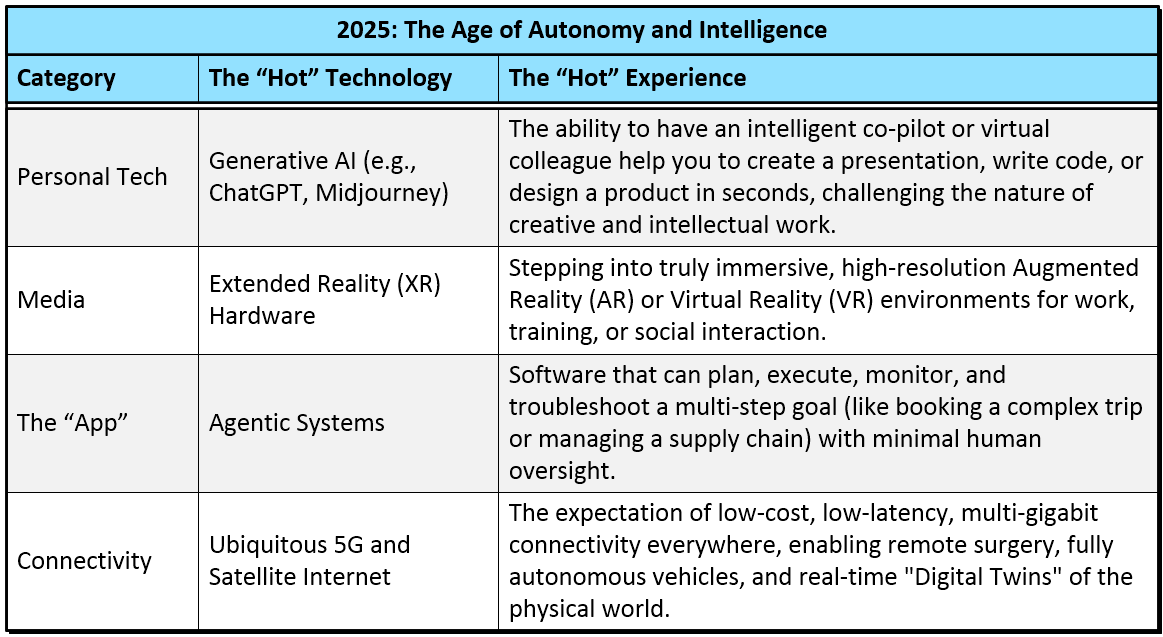 2025: The age of autonomy and intelligence (Source: Max Maxfield)
Now, half a century after the early hobbyist computer kits, technology has evolved into something altogether different. In 2025, intelligent systems are not just tools we operate but partners that anticipate, decide, and act. AI agents draft reports, design circuits, and even negotiate meetings on our behalf.
Cars can navigate themselves (sometimes… on a good day… if the wind is blowing in the right direction), factories run with minimal human oversight, and household gadgets are starting to quietly learn our routines. The conversation has shifted from “What can we make our computers do?” to “What decisions should we let our computers make?” We are entering an era where autonomy and intelligence are the baseline, and the challenge is no longer access to computing power, but rather how to direct that power responsibly—balancing convenience and creativity with ethics and control.
However, once again, we digress…
The thing that sparked my waffling here is that I was just chatting with Sumit Shah, Senior Director of Product Management and Marketing for the Adaptive & Embedded Computing Group at AMD. Sumit’s role encompasses all aspects related to FPGAs, embedded CPUs, and adaptive SoCs. Sumit is also responsible for all the hardware and software, as well as the tooling infrastructure and AI that go into these devices (I have no idea what he does in his spare time).
During our chat, I mentioned how I’m currently on a roll regarding AI-related ruminations. Sumit responded as follows:
As you say, everybody’s talking about AI right now. AI is fundamentally pervasive in almost all applications and everything we do. We’re absolutely seeing it disrupt virtually every industry. We service eight key end markets, and in every single one of those —whether it’s aerospace and defense, automotive, medical, industrial, or communications applications — everyone’s trying to figure out how to integrate AI to make it essentially do things smarter, better, faster, and cheaper.
After touching on AI in the cloud, our conversation quickly veered (much like one of Tesla’s autonomous cars) to AI at the edge. An increasing number of applications need the ability to perform more training and inference where the “internet rubber” meets the “real-world road.” Systems at the edge need to be smarter locally, which means they require the ability to perform tasks like voice translation and object detection/recognition without relying on the cloud. In turn, this means that we need to be able to shrink the AI models, and that these models must run efficiently on devices with smaller densities and very low power, often in real-time.
You can only imagine my surprise and delight to discover that Sumit came pre-armed with four example case studies that aptly illustrated the points he wished to make. These case studies were as follows:
- RADAR (Retail): Powered by AMD Zynq adaptive SoCs, RADAR has developed innovative retail solutions that transform the brick-and-mortar experience. From enabling cashier-less checkout to helping shoppers locate products within seconds, RADAR also leverages in-store behaviors to retarget loyal customers more effectively. With AMD technology, RADAR delivers real-time data and provides the flexibility to add new features over the air—reducing the need for costly hardware replacements in the future.
- Medilit (Healthcare): In this case, an AI-based device generates real-time clinical notes during patient consultations, enhancing efficiency in patient care and reducing doctor burnout. The AI Scribe uses AMD Ryzen Embedded 8000 Series processors for AI processing, including transcription, and to manage the solution’s 15B-parameter large language model (LLM). The edge AI solution generates clinical notes in real-time during patient consultations and automates medical forms, plans, and reports.
- Subaru (Automotive): Subaru is collaborating with AMD to deploy AMD Versal AI Edge Series Gen 2 adaptive SoCs to power its next-generation vision-based advanced driver assistance system (ADAS), known as EyeSight. The system is integrated into select Subaru car models and provides advanced features including adaptive cruise control, lane-keep assist, and pre-collision braking, putting state-of-the-art safety technology into the hands of consumers.
- MulticoreWare (Retail): MulticoreWare has developed an AI-powered smart checkout solution. Powered by AMD Ryzen Embedded 8000 series processors, the intelligent point-of-sale system captures a product image, scans its barcode, and uses computer vision-based object detection to verify the product against the store’s database before adding it to the customer’s cart.
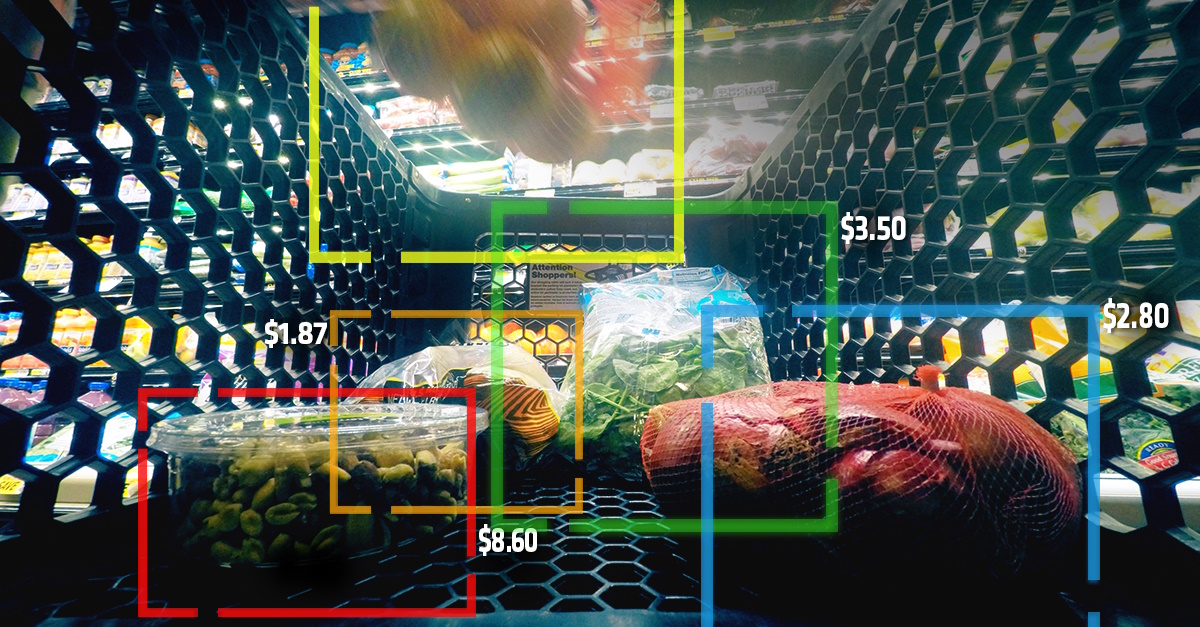
Have you ever wondered what the world looks like from inside a shopping cart?
The folks at MulticoreWare can tell you (Source: AMD)
Whilst I’m interested in all these applications, I must admit that the Subaru case study caught my attention because I own a Subaru Crosstrek and I’ve been extremely impressed with its EyeSight system. I had no idea that AMD was involved in this bodacious beauty.
I’m sorry, I’m feeling the urge to go all philosophical again, perhaps concluding this column as follows (imagine, if you will, the following paragraph being read in the dulcet tones of James Earl Jones):
So, here we stand, teetering at the edge of 2Q 21C, peering back at a journey that began with blinking lights on an Altair 8800 in 1975, that powered through the dial-up screeches that heralded the new millennium, and that has delivered us to a world where our cars watch the road, our shopping carts watch the products, and an AI quietly scribes our doctor’s notes. The only constant in this sweeping narrative is change, and—as we look into the future—only one thing is certain: the next fifty years will make the last fifty look like a leisurely walk in the park. Are we ready for what comes next?






