




On the off chance you were wondering, the city of Sheffield in England boasts two main seats of learning: Sheffield University (a.k.a. the University of Sheffield) and Sheffield Hallam University. The latter was formerly known as Sheffield Polytechnic. This was deep in the mists of time when I wore a younger man’s clothes and studied for my degree at that august establishment.
Both these institutions have storied histories. The origins of the University of Sheffield date back to the Sheffield School of Medicine (established in 1828), Firth College (established in 1879), and the Sheffield Technical School (established in 1884). These merged in 1897 to form the University College of Sheffield, which subsequently gained a Royal Charter in 1905, at which time it transmogrified into the University of Sheffield.
Meanwhile, my own alma mater (which I only recently discovered to be an allegorical Latin phrase meaning “nourishing mother”) began as the Sheffield School of Design in 1843. It became Sheffield Polytechnic in 1969 through the merger of local colleges, and achieved university status in 1992, taking the name Sheffield Hallam University. As a point of reference, the Sheffield School of Design was founded 18 years before the American Civil War kicked off in 1861. Not that this has anything to do with anything, but titbits of trivia like this “tickle my fancy,” as it were.
Historically, there has been a notable rivalry between the University of Sheffield and Sheffield Hallam University. Suffice it to say that University of Sheffield students have long been stereotyped as being overly studious and somewhat pretentious, while their counterparts at Sheffield Hallam University are widely known to be outgoing, full of fun, outrageously good-looking, and inordinately clever. (What can I say? I calls ’em like I sees ’em.)
Of course, there’s always “the exception that proves the rule.” In this case, the exception is Ben White, Co-Founder and CEO of Phlux Technology. Ben completed his PhD in infrared detectors at the University of Sheffield in 2016 and he is one of the nicest guys you could hope to meet, and that’s not something you can expect to hear me say about graduates* of Sheffield University on a regular basis (*or “weeds and wets,” as Nigel Molesworth might say).
To cut a long story short, which is contrary to my usual approach, the team at Phlux Technology has developed a new type of infrared (IR) avalanche photodiode (APD) that is making waves in the market. Rarely, if ever, has a single diode been so transformative of electronic signal performance.
Not bad, eh? What? You want more? Alright, in that case, settle down, make yourself comfortable, and I’ll begin.
The IR spectrum encompasses wavelengths from approximately 700 nanometers (nm) to 1 millimeter (mm). This range is often further divided into the near-infrared (NIR), mid-infrared (MIR), and far-infrared (FIR) sub-regions, each with its own specific wavelength range. NIR encompasses wavelengths between 700nm and 2500nm. This region is closest to the visible light spectrum.
Virtually all global digital data—especially intercontinental and internet traffic—travels over optical fibers. Most people who aren’t in the industry assume that we use white light for this purpose, but that’s as wrong as wrong can be.
Visualize, if you will, the iconic cover to Pink Floyd’s The Dark Side of the Moon album, in which a beam of white light passing through a triangular prism is refracted into a spectrum of colors against a black background.

Well, much the same thing happens to white light travelling through an optical fiber, except in this case, we call it “dispersion” because the components of the light travel at different rates and essentially “spread out.” The result is that the red part of the light arrives first and the violet part arrives last, which limits the speed by which we can transmit our digital 0s and 1s. This is because as we wind up the transmission speed, the violet tail-end from one bit will be overtaken by the leading red portion of the next bit, at which point all bets (and bits) are off.
Even if we restrict ourselves to a narrow band of, say, blue, green, or red light, the blue band will disperse more than the green, which will itself disperse more than the red. Based on this, you probably won’t be surprised to hear that the minimum dispersion is to be found in the near infrared.
But wait, there’s more, because the glass in the fiber isn’t perfectly transparent, which results in the light passing through the fiber being absorbed. The absorption coefficient quantifies the amount of optical power lost as light propagates through the fiber due to material absorption. A smaller value means the fiber absorbs less light per unit length, allowing the signal to travel longer distances without requiring amplification or regeneration.
The absorption coefficient for blue light is terrible. You really don’t want to shine blue light down an optical fiber because it won’t travel very far at all. The absorption coefficient reaches its minimum in the near-infrared region, after which it begins to rise again. In fact, the smallest absorption coefficient occurs in the near-infrared at a wavelength of 1550 nm. Modern telecom fibers have extremely low absorption coefficients—on the order of 0.2 dB/km at 1550 nm, which is close to the material’s fundamental limit.
It’s not so long ago that communications companies and/or the government were digging up the roads and burying optical cables (actually, they are still doing so). The challenge is that we are all consuming vast amounts of data—far more than anyone predicted just a few short years ago. The last thing anyone wants to do is dig up all the roads again to add more fibers in order to connect more people to the internet and upgrade everybody’s internet speeds.
The better answer is to increase the rate at which we send data; however, we now run into another problem, which is that it’s very difficult to squeeze more speed out of existing APD-based detectors.
Different materials are better (i.e., more responsive) at different frequencies. For example, silicon (Si) is well-suited for applications like LiDARs operating at 900nm wavelengths, but it’s ineffective in the near-infrared. By comparison, germanium (Ge) isn’t bad around 1400nm, but it doesn’t compare with silicon at 900nm. However, the sweet spot for 1550nm is the compound semiconductor indium gallium arsenide (InGaAs).
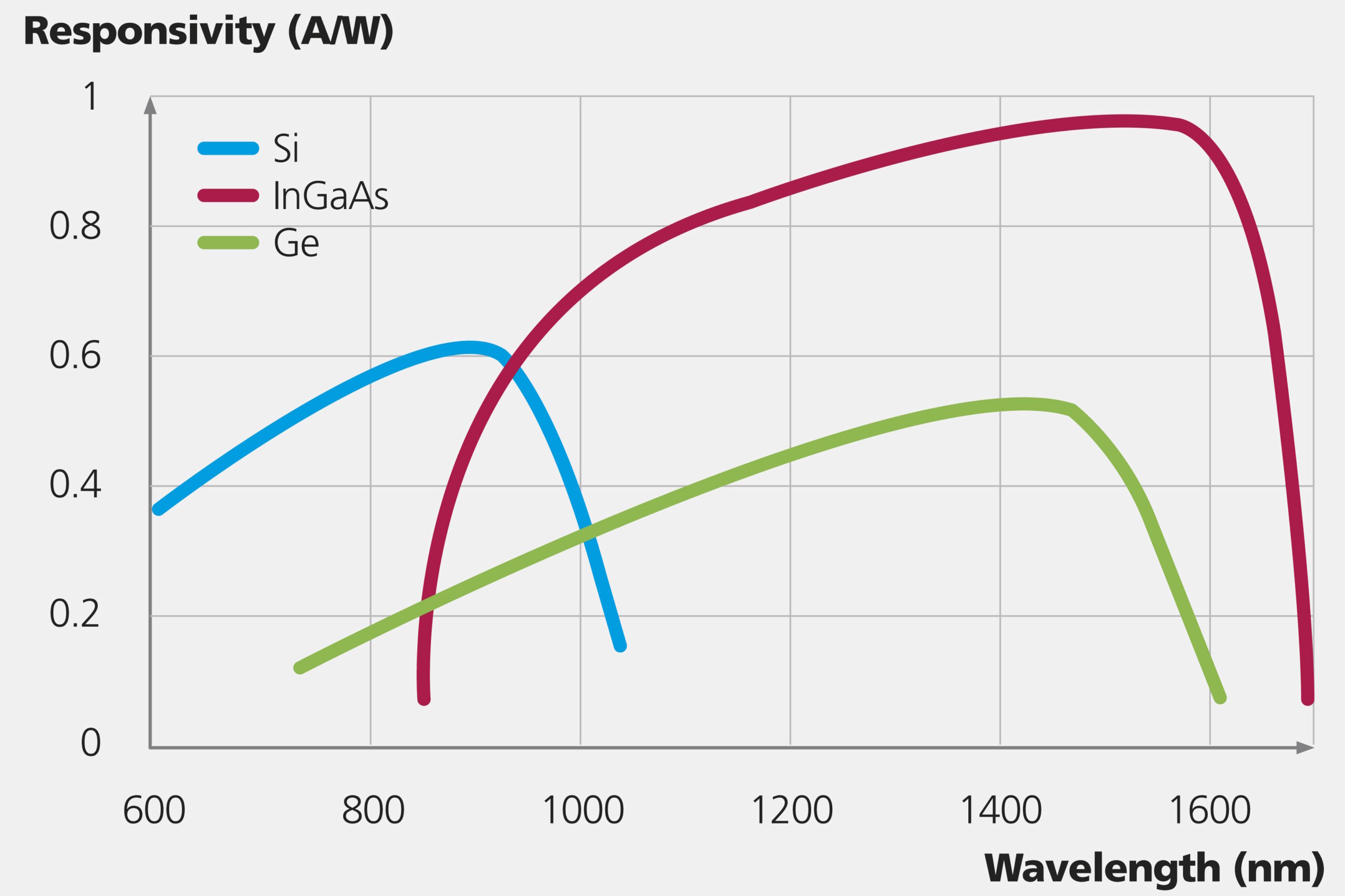
Responsivity vs. wavelength (Source: Phlux Technology)
Another aspect of 1550nm is that it’s “eye safe,” which means systems based on this wavelength can use more powerful IR lasers and achieve greater distances without endangering eyesight. The challenge has been to reduce the noise produced in traditional InGaAs APDs, thereby improving their sensitivity.
Based on eight years of research at the University of Sheffield, Ben and his colleagues added antimony (Sb) into the mix. This is a group V element, like arsenic (As) and phosphorus (P). Antimony lowers the bandgap, extending sensitivity. The resulting InGaAsSb APDs (try saying that ten times quickly), branded as Aura Noiseless InGaAs APDs, which launched in 2024, offer ~12× sensitivity improvement and up to 50% greater range over traditional devices at 1550nm.
Furthermore, these APDs have much faster overload recovery, feature ten times lower temperature drift than components without antinomy, and boast stable high-temperature performance. What’s not to love?
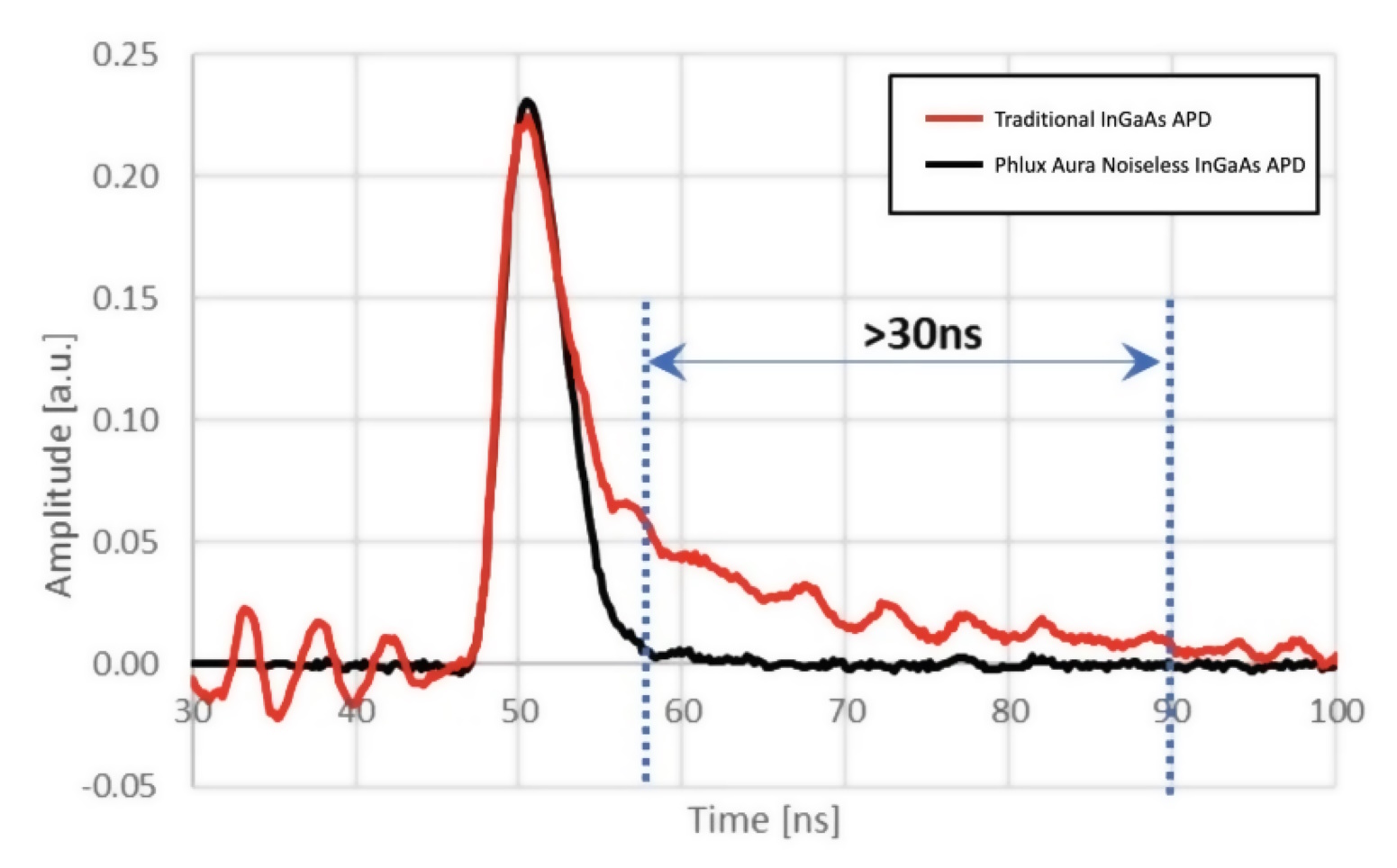
The recovery time of Aura Noiseless InGaAsSb APDs is much faster than their traditional InGaAs cousins (Source: Phlux Technology)
And, as important as optical communications are, there are many more potential applications for these new APD sensors, including, but not limited to, the following:
- Imaging
- Laser microscopy
- Raman spectroscopy
- Gas sensing
- Quantum communications
- Free space optical communications
In a nutshell, Aura Noiseless InGaAs APDs significantly enhance performance in optical ranging, imaging, and communication systems. Phlux is in an awesome position for a startup company because, unlike most semiconductor companies, they don’t need to win new design slots to generate sales. Phlux’s noiseless InGaAs APDs are drop-in replacements for traditional IR photodetectors, which makes them ideal for making instant performance upgrades to laser rangefinders, LiDAR, and optical test equipment.
I have to admit that I’m gritting my teeth that a techno-dweeb from Sheffield University came up with this rather than a techno-hero from Sheffield Hallam University. All I can assume is that some of our natural genius has started to rub off. At least this technology originated in Sheffield, not somewhere horrible like Milton Keynes (or, God forbid, France). As always, I’d love to hear your thoughts on all this in the comments below.






