feature article archive
Subscribe Now

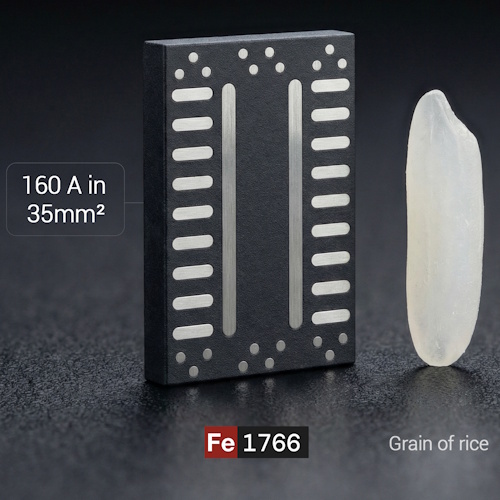
Meet the Power-Delivery Chiplets That May Save 50% of Your AI Power

If you’d tried to start a power-related conversation with me just a few short years ago, I’d probably have shrugged my shoulders in disinterest. These days, however, it seems the subject of power is on everybody’s lips. It’s a hot topic, if you’ll forgive the pun (and even if you won’t).

I remember the mainframe computer we were working on in 1980. This bodacious beauty consumed 2,000A at 5V. We thought that was a lot. We were such innocents. We didn’t have a clue about the horrors to come.

Read More → "Meet the Power-Delivery Chiplets That May Save 50% of Your AI Power"

AI at the Edge? Meet Wi-Fi in Microwatts

I’ve just been introduced to a technology that has the potential to revolutionize battery- and ambient-powered AI-enabled sensors using Bluetooth or WiFi while consuming only 1/1000th the power of regular Bluetooth and WiFi implementations. Intrigued? Read on!

Before we plunge into the fray with gusto and abandon, indulge me, if you will. I read a lot of science fiction. One of the books I read recently stuck in my mind more than most. I’m talking about The Last Human</ … Read More → "AI at the Edge? Meet Wi-Fi in Microwatts"

Do You Want To Be An AI Plumber?

Increasingly, I find myself talking to people who say something like, “We have a 1-, 2-, 4-, or 8-core proof-of-concept AI chip that can—in the future—be scaled up to 1,000 cores.” But this is the first time I’ve been told, “We have a real-world 1,000-core AI chip that can—in the future—be scaled down to 1-, 2-, 4-, or 8-cores.”

Before we delve deeper into the fray with gusto and abandon, I’d like us all to cast our minds back to ye olden days when I wore a younger … Read More → "Do You Want To Be An AI Plumber?"

Ray Holt, inventor of the first microprocessor chip set, needs our help.

Ray Holt, inventor of the first microprocessor chip set, which was used as the digital flight computer in the US Navy’s F-14 Tomcat fighter jet, is ill and needs our help. I first wrote about Ray in 2022 (see “Ray Holt and the CADC – The World’s First Military Digital Flight Computer”). That article detailed his development of the then-classified microprocessor chip set used in the aircraft’s CADC (Central Air Data Computer) with a variety of sensor inputs including air pressure, air temperature, … Read More → "Ray Holt, inventor of the first microprocessor chip set, needs our help."

Analog Neuromorphic Processors for ASICs/SoCs Offer Microwatt Edge AI

We live in exciting times with respect to AI and the devices used to implement inferencing at the edge, where the “internet rubber” meets the “real-world road,” as it were.

It reminds me of those distant days in the 1970s when we were all “feeling our way” with 8-bit microprocessors. I’m thinking of devices like the Intel 8008 (1972), Intel 8080 (1974), Motorola 6800 (1974), MOS Technology 6502 (1975), Zilog Z80 (1976), and Motorola 6809 (1978).

If I might wax eloquent for a moment, life in those days was tremendously exciting for microprocessor mavens. Nothing was standardized, and every … Read More → "Analog Neuromorphic Processors for ASICs/SoCs Offer Microwatt Edge AI"

Want Nano-Scale, CMOS-Based MEMS Sensors?

We’re talking about CMOS-based MEMS sensors that are 1,000 times smaller than their traditional silicon-based MEMS counterparts, offering greater bandwidth and higher sensitivity, while also being more cost-effective and reliable. Seriously—what’s not to love?

I’ve just been chatting with Dr. Josep Montanyà, who, along with Dr. Marc Llamas, founded Nanusens. Headquartered in Edinburgh, UK, with a Research and Development office near Barcelona, Spain, Nanusens has been focused on finding a solution to address the limitations associated with traditional MEMS … Read More → "Want Nano-Scale, CMOS-Based MEMS Sensors?"

Micro-Miniature Ethernet Switches and Routers

In a moment, I’m going to tell you about the slightest and slimmest Ethernet switches and routers you’ve never seen, but first…  I’ve told this networking narrative before, and doubtless I’ll tell it again (it’s too good to waste). I graduated with my degree in Control Engineering in the summer of I980. My first position was in a team designing CPUs for mainframe computers at International Computers Limited (ICL) in West Gorton, Manchester, UK.

The tale I’m about to tell took place somewhere … Read More → "Micro-Miniature Ethernet Switches and Routers"

Who Doesn’t Need Battery-Powered, Cloud-Free AI?

Way back in the mists of time, in those halcyon days we used to call 2010, I was fortunate enough to be invited to speak at the Embedded Systems Conference (ESC) in Bangalore (now Bengaluru), India. Formally founded as a fort in 1537, Bengaluru offers an eclectic mix of stone watchtowers and ancient temples, spectacular colonial-era architecture, and gleaming technology parks and skyscrapers.

Something else I just remembered about my brush with Bengaluru was the sensory overload associated with the tumultuous traffic. Two-lane-each-way roads routinely hosted six or more de facto lanes of vehicles jostling … Read More → "Who Doesn’t Need Battery-Powered, Cloud-Free AI?"

Make It So: Agentic AI Comes to Flux

I remember “ye olden days” when we (humans) designed electronic products by hand—conceiving circuits, selecting components, drawing schematics, laying out printed circuit boards (PCBs)… Can you imagine instead just telling an AI, “Make me a [your product here] for consumer use,” and it actually does it? Well, that day has arrived.

I’ve said it before, and I’ll doubtless say it again—things are moving fast in AI space (where no one can hear you scream). For example, GitHub Copilot is an AI-powered coding assistant developed in collaboration between GitHub and … Read More → "Make It So: Agentic AI Comes to Flux"

From Code Chaos to Cyber Confidence: Inside the World of Firmware Obfuscation

In the context of programming, the term “obfuscation” is typically taken to mean “deliberately making source code hard to read or understand while keeping it functionally correct.” The reason I used the “typically” qualifier is that I’ve just been exposed to the concept of obfuscation at the machine code level. Now my head hurts.

Since we’re already talking obfuscation, I feel it would be remiss of me not to mention the International Obfuscated C Code Contest (IOCCC). This started in 1984, … Read More → "From Code Chaos to Cyber Confidence: Inside the World of Firmware Obfuscation"

featured blogs
Nov 14, 2025
Exploring an AI-only world where digital minds build societies while humans lurk outside the looking glass....