

fresh bytes
Subscribe Now

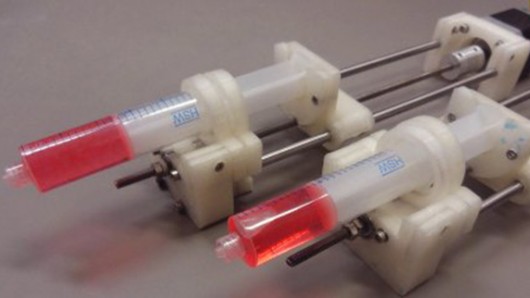
3D-printed syringe pumps could cut the cost of scientific research

3d_printed_syringe_pumps.jpg

Used in laboratories to administer small amounts of liquid for drug delivery or chemistry research, syringe pumps can cost research labs hundreds or even thousands of dollars. But researchers from Michigan Technological University have now created an open-source library of 3D-printable designs, enabling anyone in need of the commonly used scientific tool to produce their own at a fraction of the cost.

The team of Michigan Tech students, led by Associate Professor of Materials Science and Engineering Joshua Pearce, published a series of designs, each pertaining to different components of a syringe pump. Some parts would still need to be purchased separately, such as the electric motor that pushes the fluid and the syringe itself, but the remaining parts can be built using a RepRap 3D printer.
via Gizmag


Continue reading 

Leave a Reply

featured blogs
Apr 2, 2026
Build, code, and explore with your own AI-powered Mars rover kit, inspired by NASA's Perseverance mission....

featured paper

Quickly and accurately identify inter-domain leakage issues in IC designs

Sponsored by Siemens Digital Industries Software

Power domain leakage is a major IC reliability issue, often missed by traditional tools. This white paper describes challenges of identifying leakage, types of false results, and presents Siemens EDA’s Insight Analyzer. The tool proactively finds true leakage paths, filters out false positives, and helps circuit designers quickly fix risks—enabling more robust, reliable chip designs. With detailed, context-aware analysis, designers save time and improve silicon quality.

Click to read more

featured chalk talk

Connecting the World Through Space
Sponsored by Mouser Electronics and Qorvo
In this episode of Chalk Talk, Ryan Jennings from Qorvo and Amelia Dalton explore the critical components and design challenges inherent in LEO satellite infrastructure and how Qorvo’s solutions are enabling the next generation of space-based connectivity. 
Mar 30, 2026
22,908 views




