

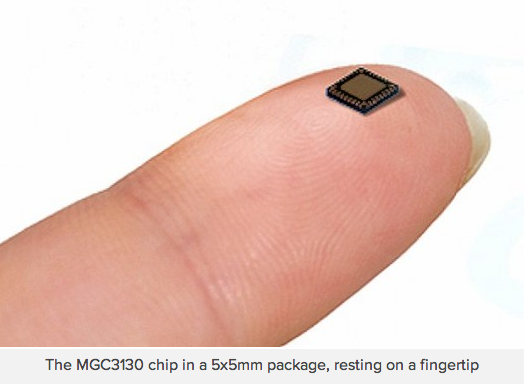
The smallest gesture can hide a world of meaning. A particular flick of a baton and a beseeching gesture can transform the key moment of a concert from mundane to ethereal. Alas, computers are seriously handicapped in understanding human gestural language, both in software and hardware. In particular, finding a method for describing gestures presented to a computer as input data for further processing has proven a difficult problem. In response, Microchip Technologies has developed the world’s first 3D gesture recognition chip that senses the gesture without contact, through its effect on electric fields.
Why are normal human gestures so difficult to translate into a form suitable for computers? The meaning of a gesture is not a simple hand position or path of motion, but a gestalt – a approximate summary of the entire gesture. It is a task nearly defying description to decipher the intended meaning of a gesture from data acquired by tracking the movement of every portion of each finger and joint of the hand and wrist. This is one of the main reasons that, despite at least 30 years of effort, artistry has consistently eluded any computer-based orchestra controlled by a human conductor. Despite this, gesture control remains an active area of development, because of the enormous market that awaits a practical system.
via gizmag






