

fresh bytes
Subscribe Now

Using a theremin for medical applications

theremin.png

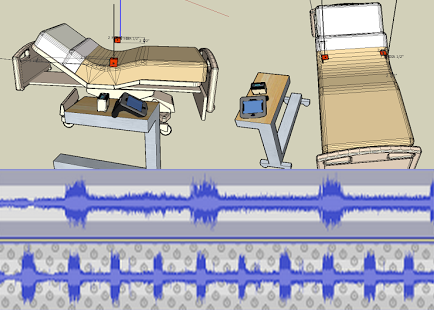
[Eswar] is not an ordinary 16 years old boy. He figured out a noninvasive way to measure breathing in hospitals for less than $50. He is using a theremin to measure the rise and fall of a patient’s chest. For our curious readers, this touch-less instrument was invented back in 1929 by the Russian inventor [Leon Theremin]. It uses the heterodyne principle and two oscillators to generate an audio signal. One electronic oscillator creates an inaudible high pitch tone while another variable oscillator is changed by adding capacitance to an antenna.

As you can guess the space between the patient’s chest and the antennas placed around the bed forms a tiny capacitor which varies when exhaling. With three simple TTL chips and a little guessing [Eswar] had a working prototype ready to be implemented in the real world.
via Hack a Day


Continue reading 

Leave a Reply

featured blogs
Dec 22, 2025
Here's a seasonal sampler of intriguing videos, curious technologies, surprising history, and random delights collected during a rare pause for breath....

featured video

Revolutionizing AI Chip Development: Synopsys Solutions for the Future

Sponsored by Synopsys

In the AI era, demand for advanced chips is soaring, creating scaling and power challenges. Discover how Synopsys accelerates AI chip development with innovative solutions, robust partnerships, and cutting-edge silicon IP for first-pass silicon success.

Click here for more information

featured news

Need Faster VNX+ Development? Elma Just Built the First Lab Platform for It

Sponsored by Elma Electronic

Struggling to evaluate VNX+ modules or build early prototypes? Elma Electronic’s new 3-slot FlexVNX+ dev chassis streamlines bring-up, testing, and system integration for VNX+ payload cards—SOSA-aligned, lab-ready, and built for fast time-to-market.

Click here to read more

featured chalk talk

Time to first prototype shouldn’t be so hard!
In this episode of Chalk Talk, Romain Petit from Siemens and Amelia Dalton examine the challenges of FPGA-based prototyping and how the automatic partitioning, automatic cabling, runtime and debug infrastructure and more of the Siemens VPS platform can make your next FPGA-based prototype project easier than ever before.
Dec 3, 2025
43,255 views



