

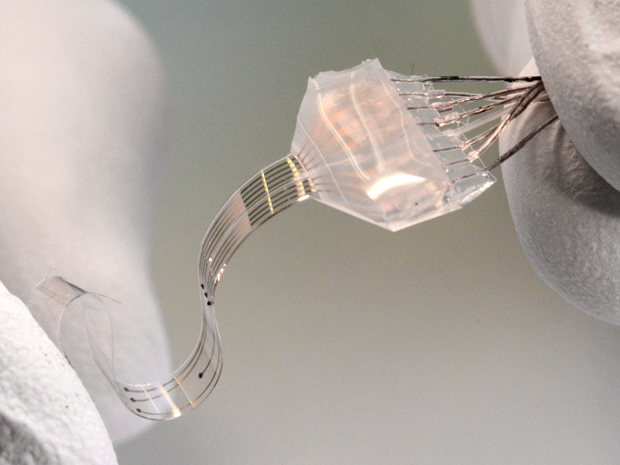
If you need a piece of hardware attached to the delicate tissue of your brain or spinal cord, wouldn’t it be preferable for that piece of hardware to actually be soft, yielding, and flexible?
That kind of thinking led researchers at a Swiss technology institute to develop a new material modeled on dura matter, the protective membrane of the brain and spinal cord. Their “e-dura” contains stretchy electrodes that can both stimulate and record from neurons. When implanted in mice, the e-dura caused less damage and inflammation than today’s rigid implants. Researchers say their biocompatible material could be the key to long-lasting neural therapies.
via IEEE Spectrum
Image: EPFL






