

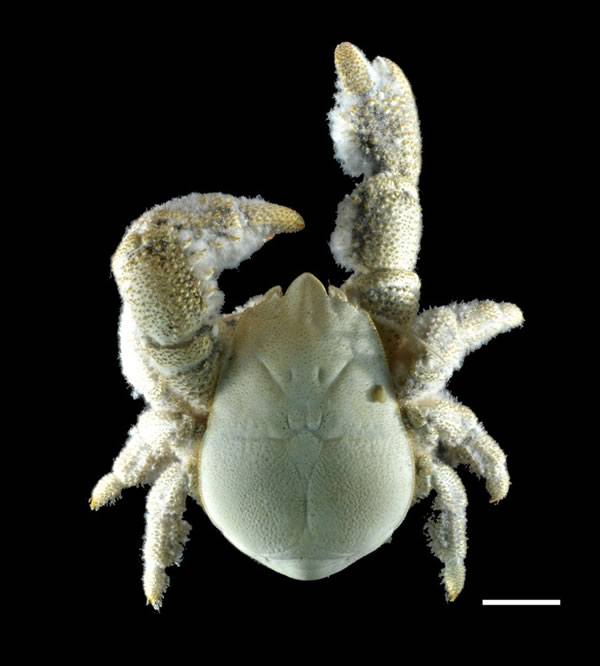
Its land dwelling namesake is still at large, but scientists have discovered a third species of the yeti crab. Meet Kiwa tyleri, a deep-sea crustacean that belongs to the yeti crab family.
Ecologist and study leader Sven Thatje explored the hydrothermal vents in East Scotia Ridge, Antarctica, using remotely-piloted submersible and discovered a thriving community of yeti crab living more than 8,500 feet under water.
“We knew immediately that we’d found something tremendously novel and unique in hydrothermal vent research,” Thatje said as reported by National Geographic.
Thatje noted that the Antarctic waters where the crabs live are so cold that they’re just above freezing. The liquid that spews out of the hydrothermal vents, however, can reach 700 °F (400 °C). That means the yeti crab has only a tiny space where the water temperature is just right: too close to the vents and they’ll fry. Too far and they’ll freeze.
That’s why the crabs pile on top of each other, Thatje said, “like beans in a jar, filling every available space.” Some 700 crabs are found in just one square meter.
via Neatorama
Image: National Environmental Research Council






