

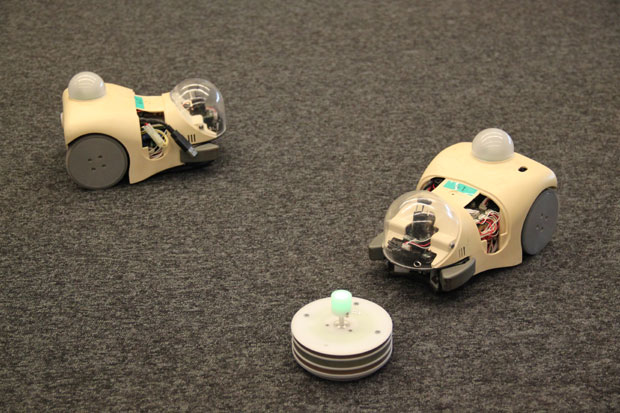
Studying evolution is tricky — it’s a process that happens over countless generations and thousands of years, but the men tasked with studying it live less than a century. Researchers at the Okinawa Institute of Science and Technology have found one way around the problem: robots. OIST’s Dr. Stefan Elfwing has been using small, rodent-like robots to study the long-term effects of disparate mating strategies, observing the evolution of the simulated species for over 1,000 generations. Two groups of robo-mice were programmed to forage for food (battery-powered recharge stations) and to find a mate (trade data through an embedded IR port), with each group following a different mating strategy. Robots dubbed “foragers” would focus on recharging, only mating if it didn’t get in the way of feeding, while “trackers” would actively seek mates and go without charging if it increased their chances of linking up IR ports.
via Engadget
Image: OIST






