

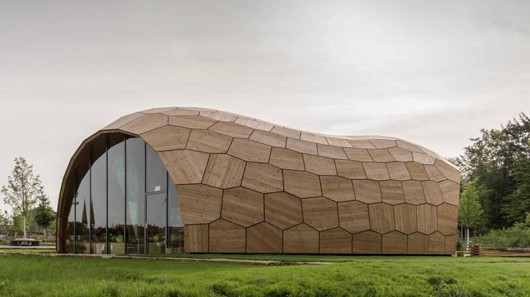
The Landesgartenschau Exhibition Hall in Stuttgart, Germany, is claimed to be the first building to have its core structure made entirely from interlocking timber sections created by robots. Made up of over 240 individual segments of beech plywood created using a robotic fabrication method, the 17 meter (55 ft) tall, 245 square meter (2,637 sq ft) structure required just 12 cubic meters (424 cubic feet) of timber to construct.
Looking remarkably like a very large peanut, the exhibition hall consists of plywood panels just 50 mm (2 in) thick that, according to the academics from the University of Stuttgart who constructed it, make use of 7,600 individual finger joints interlocked in such a way that they create a shell that needs no additional support.
Though other timber buildings – such as the “WikiHouse” – have benefited from the use of computer-controlled milling machines and robotics, most of these are made using conventional construction methods, such as stud frames and truss roofs. The Landesgartenschau Exhibition Hall is different because it uses structural forms that mimic those found in nature in its construction.
via Gizmag
Image: ICD/ITKE/IIGS University of Stuttgart






