

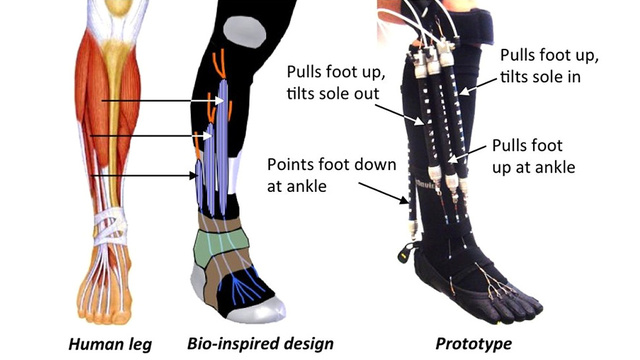
Working alongside collaborators at Harvard, MIT, USC, and a company called BioSensics, the Carnegie Mellon researchers decided to make the orthotic device from soft plastics and other non-rigid materials so that it was able to better reproduce the natural motions of an actual human foot and ankle.
Pneumatic artificial muscles—three in the foreleg and one in the back for the ankle—work alongside lightweight sensors to facilitate the actual movement for the wearer. And the prototype was able to produce a sagittal motion of the ankle—rocking the foot from side to side—of 27 degrees which is enough to reproduce a normal walking motion.
via Gizmodo






