

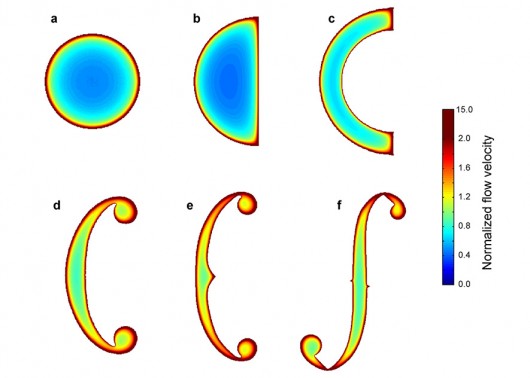
A team of MIT acousticians and fluid dynamicists have teamed up with Bostonian violin makers to meticulously analyze hundreds of instruments from the Cremonese period, considered the golden age of violin making. The findings not only reveal key design features, but also shed light on whether the development of the instruments was deliberate, or simply a product of human error…
The study identified the shape and length of a violin’s f-holes – the contoured openings through which air escapes – as a key feature affecting the power, or fullness of the produced sound. Specifically, it was found that most of the sound produced flows through the hole’s perimeter rather than its interior, meaning that the more elongated the sound hole, the more powerful a sound the violin can produce.
via Gizmag






